

Why the southern States should accept a rebase on the 2011 Census now, and have every State’s seats written into the Constitution for a generation, rather than gamble on the 2027 census.
The Map, Not the Women
Parliament may sit in special session between 20 and 22 November, The Tribune reported this morning, and the Constitution Amendment linking women’s reservation to delimitation is expected to return. Nobody in this country opposes women’s reservation. Nobody opposes a bigger Lok Sabha. And yet a Bill that every party claims to support fell in April. The quarrel, therefore, was never about women. It was about the map.
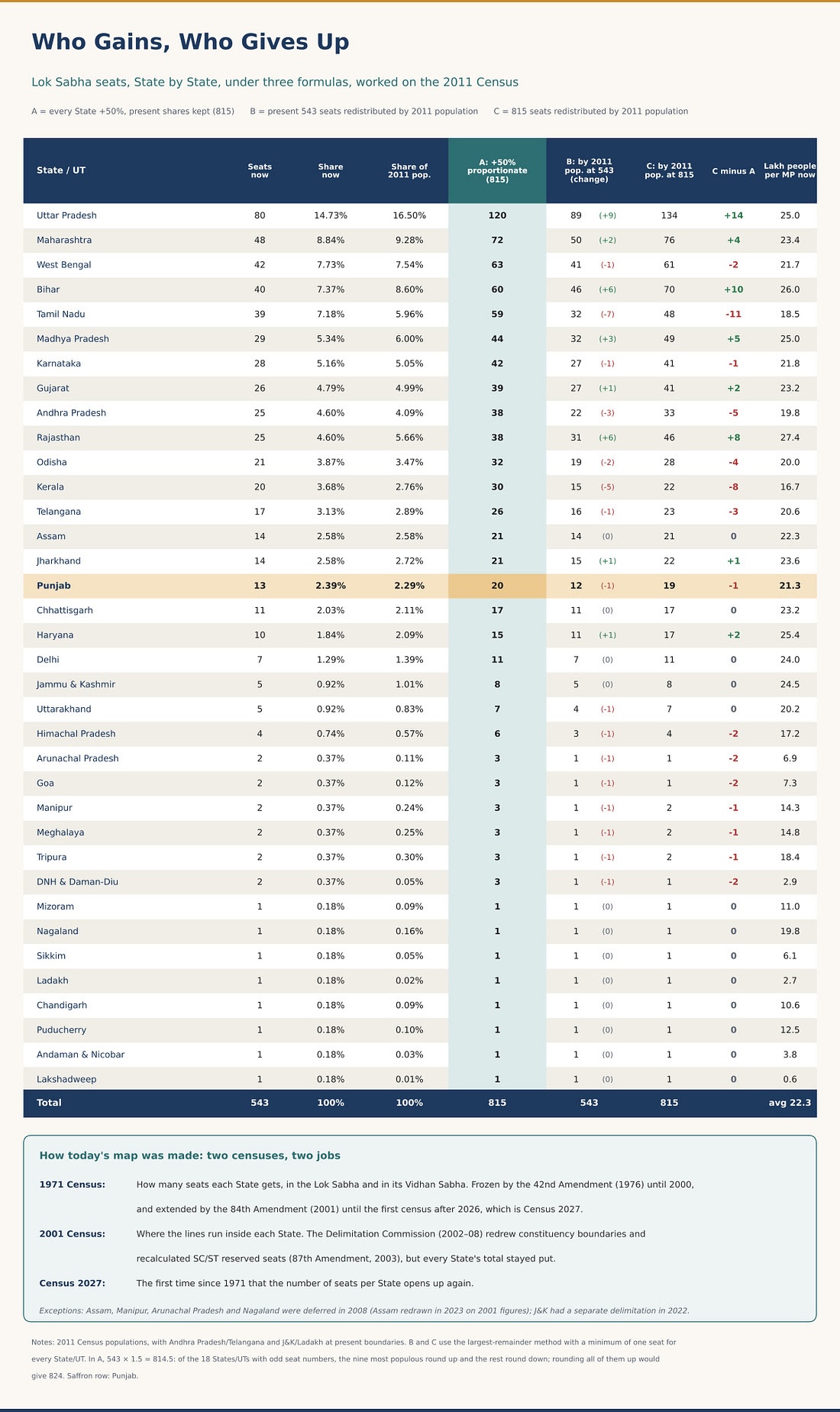
Five weeks ago, in Shah’s Gambit, I made the case for a flat 50 per cent increase for every State, with present shares frozen. Having since worked out the State-wise arithmetic on the 2011 Census (the table with this piece sets it out for all thirty-six States and Union Territories), I have come to a harder conclusion. The flat 50 per cent is the south’s best outcome on paper. It is not the one the south can bank. The settlement that can pass both Houses and hold for a generation lies one step north of it.
Two Censuses, Two Jobs, One Clock
The present map was drawn by two censuses doing two different jobs. The 1971 Census fixed how many seats each State gets, in the Lok Sabha and in its own Vidhan Sabha. The Constitution (Forty-Second Amendment) Act, 1976, froze those numbers until 2000, so that States which controlled their population would not be punished for it; the Constitution (Eighty-Fourth Amendment) Act, 2001, extended the freeze until the first census taken after 2026. The 2001 Census did the other job. The Delimitation Commission of 2002–08 used it to redraw constituency boundaries within each State and to recount the seats reserved for Scheduled Castes and Scheduled Tribes, but every State’s total stayed the same.
Then, on 16 April 2026, the Union notified the Constitution (One Hundred and Sixth Amendment) Act, 2023 (the Nari Shakti Vandan Adhiniyam) into force. That one notification started a clock. Women’s reservation begins only after a delimitation based on the first census taken after the Act commenced, and that census is now, beyond argument, Census 2027. It is already underway. In Punjab, Uttar Pradesh, Goa and Uttarakhand, self-enumeration opened today, with house-to-house counting from 1 December to 4 January; the rest of India follows from 25 January to 28 February 2027. When those figures are published, the 1976 freeze ends of its own accord.
April’s Bill: 2011 in a Fifty-Per-Cent Costume
The Government did, in fact, try the 2011 route in April, though not in so many words. The Constitution (One Hundred and Thirty-First Amendment) Bill, 2026, with the Delimitation Bill, 2026, would have taken the Lok Sabha to 850 seats (815 for the States, 35 for the Union Territories) and redistributed them on the 2011 Census, so that women’s reservation could arrive in time for 2029. The DMK says the Union Home Minister verbally assured every State half as many seats again. The text said no such thing. The DMK put the opposition’s case in one line: let it be done on a proportionate basis.
The opposition saw a 2011 rebase dressed up as a 50 per cent promise, and voted accordingly. On 17 April the Bill drew 298 votes to 230, 54 short of the 352 it needed, and the Government withdrew its two companion Bills the same evening. The lesson is plain enough. The political class reads schedules, not speeches. A disguise that failed once will fail faster the second time.
A Debt That Compounds
Think of the south’s position as a debt. The principal was run up between 1971 and 2011, when the five southern States (Tamil Nadu, Kerala, Andhra Pradesh, Telangana and Karnataka) brought their population growth down faster than the rest of India. Every census since has added interest, and Census 2027 will add more. Those five States hold 129 of the 543 seats today, or 23.8 per cent. Their share of India’s population was 20.8 per cent in 2011, and on the official projections it is about 19.3 per cent now.
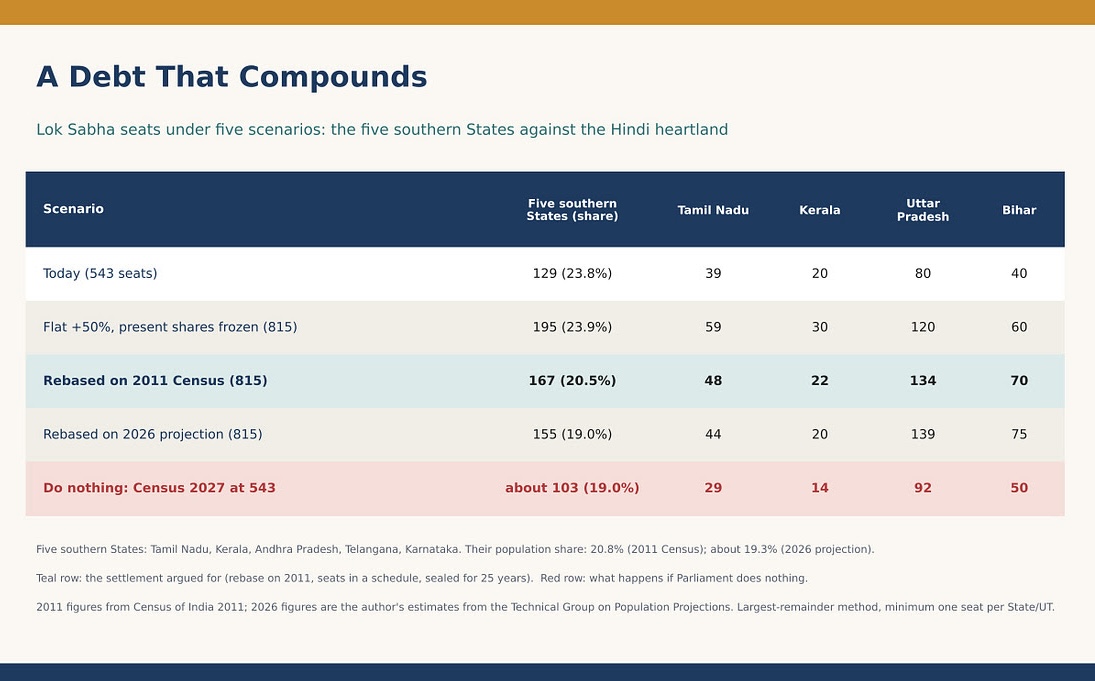
The last row is the one the south should keep before it. If Parliament does nothing, the South does not merely lose share; it loses seats outright—about 26 of them—with Kerala down to 14 and Tamil Nadu to 29. And the gap between the 2011 row and the 2026 row (12 seats in a House of 815) is the interest that will keep accruing for as long as the South waits. (Figures on 2026 are my own estimates from the official population projections; the 2011 figures are from the census itself.)
Pay the Principal, Refuse the Interest
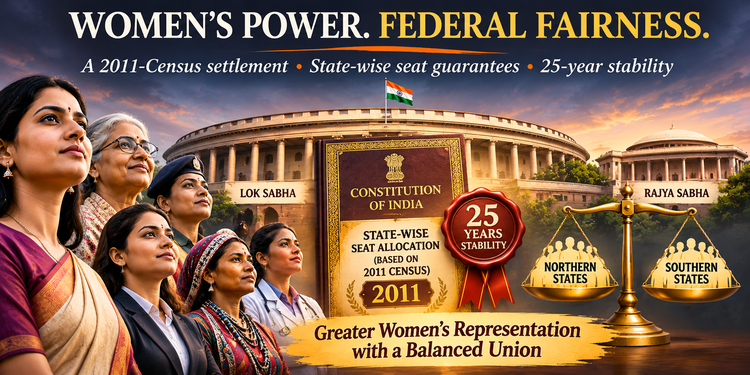
Here, then, is the bargain I would put to the southern States. Accept the rebase on the 2011 Census, openly and not in costume. Every one of them still gains seats in absolute terms: Tamil Nadu from 39 to 48, Kerala from 20 to 22, Andhra Pradesh from 25 to 33, Telangana from 17 to 23 and Karnataka from 28 to 41. They give up about three percentage points of the House. In return, they ask for three things, all in the text.
- A schedule. Every State’s seats are written into the Constitution itself, State by State, before the vote, not left to a commission or a speech.
- A seal. Those shares are frozen until the first census taken after 2051, a quarter of a century, which is what the DMK itself sought when it asked for a 25-year extension of the freeze.
- Women now. Women’s reservation is operationalised on that map, so that one-third of the House is reserved at the very next general election the delimitation can be completed for.
Why would the north accept it? Because it is paid now, in cash, and not by promissory note. Under the flat 50 per cent, Uttar Pradesh would have to settle for 120 seats when the 2011 Census entitles it to 134, and Bihar for 60 instead of 70. That is a sacrifice the Hindi heartland made once, in 1976, and is most unlikely to make twice, least of all under a Government whose base lies there. Under the 2011 rebase, the heartland gets most of what it is owed; what it forgoes is only the increment from 2011 to 2027 (Uttar Pradesh 139 against 134). The south, for its part, pays the old principal and is spared the interest, now and for twenty-five years. Neither side gets all it wants. That is usually how one recognises a settlement that will last.
Two-Thirds of Two Houses
The arithmetic leaves no room for another disguise. A constitutional amendment needs two-thirds of those present and voting, and a majority of the whole House, in each House separately. The Tribune’s count this morning puts the NDA at 305, the NCP (SP) at 8 and the twenty rebel Trinamool MPs at 20, which comes to 333. Add the DMK’s 22, still hypothetical, and it is 355 against 361 if all 540 sitting members vote. Aditi Tandon’s column in the same paper has the NDA at 320 against 360, and at 155 in the Rajya Sabha, six short there too. A senior Minister claims 15 to 18 votes in hand; Jairam Ramesh calls it a bluff. Somebody’s arithmetic is wrong.
The complexion of the House has certainly changed since April. The Trinamool has split, the DMK has lost Tamil Nadu and softened its tone, and Supriya Sule says her party will back a 50 per cent increase if it is guaranteed in law. But a margin of a handful of votes, in two Houses, is precarious by any measure. A Bill that needs the DMK will have to carry the DMK’s terms, and the first of those is a State-wise schedule. A second costume will not survive a second vote. An honest 2011 schedule, sealed for twenty-five years, might.
One more condition belongs in the same text: the Rajya Sabha must grow in the same ratio. Otherwise the House of the States falls from about a third of a joint sitting to under a quarter, and the federation loses in one chamber what it was promised in the other.
The Verdict: Settle, Schedule, Seal
Women’s reservation has been promised for three decades and written into the Constitution for three years. It should not now be held hostage to a north–south quarrel that a disguised Bill cannot settle. The south’s best outcome on paper, the flat 50 per cent, asks the heartland for a sacrifice it will not make twice. The Government’s April design asked the south to take a 2011 rebase on trust. Neither passed, and neither will. What can pass is the honest middle: rebase on 2011, write every State’s seats into a schedule, seal them for twenty-five years, enlarge the Rajya Sabha in step, and give women their third of the House on that map.
The south pays the principal. It refuses the interest. And for once, the bill arrives with the arithmetic printed on its face.