


Tuesday, November 10, 2026
  • Home
  • About Us
  • Refund Policy
  • Privacy Policy
  • Terms and Conditions
  • Advertise With Us
  • Contact Us
  • Login
  • Register
SUBSCRIBE
Welcome to Saviours Voice of Khaki
Advertisement
ADVERTISEMENT
  • Foreign Policy
  • Internal Security
  • Policing
  • Border Management
  • Corrections
  • Disaster Management
  • Interviews
  • General
No Result
View All Result
  • Foreign Policy
  • Internal Security
  • Policing
  • Border Management
  • Corrections
  • Disaster Management
  • Interviews
  • General
No Result
View All Result
Welcome to Saviours Voice of Khaki
No Result
View All Result
Home Economy

The Queen of Rain: Unlocking India’s Demographic Dividend

Naazneen BhasinDr Sarika RachuribyNaazneen BhasinandDr Sarika Rachuri
November 10, 2026
in Economy, General
Reading Time: 3 mins read
1
0
The Queen of Rain: Unlocking India’s Demographic Dividend
Share on FacebookShare on TwitterShare on LinkedInShare on WhatsApp
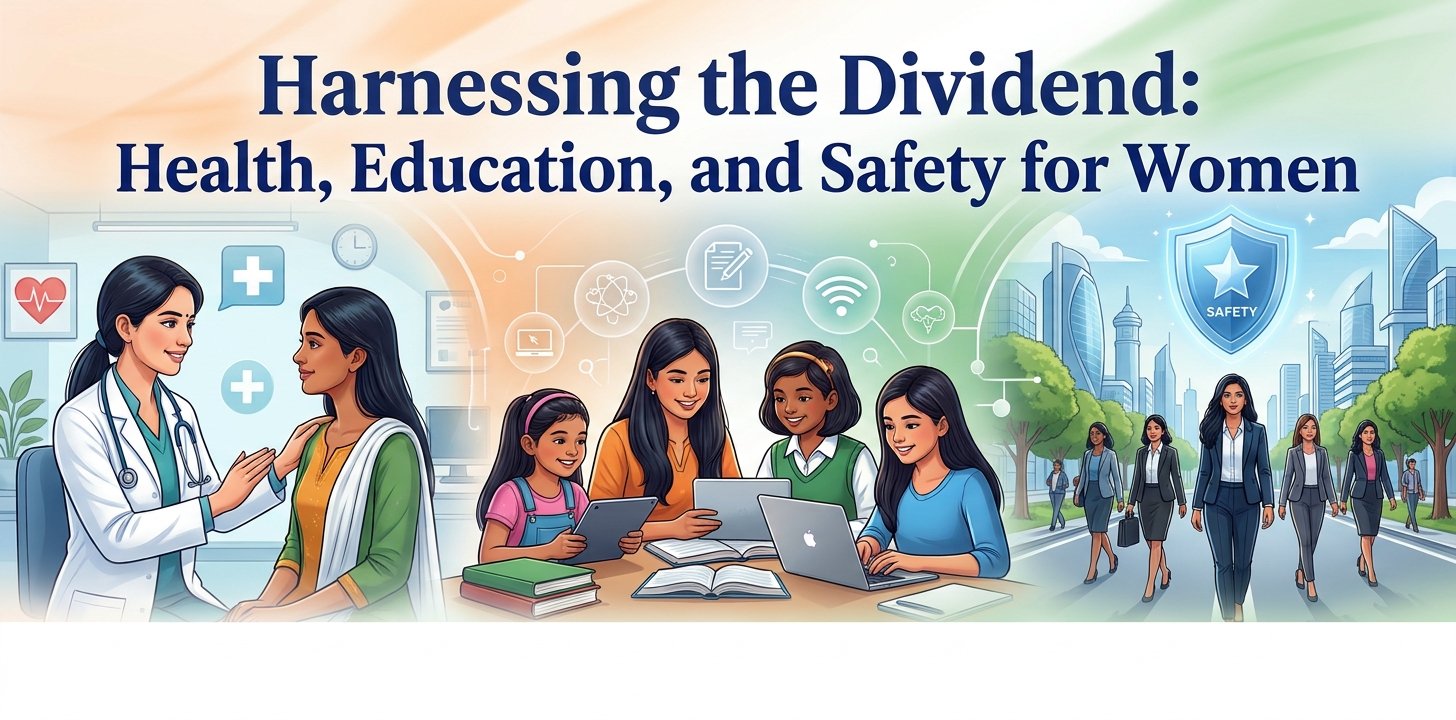
Women constitute half of India’s population. But their participation in the workforce and financial empowerment do not match. Three major issues—education, health, and safety—must be addressed to unlock their full potential.

Introduction

The classic song Queen of Rain evokes an image of a large house with many doors. Analogous to our vast nation, India has several doors to development, with women’s empowerment being one of them. In recent years, much attention has focused on India’s demographic dividend, a key determinant of which is female labour force participation.

Eminent economist Claudia Goldin argues that the precursors to higher female force participation are education, empowerment and the well-being of a woman. It is therefore counterintuitive that the three key metrics for better female labour force participation are health, education, and safety. Studies show that female literacy is the most important metric, as it directly affects health and well-being. Therefore, to harness the demographic dividend, Female labour force participation must increase.

Is Progress Enough?

It is instructive to note that in past few years, India has made rapid strides in improving Female labour force participation—in December 2025, overall labour force participation for females aged 15 years and above edged up to 35.3 per cent, up from  27.4  per cent a decade ago.

But before we congratulate ourselves, look at our peers: compared with Bangladesh (38%) and Vietnam (68.6%) alone, we trail far behind. Worse, we remain substantially below the male participation rate, which, per the ILO/World Bank Estimates of 2025, is 77 per cent for Indian males.

Within the country, there are spatial variations, with states like Himachal Pradesh (52.6%), Sikkim (53.4%) and Nagaland (50.9%) at the higher end of the spectrum and Delhi (10.9%), Haryana(18.4%), Bihar (17%) at the lower end.

Literacy alone is not enough

A conundrum that needs revisiting is that higher female literacy is necessary but not sufficient for higher female labour force participation. The evidence from Indian states is revealing. North-eastern states such as Sikkim and Nagaland, with female literacy rates exceeding 75–85%, also record female labour force participation above 50%. However, Delhi, despite a higher female literacy rate, records one of the lowest female labour force participation rates in the country. Clearly, literacy alone does not translate into economic participation. Wherein lies the missing link?

Safety is the key

Empirical evidence from India has shown that high rates of crime, particularly crime against women, significantly reduce female labour force participation. Women’s safety, which enables women to travel, access workplaces and remain in employment, as recognised by the ILO, then emerges as the key to unlocking the demographic dividend. Suffice to say, ‘Safety’ is all-encompassing. It extends beyond protection from crime to include emotional and psychological safety, safe mobility from home to the workplace and back, and workplaces free from harassment, discrimination and intimidation. Only when women feel secure at every stage of this journey can education and empowerment translate into meaningful economic participation.

Conclusion

Governments must now ensure that empowerment extends beyond policy announcements to creating an ecosystem where every woman is educated, healthy, economically independent and, above all, safe. For a nation too, it cannot be a point of pride that educating women has not adequately translated into higher female labour force participation. A large proportion of women in their productive years remains outside the labour force. This is a loss not only for women but for the nation. It leaves one of the most important factors of production underutilised, preventing human capital from being monetised and translated into a meaningful demographic dividend.
Tags: BharatDemographic DividendDemographyHealth EducationindiaParticipation in workforceSafetyViksit BharatWomen
ShareTweetShareSend
Naazneen Bhasin

Naazneen Bhasin

Nazneen Bhasin is an IPS officer of the Haryana cadre and is currently posted as IG ATS, Haryana.

Dr Sarika Rachuri

Dr Sarika Rachuri

Dr Sarika Rachuri teaches at ICFAI Business School, Mumbai

Related Posts

Data Protection versus Democratic Accountability
General

Data Protection versus Democratic Accountability

November 2, 2026
Will India Become Old Before It Becomes Rich?
Economy

Will India Become Old Before It Becomes Rich?

November 1, 2026
ROLE OF INTELLIGENCE IN PUBLIC GOVERNANCE
Foreign Policy

ROLE OF INTELLIGENCE IN PUBLIC GOVERNANCE

October 30, 2026
China Bullet Train and India Jantar Mantar
General

China Bullet Train and India Jantar Mantar

October 29, 2026

JUN-AUG 2025 ISSUE

ADVERTISEMENT

Trending Articles

The Queen of Rain: Unlocking India’s Demographic Dividend
Economy

The Queen of Rain: Unlocking India’s Demographic Dividend

byNaazneen Bhasinand1 others
November 10, 2026
Data Protection versus Democratic Accountability
General

Data Protection versus Democratic Accountability

bySomesh Goyal
November 2, 2026
Will India Become Old Before It Becomes Rich?
Economy

Will India Become Old Before It Becomes Rich?

byAshok K Abrol
November 1, 2026
ROLE OF INTELLIGENCE IN PUBLIC GOVERNANCE
Foreign Policy

ROLE OF INTELLIGENCE IN PUBLIC GOVERNANCE

byVappala Balachandran
October 30, 2026

About Saviours - Voice of Khaki

Saviours: Voice of Khaki (SVOK) aims to be the first ever platform in the Country for the men in khaki whether in the Police or Prisons or Central Armed Police Forces (CAPFs) through which they can voice their issues as well.

Quick Links

  • Home
  • About Us
  • Refund Policy
  • Privacy Policy
  • Terms and Conditions
  • Advertise With Us
  • Contact Us

Topics

  • Policing
  • Border Management
  • CAPFs
  • Corrections
  • Internal Security
  • Mod & Tech
  • Narcotics
  • Naxalism
  • Disaster Management
  • Interviews
  • Videos

Connect With Us

For PR Agencies & Content Writers: marketing@savioursmagazine.in

Connect With Us

Facebook Twitter Youtube Linkedin

© 2025 Designed by AK Network Solutions

Welcome Back!

Login to your account below

Forgotten Password? Sign Up

Create New Account!

Fill the forms below to register

All fields are required. Log In

Retrieve your password

Please enter your username or email address to reset your password.

Log In
No Result
View All Result
  • About Us
  • Advertise With Us
  • Cart
  • Checkout
  • Contact Us
  • Home
  • My account
  • Privacy Policy
  • Refund Policy
  • Subscribe
  • Terms and Conditions

© 2022 Designed by AK Network Solutions

Are you sure want to unlock this post?
Unlock left : 0
Are you sure want to cancel subscription?