

Introduction
“India will become old before it becomes rich,” a political analyst recently observed, referring to India’s failure to fully exploit its demographic dividend. This raises an important question: are our policy priorities, educational shortcomings, and employment challenges preventing us from converting a historic demographic advantage into lasting economic prosperity?
The proposition merits close examination. The argument is not that India is already an ageing society in the sense that demographic ageing has overtaken economic development. Rather, India may be approaching the latter stages of its demographic dividend without converting its enormous young population into sufficiently educated, skilled, and productively employed human capital.
Put differently, India risks losing what it gained on the swings on the roundabouts.
If India delays converting demographic potential into economic productivity, it could begin to age at a level of per-capita prosperity considerably below that attained by several East Asian economies before their populations began ageing significantly. The concern, therefore, is not merely demographic. It is economic, educational, social and, inevitably, political.
The paradox: Demography is destiny—but only if we know what to do with it.
- We put children in schools, but do we ensure that they learn?
- We give young people degrees, but do we equip them for productive work?
- We possess a vast potential workforce, but do we create enough worthwhile employment for it?
These questions lie at the heart of India’s demographic paradox. If the country fails to convert its demographic dividend into human capital, employment and productivity now, will it discover two decades hence that it has become an ageing nation before becoming a prosperous one?
Extraordinary Demographics
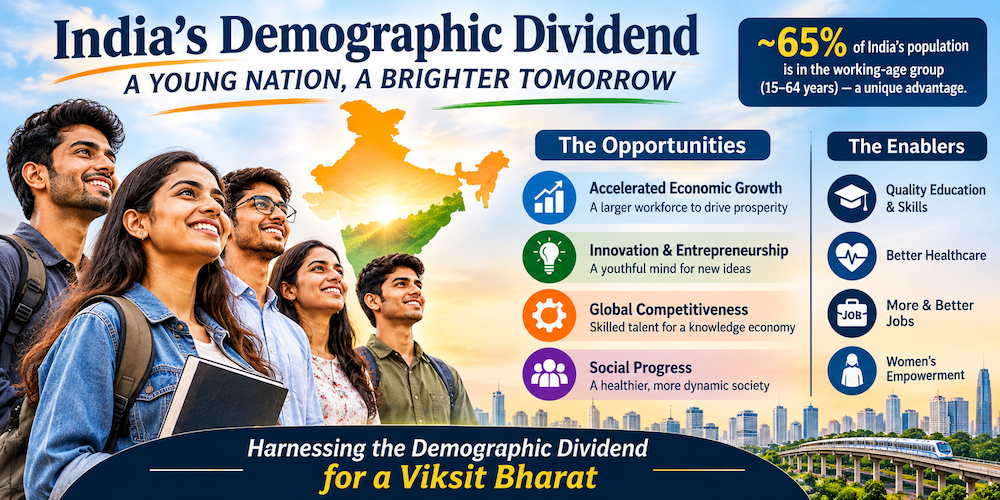
India’s demographic numbers are extraordinary. The Economic Survey 2025–26 estimates that the demographic dividend will peak around 2030, when nearly 65 per cent of the population will fall within the 15–59 age group. At the same time, fertility has fallen below replacement level, signalling a gradual transition towards an older population.
But a demographic dividend is not the same as an economic dividend. The mere presence of millions of young people does not automatically translate into higher productivity, greater prosperity or improved living standards.
The United Nations Population Fund (UNFPA) has repeatedly emphasised that the dividend materialises only when the working-age population is healthy, educated, empowered and engaged in decent work. Otherwise, a large young population can become a source of unemployment, underemployment and social frustration rather than accelerated economic growth.
The youth-led protests at Delhi’s Jantar Mantar in July 2026, sparked by anger over examination-related controversies, offer a contemporary illustration of young people’s anxieties about fairness, opportunity, and their future. The protests also underline the social consequences when educational and employment aspirations collide with doubts about the integrity of selection processes.
Education and employment are the two great tests.
The Ticking Demographic Clock
Most likely, India may become old before it becomes rich.
The UNFPA’s India Ageing Report 2023 estimates that India’s population aged 60 and above could rise from approximately 153 million in 2022 to 347 million by 2050. By then, older people could account for more than one-fifth of the country’s population, creating substantial challenges for healthcare, social security, and care for older persons.
This is the central paradox: the demographic dividend has an expiry date. Demography offers an opportunity, not a guarantee. Demography supplies the potential; public policy, institutional competence and economic opportunity determine how much of that potential is realised.
Education: the First Conversion Challenge
India has made considerable progress in expanding access to schooling. The Ministry of Education’s UDISE+ 2024–25 data record approximately 247 million school enrolments, from the foundational stage through secondary education, supported by more than 10 million teachers.
Yet enrolment is an input. Learning is the outcome.
The Annual Status of Education Report (ASER) 2024 corrects complacency that can arise from improved access. Only 45.8 per cent of children in Standard VIII could perform the basic arithmetic task of division. This improved on earlier surveys.
A young person who spends twelve years in school but emerges without adequate literacy, numeracy, digital competence, communication skills, or problem-solving ability has not necessarily acquired the human capital a modern economy requires. The danger is that we may produce a generation that is formally educated but insufficiently equipped for productive employment.
The degree–job mismatch: educated, qualified and still waiting for jobs.
India’s expansion of higher education has opened opportunities for millions. Yet it is dangerous to assume that more graduates necessarily mean a proportionately larger stock of productive human capital.
Employment: the second conversion challenge
The demographic dividend requires jobs—gainful, productive employment—not merely a large population of working age.
The World Bank’s 2025 report on India’s long-term growth trajectory sets out the scale of the challenge. If India reaches high-income status by 2050, it would need to raise overall labour-force participation from 56.4 per cent to above 65 per cent, increase investment substantially, and accelerate productivity growth. The report also emphasises the need to raise female labour-force participation and create more, better jobs.
This raises an important question: can India realise its demographic dividend while a substantial proportion of its women remain outside, or only partially integrated into, productive employment?
The Economic Survey 2025–26 records an increase in the female labour-force participation rate from 23.3 per cent in 2017–18 to 41.7 per cent in 2023–24. This significant change deserves acknowledgement. However, participation figures alone do not tell us enough about the quality, remuneration, security or productivity of the work undertaken. Persistent barriers include mobility, childcare and other care responsibilities, workplace safety, inflexible working arrangements and unequal access to opportunities. Women also remain underrepresented in several higher-productivity occupations.
The economic implications extend beyond gender equality. When women who want to work cannot, the country loses skills, enterprise, income, and productive capacity. A demographic dividend that fails to draw fully on women’s abilities is, by definition, incomplete.
The manufacturing question: where will jobs come from?
Historically, several East Asian economies used their demographic windows to move large numbers of workers from agriculture into manufacturing and subsequently into higher-productivity services. This structural transformation raised incomes, expanded the industrial base, and created opportunities for workers with varying levels of education.
India’s development trajectory has been different.
A modern economy certainly needs IT professionals, engineers, scientists, managers and civil servants. But it also needs a vast range of jobs for young people who may not possess advanced degrees or specialised technical qualifications.
Manufacturing, construction, logistics, tourism and hospitality, healthcare, education, retail, modern agriculture, electronics, textiles, food processing, digital services, and the care economy can all help create jobs. Small and medium enterprises are particularly important because they can provide livelihoods across regions and skill levels.
The challenge is to expand these sectors while raising productivity, improving working conditions, and enabling workers to move into better-paid jobs.
This is not an argument for manufacturing at the expense of services. India needs both, along with more productive agriculture. The objective must be a diversified economy that can generate employment at a scale commensurate with the number of people entering the workforce.
Skill Development: Numbers Must Translate into Livelihoods
Recognising the importance of employable skills, successive governments have introduced training initiatives. In contrast, the present government has placed particular emphasis on programmes such as Skill India, the Pradhan Mantri Kaushal Vikas Yojana (PMKVY), apprenticeships and the Skill India Digital Hub. These initiatives seek to widen access to training and prepare workers for changing labour-market requirements.
Large numbers of people trained or certified can make for impressive administrative statistics. But training numbers alone do not show whether participants have secured jobs, whether those jobs match their training, whether employers value the qualifications, or whether workers’ incomes have improved.
The more meaningful questions are these:
- How many trainees secure employment after completing their courses?
- How many remain employed after six or twelve months?
- Are their jobs relevant to the skills acquired?
- Do their wages and career prospects improve?
- Are employers involved in designing curricula, providing apprenticeships and assessing competence?
- Do training institutions respond to actual labour demand in their regions?
These are the outcomes against which a skills programme should be judged.
The Geographical Paradox: One Country, Several Demographic Transitions
India’s demographic transition is not uniform. Different states are moving through it at different speeds.
Several southern states are ageing faster than some northern states, where fertility remains relatively higher, and populations are younger. UNFPA’s ageing research highlights these regional differences and the need to prepare for the consequences of population ageing well before they become overwhelming.
India could therefore manage two demographic realities simultaneously: states with relatively older populations and states with a much larger pool of young workers.
This divergence also presents an economic opportunity.
Younger states can supply workforce; states with more mature economies may offer jobs, infrastructure, capital and established industrial networks. Internal migration can connect the two, helping workers find opportunities while meeting employers’ demand for labour.
But migration cannot be treated merely as movement from one state to another. It requires affordable housing, safe transport, access to healthcare, portable social-security benefits, schooling for migrant children and protection against exploitation. Moreover, it may face political pressure.
Migrant workers’ dignity and security matter as much as their economic contribution.
If these conditions are created, India’s internal diversity could become a source of strength. If they are neglected, demographic differences may instead deepen regional inequalities and social tensions.
The policy question: is India moving fast enough?
Critics of Modinomics often argue that the Modi government has squandered India’s demographic dividend. That is a forceful political charge, but the more useful question is a broader one:
Has India’s policy architecture been sufficiently effective in converting demographic potential into productive human capital?
Credit must go to the present government for recognising several relevant challenges and introducing a range of initiatives. These include the National Education Policy 2020, Skill India, PMKVY, Make in India, production-linked incentive schemes, apprenticeships, digital infrastructure, the Mudra programme and investments in physical infrastructure.
These initiatives matter. However, their outcomes require independent scrutiny.
Consider Make in India. The ambition to strengthen domestic manufacturing is strategically important. Still, its success depends on a wider ecosystem: competitive logistics, reliable power, timely clearances, access to land and finance, efficient supply chains, predictable regulation and a workforce with the necessary skills.
Geopolitical disruptions can complicate access to inputs and markets, while dependence on imported components in important sectors can expose domestic production to external shocks. These constraints must be addressed alongside efforts to expand manufacturing and employment.
Similarly, digital infrastructure and financial inclusion can enable economic participation, but they cannot substitute for good schools, competent training institutions or sufficient demand for labour.
Nor can infrastructure investment alone guarantee that the economy will generate enough productive employment for the millions of young people entering the workforce.
The question, therefore, is not whether India has announced the right objectives. The question is whether policy execution delivers outcomes commensurate with those objectives.
The demographic transition began well before 2014 and will continue long after the present government. Successive governments have inherited and shaped the country’s educational, economic, and institutional landscape. The opportunity is national; so is the responsibility. Political accountability, however, requires us to examine the policies and outcomes of the government in office.
The East Asian Lesson: Timing Matters
The experience of East Asian economies offers an important, though not mechanically transferable, lesson. Their success did not arise simply because they had large working-age populations. It depended on a combination of education, public health, labour-intensive industrialisation, investment, export competitiveness and the ability to move workers into increasingly productive activities.
India cannot simply replicate their historical trajectory. Its scale, federal structure, democratic institutions, technological circumstances, and social diversity differ. Automation and artificial intelligence also make today’s global employment environment unlike that of earlier industrialisers.
Nevertheless, the underlying lesson remains relevant: a favourable demographic structure creates an opportunity, not an entitlement to prosperity.
Countries must invest in people, enable productive enterprise, and create the conditions for workers to move from low-productivity activities to higher-productivity ones.
The cost of delay is especially high because demographic windows do not remain open indefinitely. Investments in foundational education take years to yield their full returns; industrial ecosystems take time to mature; and workers need opportunities to acquire experience and build careers.
A country that postpones these investments may find that the population structure that once promised an advantage has begun to change before the expected economic gains materialise.
Conclusion
India does not need to prevent ageing. Ageing is, in part, a consequence of progress: lower fertility, lower mortality and longer life expectancy are achievements to be welcomed. The real danger is premature ageing without sufficient prosperity. As today’s young workers age, they will need healthcare, pensions, financial security, and long-term care. The UNFPA projection of approximately 347 million Indians aged 60 and above by 2050 illustrates the magnitude of the challenge.
The question is not simply how many elderly people India will have. It is what economic resources, social-security systems, and public institutions the country will have developed by the time it needs them.
We cannot postpone these questions until the demographic transition is complete. If any link in this chain fails, the demographic dividend leaks away.
This is why the proposition that India may become old before it becomes rich deserves serious consideration.
India still possesses enormous advantages: a large workforce, entrepreneurial energy, expanding infrastructure, technological capabilities and the capacity to undertake reforms. The challenge is to bring these strengths together in a coherent strategy that puts learning, employability, productive employment and rising productivity at its centre.
The race is not between India and some abstract demographic deadline. It is between the time required to build a prosperous economy and the time available before the country’s population structure changes.
Demography is destiny—but only if a country knows what to do with its demography.
India’s task is to become sufficiently prosperous before the demands of an ageing society weigh more heavily on its resources. The objective is not merely to live longer, but to ensure that longer lives are supported by greater economic security, better healthcare and the dignity that prosperity should bring.
The demographic dividend is not a perpetual inheritance. It is a time-bound opportunity.