


Introduction
Perhaps our colonial past explains the traditional practice in our system of administration of keeping intelligence departments away from public governance bodies, both at the Centre and in the States. Unfortunately, even after independence, the same attitude continues. As a result, our governments and the public view intelligence as esoteric and mysterious, and keep it out of public view.
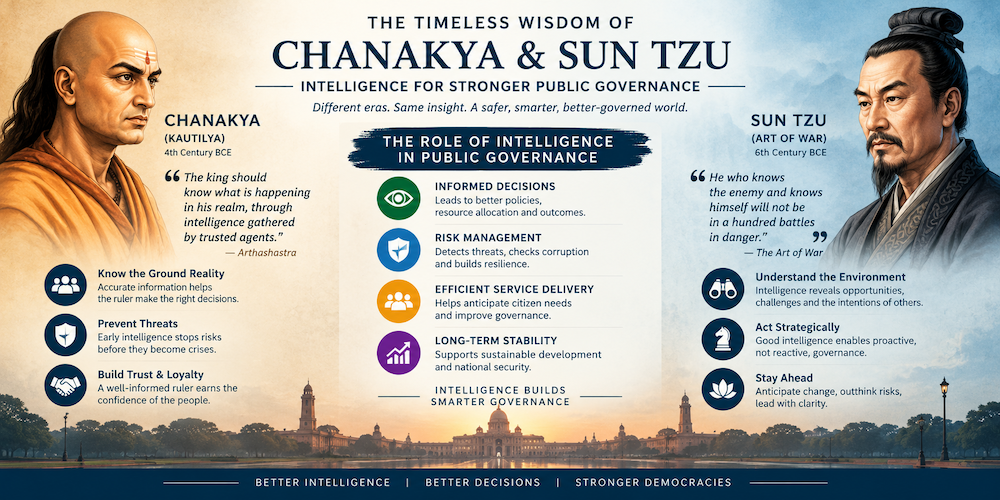
That was not the case in ancient times, when intelligence was considered a necessary part of public governance. Sun Tzu, Chanakya and Thiruvalluvar had incorporated the principles of intelligence in governance in their works and prescribed how such activities should be conducted.
 While Great Britain considered the working of their intelligence departments as secret and to be kept away even from their parliament till 1994, the United States of America, its former colony, went ahead and codified the working of its intelligence agencies by passing the National Security Act of 1947 and the Central Intelligence Agency (CIA) Act of 1949.
President Harry Truman’s aversion to secrecy in government work was one reason he decided to regulate the CIA and FBI in America legally. In contrast, the UK passed the Intelligence Services Act only in 1994, setting up the Intelligence & Security Committee (ISC) of Parliament to oversee the work of its intelligence organisations. However, in India, an excellent private bill, “The Intelligence Services – Powers and Regulation,” introduced by Manish Tewari, then Congress MP (later minister), in 2011, suffered a silent death when even the Congress-led UPA government failed to support it.
Reasons for treating intelligence agencies as secret adjuncts:
During the colonial times, the British wanted to give a misleading impression to hoodwink the natives, especially after the First War of Independence in 1857. This policy became more compelling after Viceroy Lord Mayo was assassinated in the Andaman Jail in 1872. Afterwards, Viceroy Northbrook, Mayo’s successor (1872-76), felt the need for “a detective Police for political purposes” and asked the Thugee and Dacoity Department, originally established by Col. William Henry Sleeman, to handle that assignment. In other words, he wanted a political domestic spy agency camouflaged within a crime investigation body.
On 15 November 1887, Viceroy Lord Dufferin suggested to Lord Cross, Secretary of State for India, that he would utilise “the services of the Police force, and in Native States, the existing means at the disposal of Political Officers, for collection of intelligence on political, social and religious movements.” Dufferin underscored the secrecy of the communications, as “it would not do for the native press to get it into their heads, that we were about to establish a Third Section after the Russian pattern.”
Here, Dufferin refers to the “Third Section of His Imperial Majesty’s Own Chancellery,” the secret Police in Imperial Russia, which was replaced by the spy agency “Okhrana” in 1880 following the assassination of Tsar Alexander II. Later researchers found deliberate attempts in India to hide the creation of a central intelligence agency to avoid public criticism.
The White Hall approved this. Thus, officially, the political intelligence apparatus for colonial India was born on 23 December 1887, when the Secretary of State approved the proposal for improving the means of obtaining secret and political intelligence. This practice continues even now.
How Intelligence “Failures” adversely affect public governance
During my lecture at the MIT-World Peace University in Pune on 28 September 2026, I highlighted how failures in intelligence processing led to major incidents like 9/11 (USA) and 26/11 (India), which adversely affected public governance and eroded trust in governments.
First, the casualties: While 9/11 in the USA resulted in more than 3000 deaths, India’s 26/11 saw 175 deaths, including 20 security personnel, with a record number of senior officers dying. The second was financial: while 9/11 resulted in an immediate loss of US$ 83-123 billion, its infrastructure damage ran into hundreds of billions of dollars. Similarly, the immediate financial loss of 26/11 was Rs. 4000 crores, not counting several thousand crores in business losses for hotels and shops over several days.
An important additional fact was the humiliation and loss of faith in governments: 9/11 resulted in a total shake-up of the American system of governance, while 26/11 ended with a political avalanche in New Delhi and Mumbai.
However, not all such incidents are “Intelligence Failures”
“Raw intelligence becomes policy for action only after an alchemic process of collation, analysis, dissemination, arbitration, policy adjudication and decision- making. Any inter-space in this process would lead to a situation in which intelligence, including technical pointers already available in some form with any wing of a government, does not result in policy or action. This leads to an impression of ‘Intelligence Failure’.
I told them that my research over several incidents had clearly revealed that in most of these cases there was no dearth of intelligence pointers: there were definitive intelligence alerts – what was missing was action following such alerts.
Pearl Harbour Attack: Sunday, 7 December 1941
A 1960 study by the Combat Studies Institute in Kansas revealed that a crucial intercepted Japanese message of 29 November 1941, decoded only on 3 December, was never taken seriously and was not passed on to local naval commanders in Hawaii for action. Officials also did not send the highly sensitive “Magic” decryption machine to Honolulu because they feared the Japanese might break into it through moles at their consulate. Instead, they placed it in London.
As a result, Admiral Kimmel in Honolulu could not keep himself abreast of the day-to-day developments. In contrast, Gen. MacArthur, commander of U.S. Army Forces in the Far East, positioned in the Philippines, could know as he had the machine. During the post-attack enquiry, Kimmel complained bitterly about this.
A similar December 1974 study by the Army War College’s Strategic Studies Institute in Pennsylvania found that at least 9 “pointers” were available before the attacks, which, with careful analysis, could have enabled the Hawaii-based U.S. forces to take preventive measures.
First phase of the Yom Kippur War: 6 October 1973
At 2:00 PM, nearly 200 Egyptian combat aircraft conducted large airstrikes against three Israeli airbases, their Hawk missile batteries, command centres, artillery, and radar installations. Also, fourteen Egyptian bombers attacked Israeli targets in Sinai and central Israel. At the same time, 32,000 Egyptian infantrymen crossed the land border. The Syrians attacked the Golan Heights. However, the Israelis counter-attacked after initial shocks, inflicting heavy losses on combined Egyptian and Syrian forces. The war ended with a cease-fire on 25 October. It resulted in heavy casualties on all sides.
The national outcry compelled the Israeli government to appoint the “Agranat Commission” headed by Shimon Agranat, Chief Justice of Israel’s Supreme Court, on 21 November 1973 to enquire into the initial lapses which were responsible for 2,812 Israeli soldiers’ deaths. It held 140 sessions, examined fifty-eight witnesses, and submitted three reports. Its first interim report, published on 1 April 1974, caused such a sensation that Prime Minister Golda Meir had to resign. The report recommended dismissal of Defence Intelligence Chief General Eliyahu Zeria and others. The commission found that faulty analysis led them to reject several pointers indicating the strong possibility of such a surprise raid.
Fifty years later, another attack: Hamas Gaza raid on 7 October 2023
There were parallels between the 6 October 1973 “lightning” Egypt-Syrian war on the “Yom Kippur” prayer day, which killed 2,812 IDF soldiers, and the sudden Hamas assault on Israel on 7 October 2023, when 1200 Israelis were killed and 251 hostages were seized. Both caused tremendous trauma on the Israeli psyche, as in both cases there was prior intelligence which was not acted upon by decision-makers. Following this, the brutal “Hamas War” started, resulting in more than 75,000 Palestinian deaths, including women and children.
In 2023, the entire Gaza division was overrun for hours, while the IDF top command was unaware that “the regional division was not functioning for nearly 10 hours during the onslaught while 767 troops faced 5,000 terrorists”, as the ‘Times of Israel’ put it. Yet Prime Minister Benjamin Netanyahu has neither appointed any commission of enquiry nor has he resigned, on the ground that he is conducting the war against Hamas. Sufficient indications have come in international media that the border watchers, especially IDF women, had alerted their superiors-yet their higher ranks did not take these warnings seriously.
23 October 1983: Beirut Marine barracks bombing
This was one of the worst terrorist attacks against US forces in history due to a vehicle bombing. In1975, a very violent civil war broke out in Lebanon. Israel was helping Maronite Christians while Syria was aiding the Muslims. The presence of the Palestinian Liberation Organisation (PLO) and Iranian-backed “Islamic Jihad” had complicated matters. In 1982, President Ronald Reagan decided to deploy US Marines as part of the UN-sponsored multinational force (Italian, French and American) for peacekeeping. The idea was to maintain Lebanon as a “buffer zone” between Israel and Syria.
In all, 1,800 US Marines were deployed to Lebanon. 300 of them were living in a four-storeyed building near Beirut airport. The first job of the French and US peacekeeping troops was to evacuate PLO fighters to the ships by 10 September 1982 for their voyage to Tunisia.
On 23 October, two horrific vehicle-borne bombings took place outside the barracks that housed US Marines and French soldiers. The first to be hit was the American barracks at 6:22 AM. The second attack on the French barracks was a few minutes later at the nine-storeyed Drakkar building a few kilometres away. This was perhaps the first suicide vehicle bombing in the world. The first attack killed 241 American Marines while the second resulted in 58 French deaths.
On 7 February 1984, President Ronald Reagan asked the Marines to start withdrawing. This incident called into question the US military’s understanding and preparedness to deal with terrorism. As a result, US Defence Secretary Casper Weinberger appointed a commission, led by Admiral R.L.J. Long, to examine whether the incident could have been prevented. His enquiry revealed that the US could not interpret voluminous data and hence became a victim of terrorism. Still, there was no clear indication that any warning existed.
Seventeen years later, a timely alert, which could have enabled the Marines to take preventive measures, sprang up dramatically in a court in the District of Columbia (US) which was hearing a case launched by the families of US Marines for monetary compensation. The series of lawsuits filed after the 9/11 attacks had encouraged the families of the 241 US Beirut peacekeepers to sue the US government, the Islamic Republic of Iran and its Ministry of Information and Security for damages. The suits were filed from 3 October to 28 December 2001. By then, the petitioners had discovered a critical intelligence alert issued by the US National Security Agency (NSA) before the incident. They did not pass it on to the Beirut Marines to take preventive action.
This alert was based on an intercept from Iranian Intelligence headquarters in Tehran to Ali Akbar Mohtashemi, then Iran’s ambassador in Damascus. The message directed the Iranian Ambassador to contact Hussein Musawi, leader of the terrorist group Islamic Amal, and to instruct him … “to take a spectacular action against the United States Marines”.
In July 2012, Federal Judge Royce Lamberth ordered Iran to pay more than $813 million in damages and interest to the families of the 241 US peacekeepers who were killed. The judgment said specifically that Tehran had to be “punished to the fullest extent legally possible… Iran is racking up quite a bill from its sponsorship of terrorism.” This was the first time a terrorist sponsoring nation was legally held accountable. Usually, foreign states enjoy immunity from local courts. However, the US Foreign Sovereign Immunities Act (FSIA) 1976 includes a provision that holds a foreign government responsible for state-sponsored terrorism. This was applied in the Beirut barracks bombing case.
However, the US would not have been able to recover money from Iran but for a historical accident. In 1979, President Jimmy Carter froze Iranian assets in the US worth US$ 100 billion after Iranian Revolutionary Guards held fifty-two US embassy personnel as hostages. Some of these assets were unfrozen when the 1981 Algiers accord was signed, ending the hostage crisis.
In April 2016, the US Supreme Court ruled that frozen assets of Iran’s Central Bank held in the US could be used to pay compensation to families of the victims.
The final question is, why was this NSA intercept not used by US Intelligence to forewarn and save the precious lives of 241 Marines? How did the NSA alert only surface when a civil suit for monetary compensation was filed?
2 October 1986 Rajghat incident
Sometime in September 1986, an operative of the Indian external Intelligence agency R&AW received information that a serious armed attack would take place on 2 October 1986 when the top leadership of the country was assembling at “Rajghat”, the mausoleum of Mahatma Gandhi, father of the Indian nation, to pay homage on his birth anniversary. A terrorist dressed as a gardener would mount an armed attack, hiding behind the bushes.
This information, which was received through an unverified source, seemed at first impossible, as during an event like this at Rajghat, every inch of the ground would have been kept under watch by the Special Protection Group (SPG) guarding the Prime Minister, assisted by the Intelligence Bureau (IB) and by the Delhi Police. There was a long discussion in R&AW on whether to disseminate this information or not, as the source was “casual” and because he was raised for watching overseas travels of Sikh militants. In addition, R&AW was not responsible for internal intelligence. Another fear was that it would result in derisive comments if it turned out to be a hoax.
However, officials decided to disseminate it because VVIP security was involved. Amazingly, the incident took place. A subsequent investigation revealed that the alert was shared with concerned authorities, including the Intelligence Bureau, Delhi Police, and the “Special Protection Group.” The concerned agencies were expected to take further necessary action. After the prayers were over, to everyone’s horror, the assembled personages, including the President, Prime Minister and the top leadership of the country, were fired upon. Fortunately, the assailant could not equip himself with more than an old pellet-shot muzzle-loading weapon and hence the damage was minimal. Had he been able to get a more deadly weapon like an AK-47, the entire leadership of the country would have been wiped out.
Investigation revealed that this information was treated the same way as all such intelligence inputs were until then—each agency, as in the US (before 9/11), was expected to digest the intelligence report and take its own action in parallel, without coordination. No doubt, all of them made searches of the periphery, but the assailant had outwitted the security teams by climbing on a tree and hiding there for nearly forty-eight hours with his weapon!
The Centre then started a system of weekly meetings chaired by the Minister of State in the Home Ministry (Shri P. Chidambaram) for intelligence coordination and arbitration, to ensure that all intelligence on the Prime Minister’s security was synthesised after plugging the gaps. This was the beginning of the idea in India of having a National Security Council to coordinate intelligence. All concerned security departments, including Intelligence and Defence, regularly attended these meetings, discussed the Prime Minister’s programme for the coming weeks, pooled their intelligence for a broad picture, and took necessary measures. The minister could coordinate and arbitrate by tasking various departments to identify missing links in information, even though they worked under different ministries.
Unfortunately, this practice was confined to PM Security and did not extend to other security threats. It could not prevent a former PM’s assassination later.
Rajiv Gandhi and Gamini Dissanayaka assassinations (1991 and1994)
Former Prime Minister Rajiv Gandhi was killed on 21 May 1991 in a suicide bomb blast during his poll campaign. Investigation into the assassination, and confirmed later by the Jain Commission, revealed that definitive technical pointers were collected by the Indian intelligence agencies well before the incident. But no follow-up action or warning was issued because the raw intelligence was not processed for dissemination. Had these technical indicators been converted into intelligence, this colossal tragedy could have been avoided. Like any big bureaucracy, the Indian intelligence agencies were lulled into believing all was well as long as the machinery for collecting Technical Intelligence was functioning. No one cared to check whether it was converting raw products into actionable intelligence.
On the other hand, several actions failed to follow intelligence alerts. We have already seen the 2 October 1986 incident. Gamini Dissanayaka, one of Sri Lanka’s brightest politicians, was one such case. Gamini, like Rajiv Gandhi, would have become the island’s Prime Minister had the tragedy not happened. Tragically, he was also assassinated in a similar suicide bomb attack in Colombo during a poll rally on 24 October 1994. The Indian Intelligence, which had upgraded its vigilance after the disastrous failure in respect of Rajiv Gandhi, could pick up definite technical pointers regarding the assassination and had alerted Sri Lankan authorities through proper channels. Yet the incident took place, killing Gamini and fifty of his followers, since the information available with the Sri Lankan government was not converted into protective or preventive action due to a failure in intelligence arbitration or co-ordination in that country.
No more revealing example of the failure of what we call “Intelligence Liaison” than the Gamini Dissanayaka incident above. Intelligence on terrorism available to a foreign agency often does not reach the destination where preventive action is needed, especially when bilateral relations are frosty. Of course, we do have exceptions like President Donald Trump alerting Russian President Vladimir Putin in December 2019 about an impending Islamic State (IS) attack on St Petersburg over the New Year period, which prevented such mass attacks.
What do these incidents reveal?
“I agree with your observation that the interest of the elected representatives of the people in knowing more about the work of the intelligence agencies is legitimate. It would be wise to accept this demand and to cooperate with the elected representatives selectively. This happens in all democracies and would happen in India too.”
-R.N.Kao
This will have two benefits: First, it would make intelligence agencies more accountable for their actions. Second, it will better protect intelligence operatives who face considerable personal risks in foreign target countries and insurgency-prone domestic theatres. As of now, they get only the same legal protection available to other government servants doing normal duties in peaceful surroundings.
“I agree with your observation that the interest of the elected representatives of the people in knowing more about the work of the intelligence agencies is legitimate. It would be wise to accept this demand and to cooperate with the elected representatives selectively. This happens in all democracies and would happen in India too.”