

Introduction
People have made countless comparisons between India and China, and the verdict has always been the same and unanimous. China is far ahead, and it will take India decades, if not more, to simply catch up. Indeed, China is estimated to overtake the United States as the world’s number-one economy. The glittering cities, high-speed trains, robots dancing in malls, and technology not seen elsewhere all seem to support this notion. China is an economic marvel, a futuristic society whose growth other nations can only dream of. The massive transformation from a rural economy that produced nothing for export to one earning around a trillion dollars in 2025 is staggering. Chinese goods are now on shelves in every corner of the world, a reality no one can dispute.
China: Asia’s Economic Behemoth
China’s economic growth remains the envy of the world. Its trade surplus is surpassing records, driven by high-tech exports, electric vehicles (EVs), and solar manufacturing. Interestingly, it is the world’s second-largest economy in nominal terms, behind the United States, but the largest when adjusted for purchasing power parity (PPP), which accounts for the cost of living. Chinese companies dominate manufacturing in nearly every engineering, medical, and consumer product sector. China’s high-speed railways, highways, and ports have enabled extraordinary connectivity within the country, and Belt & Road projects link Chinese factories to major parts of the world. China is also becoming a leader in research publications. China produces nearly twice as much total scientific research output as the United States and leads in top 1%-cited papers. Academic publication indices suggest that China holds a 17% advantage in elite natural science publications over the United States (37,273 articles to 31,930 in 2024).
Let’s admit that comparing the Indian and Chinese economies is futile. In 1987, China’s and India’s nominal GDP were almost equal. Even on a PPP basis, China was only slightly ahead of India in 1990. By 2026, however, China’s GDP of $20,852 billion is almost five times India’s $4,153 billion. Other social indicators, such as the Human Development Index, show similar disparities. China ranks near the upper tier (roughly 78th globally, with an HDI around 0.797), driven by heavy health infrastructure investments and universal health coverage. India continues to rank lower (around 130th with an HDI of 0.684), facing ongoing challenges in public service quality and health disparities. Life expectancy and lower rates of communicable, maternal, and perinatal mortality are also much better compared to India, which has higher infectious diseases, lower life expectancy and higher infant mortality. There is really no doubt that China has outpaced India in all economic and social development indices. Indeed, researchers who examine markets in India and China and survey social conditions ask, exasperated, “Where is the competition?”
Another Matrix, Another Story
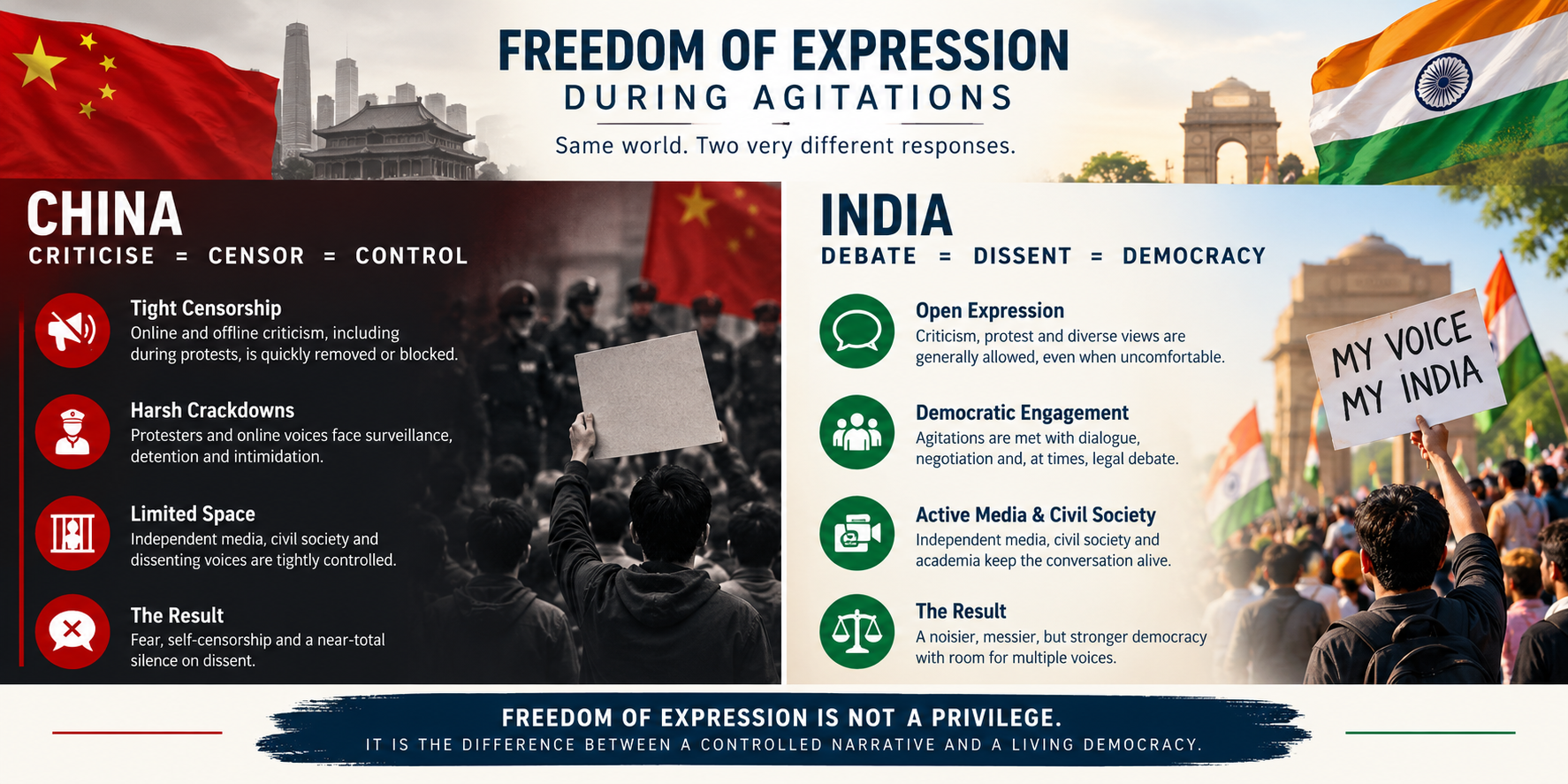
However, another picture is occasionally whispered in these debates. Andrew Higgins, a New York Times correspondent (2026) recently published an article titled ‘Where every tree hides an enemy’. As the title suggests, the Chinese Police have grown bigger, more intrusive and, using omnipresent surveillance cameras, are now monitoring just about everyone in the country. His old friend refused to keep the appointment after Police visited his apartment. Police intercepted Andrew’s message and quickly located his friend. Andrew reports counting 30 CCTV cameras from his hotel to the nearby subway station. The guard snatched his wife’s pen, insisting it contained red ink. Apparently, in 1989, during the Tiananmen Square protests, students hurled red ink at Mao’s portrait. So, red ink pens are now a threat to the government. Andrew wondered, ‘How can it be that a proud, nuclear-armed world power is scared of red ink?
Accordingly, this competition between China and India should not be limited to economics and GDP growth. Human development is about more than providing material goods. All human beings strive for comfort, food, health, housing and education. But they want more than that. They want to engage with others, do as they want, and, most importantly, have the freedom to say what they want. The ability to live one’s life as one wants is a fundamental human right, and everyone desires it.
India’s Civilisational Supremacy
This reminds me of a small episode that I encountered recently. I got into a debate at a China-India seminar where the Chinese Consul from Chicago was also participating. As usual, all the speakers and the Consul spoke glowingly about China’s economic progress. Condescendingly, they all spoke of India’s great potential, but said it would take decades. When it was my turn, I said it would probably take 100 years or more for the two countries to reach the same level. This pleased the Consul, and everyone nodded smilingly. But I added that I meant China would take 100 years to equal India, which raised several eyebrows. I argued that India can reach China’s economic indices in perhaps 2-3 decades, but China will need more than 100 years to achieve even a fraction of the democratic functioning India has attained. Today, China cannot dare to hold even one single free and fair election in the remotest part of the vast country. For the nation and its people to become democratic, people must be able to choose their leaders, think freely, and pursue their interests and vocations. This is inconceivable, for the current Chinese leadership will not relent an inch and let even a professor say something in her class. The communist party stalwarts seek power and do not hesitate to use the most advanced technology to spy upon their people and to suppress them. China may be an economic miracle at present, but in the long-term race, it is far behind India. All societies seek economic development and want their people to live comfortably, with freedom, independence, and the ability to choose. A single factor cannot judge the India-China race.
Jantar Mantar Raises Questions
But this brings me to the current developments going on at Jantar Mantar. The policing of public protests against the Election Commissioner suggests authoritarian tendencies and the denial of citizens’ rights. In the name of maintaining order, hundreds of young people are being arrested and harassed. The right to protest government policies is a fundamental right and cannot be denied. Similarly, the constitution guarantees the right of assembly and freedom of speech. Even if these protests are abusive and mock the rulers, the Police should tolerate them and allow them to express themselves. Of course, protesters and opposition parties also need to accept democratic norms and the value of settling disputes through discussion and negotiation rather than spreading anarchy in the streets.
Kerala Shows the Way
Furthermore, southern states, particularly Kerala, also show that democracy can deliver economic development along with good education, health facilities, and better infrastructure. Sen asserts that democracy has complex demands, and that free and fair elections and the right to vote are indeed important. However, protecting liberties and freedoms, respecting legal entitlements, and guaranteeing free discussion, uncensored news distribution, and fair comment are equally necessary for a democratic country. We must understand that democracy has enabled India to be home to major languages and all religions. India is not only a Hindu-majority region, but also has the world’s third-largest Muslim population. Millions of Christians, Buddhists, Sikhs, Parsees, and Jains live as equal citizens. This vast, diverse country, with thousands of years of civilisation, is held together by its working democracy. When dealing with the protests at Jantar Mantar, Police officers, rulers, and protesters must keep the big picture in mind.
- Amartya Sen. 1999. Democracy as a Universal Value. Journal of Democracy, 10(3): 3-17.
- Andrew Higgins. 2026. Where Every Tree Hides ‘an Enemy’: How I Watched China’s Paranoia Grow, New York Times, dated 11 October.
- Neha Sahay. 2026. Policed Idea, The Telegraph, 26 September.