

The World Has Changed
On 7 April 2026, with the Strait of Hormuz closed and roughly a thousand ships stranded in the Gulf, Bahrain asked the UN Security Council to authorise “all necessary means” to reopen it. Russia and China vetoed the resolution. The world’s busiest oil chokepoint stayed shut for months, and the body charged with international peace could do nothing about it.
That is the world India lives in now. Resolutions are vetoed or ignored, and a determined state with mines, drones and fast boats can hold a global artery hostage. From Panchsheel onward, India’s instinct has been to trust that law and goodwill would carry the day. That instinct is honourable. It is no longer sufficient.
I do not say this to mock our traditions of peace. The Buddha’s teaching travelled out of India by two roads: over the Himalayas to Tibet, carried by teachers such as Padmasambhava and Atisha, and across the sea to Sri Lanka, Myanmar and Southeast Asia, carried by Indian sailors and merchants. Our civilisational reach has always depended on open passes and open sea-lanes alike. Today those sea-lanes are also our lifeline, and they need a navy to keep them open.
Three Chokepoints
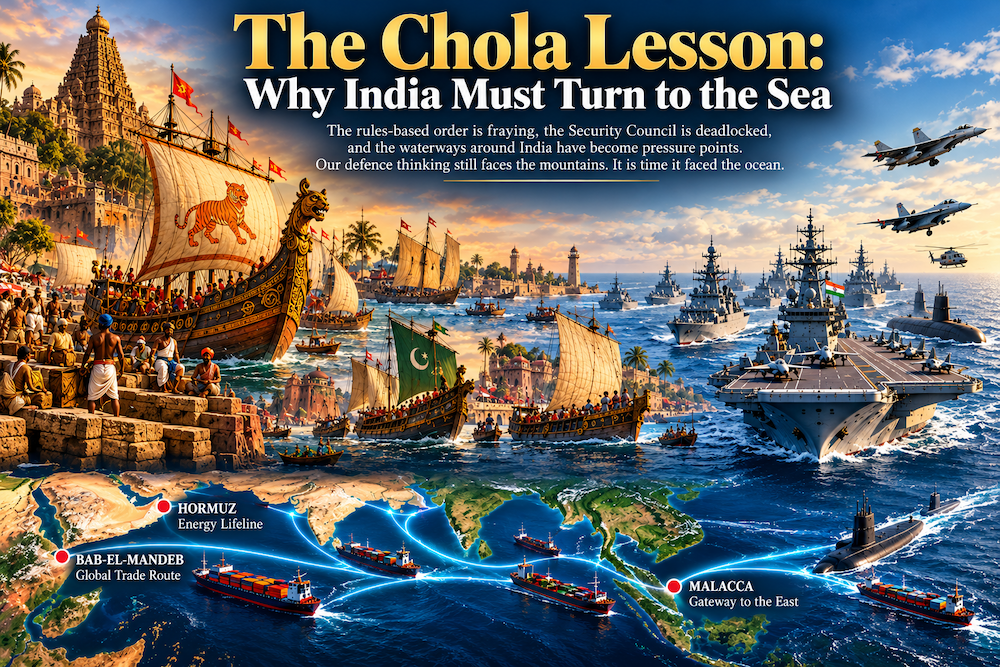
Three narrow waterways decide India’s fortunes. Hormuz, to the west, carries a large share of our crude and gas. This year Iran declared that only ships it approved could pass, and the International Maritime Organisation confirmed 46 attacks on shipping by mid-June. India coped through nimble procurement: by March, about 70 per cent of our crude imports were coming from outside the strait. It was also a warning.
Bab-el-Mandeb, at the mouth of the Red Sea, has been under Houthi fire since late 2023, and every Indian tanker using the Suez route now prices that risk in. Malacca, to the east, is China’s own nightmare, the “Malacca dilemma” Beijing has worried over for two decades. The Andaman and Nicobar Islands, home to India’s only tri-service command, overlook its western mouth. That is a geographic gift no amount of money could buy.
Whoever can keep a waterway open, or close it, holds a lever over every economy that depends on it.
“For whosoever commands the sea commands the trade; whosoever commands the trade of the world commands the riches of the world, and consequently the world itself.”
-Sir Walter Raleigh

The String Around Our Neck
China understood this long before we did. In 2017, Sri Lanka handed a Chinese company the Hambantota port on a 99-year lease. China has a military base in Djibouti, runs Gwadar in Pakistan, is building a port at Kyaukphyu in Myanmar, and helped Bangladesh build its submarine base at Pekua. Chinese “research” vessels, which also map the seabed for submarines, regularly call at Colombo and Male. The Maldives, which asked Indian military personnel to leave in 2024 before relations thawed, showed how quickly ground can shift.
India has begun to respond, with the airstrip on Mauritius’s Agalega island, INS Jatayu at Minicoy, the Great Nicobar project, and INS Varsha near Visakhapatnam for nuclear submarines. These are the right moves. They are not yet enough.
What the Cholas Knew
In 1025, Rajendra Chola sent a fleet across the Bay of Bengal to strike the Srivijaya kingdom, which controlled the Malacca straits and was squeezing Chola trade. It worked, and for a century Tamil merchant guilds traded freely across Southeast Asia. Before the Cholas, Chera ports traded with Rome. After them, the Kunjali Marakkars fought the Portuguese, and Kanhoji Angre’s Maratha fleet held the Konkan coast.
The continental empires forgot this. As I wrote recently in these pages, Aurangzeb’s Mughal Empire humbled the East India Company in 1690. But look at how that war was won. In Bengal, the Mughal army drove the Company out, while on the western coast the Company’s ships seized Mughal vessels, including pilgrim ships, and the emperor’s land forces could do nothing. The war turned only in 1689, when Sidi Yakut Khan’s fleet from Janjira besieged the English in Bombay until they sued for peace. Even at its height, the empire needed a navy to win, and it had to borrow one because it had never built its own. Within a century, the Company, which ruled the waves, ruled India.
The View from Delhi
Part of the reason lies in where India has been ruled from. For most of the last eight centuries, power has sat in Delhi, nearly a thousand kilometres from the sea. Even the British, who ruled from Calcutta until 1911, eventually moved to New Delhi. Delhi’s rulers looked north-west, towards the Khyber and the Hindu Kush, because that was the road every invader had taken, from Mahmud of Ghazni to Ahmad Shah Abdali and in 1327 Muhammad bin Tughlaq even moved his capital to Devagiri, renamed Daulatabad, partly, as Ibn Battuta recorded, to escape the Mongol raids. He returned to Delhi by 1335, but the instinct that danger comes over the mountains stayed with the Indian state.
The map tells a different story today. Remeasured in 2025, India’s coastline is about 11,098 km, close to three-quarters the length of our 15,106 km land border, with more than 1,300 islands besides. Yet the Navy receives about 11 per cent of the service’s running budget, compared with the Army’s 71 per cent. The land borders are contested, but the sea is not, for now. But the gap between the size of the sea frontier and the attention we give it is too wide to ignore.
Where We Stand
Signs of a Paradigm Shift
During Operation Sindoor in May 2025, the Navy’s carrier groups went to sea within days of Pahalgam, and its Director General of Naval Operations said they kept Pakistan’s navy in harbour or close to its coast, with Karachi within range. In 1971 the Navy had to sail into Karachi to make the point. In 2025, its presence alone made it.
The outgoing Chief of the Air Staff, Air Chief Marshal A.P. Singh, who retires on 31 October, has shown what candour from the top looks like, publicly criticising HAL over delayed Tejas deliveries and setting out the IAF’s claims of Pakistani aircraft downed during Sindoor, which Pakistan denies. And the Rafales are coming: 26 Rafale M carrier fighters for the Navy from 2029, and 114 Rafales for the Air Force cleared in February 2026. Carrier aircraft without enough carriers are only half a capability.
The Channel We Never Dug
A ship going from Chennai to Kochi still has to sail around Sri Lanka, because the Palk Strait and the shoals of Adam’s Bridge are too shallow to cross. The Sethusamudram Shipping Canal Project, approved in 2005 at ₹2,427 crore, would have saved up to 424 nautical miles and about 36 hours. Dredging stopped in 2007 when the Supreme Court stayed work in the Ram Setu area, and the project has lain in limbo ever since, with more than ₹800 crore spent.
I revere Lord Rama as millions of Indians do. But local legend holds that Lord Rama himself broke the setu with the tip of his bow, which is how Dhanushkodi got its name. The defence of the realm came first. A nation that saw the Ram Mandir rise at Ayodhya after a quincentennial wait can honour Lord Rama’s memory and still take a hard decision in the national interest.
When Egypt’s Aswan High Dam threatened the temples of Abu Simbel, Egypt did not abandon the dam. Between 1964 and 1968, with UNESCO’s help, engineers cut the temples into more than a thousand blocks and rebuilt them on higher ground. Faith and engineering can live together when a nation plans with care. The ecological concerns over the Gulf of Mannar deserve an answer through an alignment that spares the setu and a joint assessment with Sri Lanka. What India cannot afford is another twenty years of litigation, including Dr Subramanian Swamy’s petition for national monument status for Ram Setu, on which the Supreme Court issued notice in August 2025.
There is a bolder answer still: build Lord Rama’s bridge again, in steel and concrete. A road-and-rail link from Dhanushkodi to Talaimannar, with a navigation span high enough for the largest ships to pass beneath, would join two economies and two coasts. The new Pamban rail bridge, opened in April 2025 with India’s first vertical-lift span, shows we can build in these waters. Colombo said in 2025 it was “not yet ready,” but a 2026 Sri Lankan study found that cargo could cross by land in about nine hours, against 40 to 122 hours by sea. A modern Ram Setu would honour the old one better than a half-dug channel.
What We Must Now Do
- Decide on the third carrier. With two, one is usually in refit. The decision has waited long enough.
- Build the nuclear attack submarines. Two were cleared in October 2024, with six planned. They should be accelerated, not merely funded.
-
Turn the islands into bases. The Andamans and Lakshadweep are our unsinkable carriers and need runways, fuel and surveillance to match.
-
Fix shipbuilding. Our public yards are stretched, and private yards need steady orders to grow.
-
See the whole ocean. Patrol aircraft, drones and satellites should feed one picture of every ship in the Indian Ocean, shared with friendly navies through the Gurugram fusion centre.
-
Protect the merchant lifeline. A navy that escorts tankers needs Indian-flagged tankers to escort. The government has begun aggregating demand from its oil companies to support Indian shipping lines, and that effort should become a national priority.
-
Keep the neighbours close. India must offer Sri Lanka, the Maldives, Mauritius, Myanmar and Bangladesh better terms than China does, and a navy that arrives first after every cyclone.
-
Deter Pakistan at sea. Sindoor showed that a forward naval posture can bottle up Pakistan’s navy without a shot. That deterrent should stay sharp.