

Operational Shift: Moving from Command-and-Control to Modern De-escalation
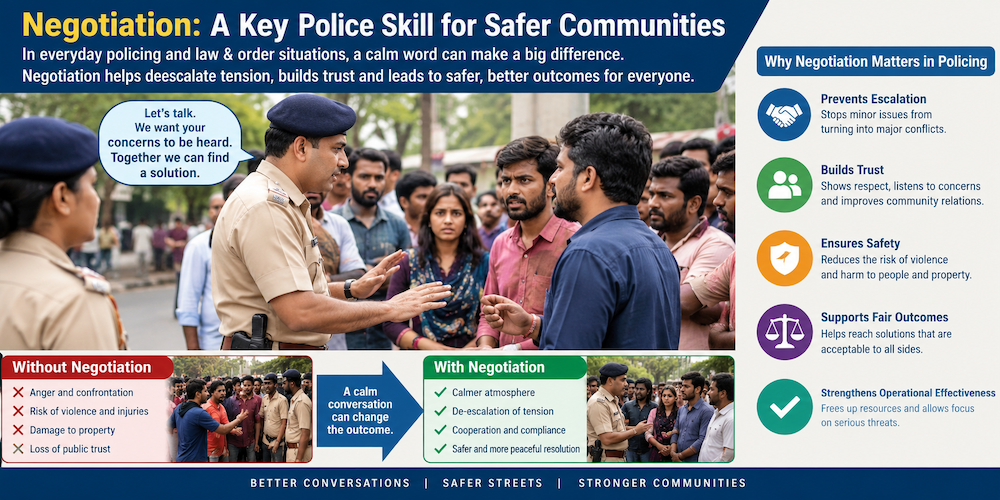
This article argues for a change in emphasis. Treat negotiation as a core policing skill. It should be taught, practised, assessed and rewarded. It should be a first line of defence, not a last resort after force fails.
For decades, traditional policing in India has heavily relied on a rigid “command-and-control” methodology. Under this legacy framework, Police authority is projected through immediate submission, physical dominance, and the overt display of force. While this heavy-handed approach may offer a temporary illusion of control during routine crowd management, it frequently backfires in modern, high-voltage crises. In situations involving deeply agitated individuals, mental health emergencies, or barricaded suspects, an immediate resort to aggressive commands often escalates public hostility and triggers panic. When an officer’s only tools are compliance or coercion, the situation rapidly deteriorates into violence. This systemic reliance on force not only places the lives of citizens at risk but also unnecessarily endangers the first responders who find themselves on the immediate frontlines of an unpredictable confrontation.
Consequently, modern law enforcement requires a fundamental paradigm shift that repositions negotiation as a primary tactical asset. Transitioning to a model of strategic de-escalation does not mean retreating or compromising Police authority; rather, it represents a sophisticated evolution in field tactics. By prioritising active listening, emotional regulation, and structured dialogue, officers can lower a conflict’s psychological temperature before it reaches a point of no return. This approach turns communication into a proactive shield, allowing first responders to gather vital field intelligence, create a tactical pause, and systematically defuse threats without firing a single shot. Institutionalising this shift ensures Indian Police personnel are no longer just enforcers of order, but highly skilled crisis managers who can preserve human life while decisively maintaining the rule of law.
What We Mean by Negotiation
First, negotiation is not appeasement. An officer who negotiates still arrests when the law requires an arrest. He gets there without a fight.
Second, negotiation is not only for hostage cases. Crisis negotiation is one end of a wide spectrum. At the other end sit ordinary exchanges. A traffic stop. A neighbour dispute. A domestic call. A protest permission. A family at a Police station with a missing child.
Where the Idea Comes From
Modern crisis negotiation has a clear history. It grew out of failure. After the 1971 Attica prison uprising, which was a violent rebellion at the Attica Correctional Facility in New York, the New York Police Department (NYPD) established the world’s first formal Hostage Negotiation Team in 1973. Detective Harvey Schlossberg, a clinical psychologist, and Lieutenant Frank Bolz pioneered this initiative, developing a psychology-based model focused on de-escalation and dialogue rather than tactical force. The FBI later developed its own crisis negotiation programme. The central lesson was simple. Time is a tool. Patience saves lives. Most tense standoffs end without violence when trained people talk.
A second body of work comes from academic negotiation theory. The 1981 book Getting to Yes by Roger Fisher and William Ury popularised “principled negotiation”. It stresses interests over positions. It stresses separating people from problems. Later writers such as Chris Voss, a former FBI lead international kidnapping negotiator who brought high-stakes negotiation tactics to a wider audience through his bestselling book, Never Split the Difference: Negotiating As If Your Life Depended on It, co-authored with Tahl Raz.
A third strand comes from legitimacy research. Tom R. Tyler and colleagues have established that procedural justice—the perception that legal authorities act fairly, neutrally, and with respect—is a primary driver of legal compliance and legitimacy. The finding is consistent. People obey the law more willingly when they feel they were treated fairly and heard. This holds even when the outcome goes against them. All three strands point the same way. How Police speak shapes how citizens respond.
The Indian Context
Indian policing operates under a quasi-federal structure where state forces handle local law and order, while the Indian Police Service (IPS) provides senior leadership. The system faces critical challenges including political interference, severe staff shortages (137 personnel per lakh in 2016; however, the Bureau of Police Research and Development (BPR&D) and the India Justice Report indicate that India’s actual police-to-population ratio has incrementally improved to roughly 152 to 155 actual personnel per lakh, below the UN standard of 222), and a persistent trust deficit due to historical colonial legacies. Transforming the force into a citizen-centric institution requires modernising infrastructure, enhancing forensic capabilities, and implementing robust accountability mechanisms.
Police is a State subject. Under the Constitution’s Seventh Schedule, Police falls in the State List. There are 28 State forces, plus Union Territory forces and central armed Police forces. A single national curriculum is therefore hard to impose. Reform has to work through State Police academies and State governments.
The ratio is stretched. With an acute staff shortage, Officers often handle heavy caseloads. They work long hours. Fatigue and stress make short tempers more likely. Any negotiation framework must be light enough to survive a thin, tired force.
Crowds are common. Festivals, processions, rallies, agitations, and caste or community tensions are routine. Public order is a daily business. Large crowds are often negotiated with, whether the Police admit it or not. Senior officers have long held informal talks with community leaders, elders and organisers. The practice exists. The institution does not.
Trust is uneven. Many citizens fear the Police. Some fear the station more than the crime. Reports from civil society and the National Human Rights Commission have repeatedly raised concerns about custodial violence. Public surveys on Police trust show wide gaps across States and communities. A culture of talking first can help rebuild confidence.
Courts have set limits. The Supreme Court has laid down binding guidance on arrest and custody. Under the Bharatiya Nagarik Suraksha Sanhita, 2023, which replaced the Code of Criminal Procedure from 1 July 2024, the arrest framework continues to stress necessity and procedure. A Police culture that resolves matters through communication fits these legal expectations.
Language and culture matter. An officer posted in a new district may not speak the local dialect. Gestures, honorifics and local customs vary sharply. Negotiation here means cultural literacy as much as technique.
Why Force Is Not Always the Answer
Force has a place. Some situations demand it at once, such as an armed attacker or an imminent threat to life. No negotiation framework denies this. But force has costs. It escalates. A show of force can harden a crowd, and humiliated people rarely back down. It also creates evidence problems. Cases built on coerced statements collapse in court. It brings legal exposure too. Officers face inquiries, suspensions and prosecutions, and careers can end over a single bad hour.
Force also damages legitimacy. Every incident of excess becomes a story. Phones record, social media spreads, and one clip can undo years of community work. It also endangers officers, since escalating situations injure Police as much as citizens. Negotiation does not remove these risks. It lowers them. Even a partial reduction in confrontations matters across thousands of daily interactions. For a force that deals with the public every hour, that reduction is not a minor gain. It is a real measure of safety, trust and professional strength.
A Practical Framework for Indian Police
The practical framework for negotiations has five layers: Prepare, Contact, Listen, Propose and Close. Good negotiation starts before the conversation. Officers should read the situation. Who is present? Who leads? What do they want? They should also know their own limits. What can be offered lawfully, and what needs a senior’s approval? A calm body matters too. Slow breathing, a steady voice and an open posture set the tone. Contact then begins in the first thirty seconds. The officer should identify himself, use respectful address and state his purpose. One clear voice should lead, because several officers shouting at once confuse everyone.
Distance and position matter, too, since an officer who crowds a person invites a reaction. Listening is the heart of the skill, and it is the weakest part of most training. The officer should pause and let the person finish. He should paraphrase what he heard, name the emotion, and ask open questions such as, “What do you need us to do first?” None of this concedes the point. It shows the person he has been heard, and an angry person who feels heard often lowers his voice within minutes. Listening also yields intelligence. Officers learn who is driving the anger, and the stated demand is often not the real one.
Once emotions settle, the officer can move to options. He should offer only what he can deliver. That may be a registered FIR, a named officer to follow up, a time to meet with a senior, a medical examination, or a written acknowledgement. He should never promise what he cannot do. A broken promise destroys trust faster than a refusal. It is better to say, “I cannot do that, but here is what I can do.” Where possible, he should also give people a face-saving way out. Crowds don’t retreat if retreat looks like defeat, and a small, visible gain helps them step back.
Every negotiation needs a proper ending. The officer should confirm what has been agreed and repeat it clearly. He should record it and follow up. Follow-up is where most efforts fail. A promise made at the roadside must reach the station diary, and someone must own it. If nothing happens, the next crowd will remember. This final step turns a single calm exchange into lasting credibility. Over time, a station that keeps its word earns a reputation that no training module can create. Citizens approach the Police earlier, raising concerns before tensions harden into confrontation. That is the real return on a well-closed negotiation.
Negotiation at Different Levels
The same logic applies at every scale, but the tools differ. For the beat constable, negotiation means everyday conversations, like calming a shouting match or settling a petty dispute. Training should be short and practical, built around a few useful phrases and the habit of pausing. The Station House Officer sits at the junction of law and community. He can mediate disputes and guide parties toward lawful resolution, but he must not become an informal judge. District leadership should open channels with unions, associations, and community leaders before a protest becomes a crisis. At the top, crisis negotiators handle hostage cases, barricaded suspects and suicide attempts. Such trained teams exist in parts of the country, but coverage across States remains patchy.
Special Situations Deserving Attention
Some situations need extra care. Police often meet people in acute distress, such as a man threatening to jump or a woman in a severe mental health episode. Force here can be fatal, so slow, calm speech and a few crisis-communication skills matter. In domestic disputes, officers must balance safety with sensitivity. Where violence exists, the law must take its course, and negotiation must never push a victim back into danger. In protests, early contact with organisers, clear ground rules and named contact officers keep small incidents from spiralling. Children, the elderly, persons with disabilities and marginalised groups also need adapted communication. An officer who speaks to a frightened child like a suspect has already failed.
Making It Stick: Systems, Objections and Limits
Skills do not spread through speeches. They spread through systems. Negotiation should be part of basic training at every Police academy, not only in specialist cells. Every first responder needs basic negotiation literacy. Training should use role-play, local scenarios and refresher modules, with trainers trained first. Active listening and empathy are simple enough to scale across the force. States should issue short field guides in regional languages that set clear triggers for de-escalation, calling a senior, and using force. Each State should also build at least one trained crisis negotiation team, chosen for temperament rather than rank. Appraisals should reward peaceful resolution, and every major event should end with a debrief.
Words are defensive gear. A calm voice protects officers as much as any helmet. The tactical pause buys time, and time lets tempers cool and backup arrive. Talking doesn’t weaken authority; a calm officer with clear instructions earns respect. It also saves time, since a ten-minute standoff beats a ten-hour riot. Training teaches officers to hold firm lines and detect manipulation. The practice is old, as panchayats and village elders have long resolved disputes through dialogue. Pilot programmes should track incidents resolved without force, complaints, injuries and citizen satisfaction. Officers also need counselling and reasonable duty hours. Negotiation is not a cure-all. It will not fix understaffing, political interference or corruption. The aim is a wider toolkit, not a weaker Police.
The Road Ahead
India’s Police face rising expectations. Citizens are more aware, cameras are everywhere, and courts are watchful. A force that relies only on badge and gun will struggle in this setting. A force that can also listen, explain and persuade will use less force, win more trust and lose fewer officers to injury and inquiry. The path is not easy. Thanas are short-staffed, dialects differ, and distrust runs deep. Yet professional excellence should not be measured by toughness alone. Return to the constable at the crossing. With even two days of good training, he knows how to pause, approach the elder and promise only what he can deliver. Over time, fewer complaints and stronger community trust will show that it works. The same is true of institutionalising negotiation. It asks Police to be effective, not gentle. The badge gives authority, and the gun gives force. Negotiation gives consent.