

Introduction
This deceptively simple proposition encapsulates one of the enduring dilemmas of democratic governance: how does the State preserve public order without undermining the very freedoms that confer legitimacy upon it? The State is entrusted with maintaining peace, preventing crime, protecting life and property, and enabling citizens to go about their daily lives without fear. Without order, liberty itself becomes vulnerable. The freedom of the strong can become the oppression of the weak, while one individual’s liberty may threaten another’s rights.
Yet an equally compelling truth remains: order is a means; liberty is one of the ends.
A State that maintains peace by silencing dissent, suppressing peaceful protests, intimidating critics or exercising coercive power indiscriminately may achieve outward tranquillity, but risks sacrificing the democratic spirit that order is meant to protect. The distinction, therefore, is not between order and disorder, but between order maintained under the rule of law and order imposed through the unchecked exercise of authority.
The Legitimacy of Order
Order is essential, but it cannot become an excuse for authoritarianism. No democracy can function without an effective Police force, an impartial administration, and consistently enforced laws. The State must act firmly against violence, arson, rioting and the deliberate intimidation of citizens. The right to protest cannot become a licence to destroy public property or endanger human life.
However, the inconvenience caused by dissent does not, by itself, make dissent unlawful. A peaceful demonstration may disrupt traffic, disrupt neighbourhood business, challenge the government, or expose administrative failures. These are not sufficient grounds, in themselves, for suppressing it.
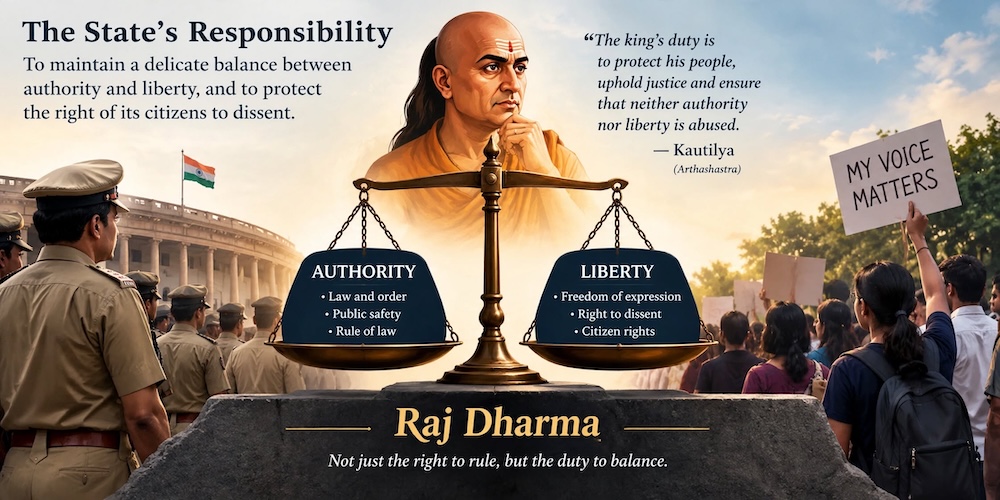
The ancient Indian conception of Raj Dharma offers a timeless moral compass for the exercise of State authority. Kautilya, in the Arthaśāstra, expresses this principle in the following verse:
प्रजासुखे सुखं राज्ञः प्रजानां च हिते हितम्।
नात्मप्रियं हितं राज्ञः प्रजानां तु प्रियं हितम्॥
Kautilya reminds the ruler that the people’s happiness and welfare must take precedence over personal preferences. In the context of public order, this principle is especially significant. The State has a duty to preserve peace, prevent violence, and protect citizens’ rights; however, its authority cannot become an instrument for extinguishing the liberties it exists to safeguard.
Public figures have invoked the idea of Raj Dharma in different contexts, but its meaning should not be reduced to any one political interpretation. Properly understood, it is a general ethical principle: political power must ultimately be judged by its fidelity to the people’s welfare, dignity, and equal protection.
The real test of democracy is not how a government treats those who agree with it, but how it exercises power when confronted by those who disagree. The State must distinguish between dissent and disobedience, peaceful assembly and violent mobilisation, and criticism of authority and an actionable threat to public safety. When these distinctions are blurred, the preservation of order can become a pretext for curtailing liberty.
The Importance of Liberty
Liberty is not a concession granted by the State. In a constitutional democracy, fundamental rights are not favours bestowed by the government; they are constitutional guarantees that constrain the exercise of governmental power.
In India, Article 19 protects specified freedoms, including speech and expression, peaceful assembly and association, subject to constitutionally permitted restrictions. Article 21 protects life and personal liberty, and the State may deprive them only in accordance with constitutionally valid legal procedure. These rights are not absolute. The State may impose lawful and proportionate restrictions to address legitimate threats to public order and other constitutionally recognised interests. But the existence of a power to restrict liberty does not automatically justify its exercise.
The question is not merely whether the State has the power to act, but whether its action is lawful, necessary, proportionate and accountable. Restrictions imposed by invoking the spectre of anarchy, unsubstantiated national-security concerns, or the need to preserve public order may question the State’s accountability. The Constitution is supreme precisely because it establishes checks and balances against the exercise of untrammelled power.
The Role of the Police
The Police stand at the intersection of order and liberty. This is where the principle acquires particular significance for professional policing. Police officers must often make difficult decisions under intense pressure: a volatile crowd, an inflammatory rumour, a political demonstration, a communal confrontation or the possibility of violence spreading rapidly. In such circumstances, indecision can have serious consequences.
But firmness and restraint are not contradictory virtues. Indeed, the highest form of professional policing lies in the ability to combine the two.
A mature Police force should distinguish peaceful demonstrators from violent elements rather than treating an entire assembly as hostile; use only the minimum force reasonably necessary to address the actual threat; and escalate its response only when circumstances justify it.
Reports and public perceptions concerning Police action during a protest in Delhi, including an attempted march to Parliament by a group identified in some accounts as the CJP, illustrate why allegations of excessive force should be assessed through verified records, independent inquiries and due process rather than conclusively characterised in advance. If an operation involved disproportionate force, the appropriate response should include accountability and institutional review. If an immediate and documented threat legally justified the action, that context should also be examined fairly.
The broader lesson is the importance of sound intelligence, advance assessment and professional judgement. Rather than acting on rumours or vague presumptions, the Police must gather reliable, real-time intelligence and assess the situation before resorting to coercive measures that may raise public concern.
Equally important is the capacity for negotiation. Maintaining public order is not merely about enforcing the law; it requires judgement, restraint, impartiality, and an understanding of human behaviour.
Dialogue, patience and persuasion can often help defuse seemingly intractable situations. Negotiation works best when it begins before positions harden and confrontation becomes inevitable.
During student protests or other periods of unrest, authorities may face competing interpretations of a movement’s causes and organisation. Claims that a protest is being directed by an alleged “deep state” or is part of a foreign-inspired effort to bring about political change should not be treated as established facts without credible, publicly verifiable evidence. Comparisons with political developments in Bangladesh or elsewhere may provide context, but they should not replace a careful assessment of the specific facts, grievances and risks in India.
The lesson is clear: when authority replaces evidence and dialogue with speculation, it risks turning a manageable protest into a larger confrontation. Institutionalising negotiation skills in everyday policing is therefore essential to building a more humane, intelligent, and effective Police force.
The Police must also ensure impartial enforcement, without allowing political affiliation, social identity or criticism of the government to determine how citizens are treated. Their credibility depends on a willingness to accept accountability through proper documentation, independent scrutiny and investigation of credible allegations of misconduct.
The objective should not be to demonstrate the superiority of the State’s coercive power, but to restore normalcy while preserving citizens’ dignity and rights. There will, of course, be situations in which force is unavoidable. Restraint does not mean helplessness, just as firmness does not mean brutality. The professional obligation is to ensure that every response is calibrated to the threat and remains within the law.
A Police force that is feared may secure temporary compliance; one perceived as fair, competent, and restrained is better placed to command lasting public trust.
Silence Does Not Always Mean Peace
It is easy to confuse silence with peace. An absence of visible protest does not necessarily indicate public satisfaction. The illusion that “all is well” may reflect genuine confidence in the administration, but it may equally reflect fear, resignation or the belief that speaking out carries unacceptable risks. A democracy needs more than the absence of disorder. It needs institutions through which grievances can be expressed, examined and addressed.
A peaceful protest, a free press, an independent judiciary and a functioning opposition are not necessarily obstacles to good governance. They can serve as early-warning mechanisms, exposing injustice, correcting administrative excesses and preventing discontent from escalating.
Suppressing every visible expression of dissatisfaction may conceal a problem without resolving it. A government that listens to criticism may discover the causes of unrest; one that merely suppresses criticism may discover them only when unrest erupts and becomes difficult to control.
This is not an argument for tolerating violence or abandoning law enforcement. It is an argument for recognising that durable public order depends upon legitimate channels for dissent and redressal.
The Supremacy of the Constitution
Governments today, regardless of political colour or ideology, must not lose sight of a time-tested constitutional principle: law must restrain power. India’s constitutional framework seeks to balance public order and individual freedom, rather than treat either as an unconditional overriding consideration.
In Maneka Gandhi v. Union of India (1978), the Supreme Court significantly developed the interpretation of personal liberty under Article 21, emphasising that the procedure depriving a person of liberty must meet constitutional standards of fairness, reasonableness and non-arbitrariness.
Similarly, in Anuradha Bhasin v. Union of India (2020), the Court examined restrictions on internet access in the context of fundamental rights and held, among other things, that such restrictions must satisfy requirements of legality, necessity and proportionality, with the relevant orders subject to review.
These judgments reinforce a broader constitutional philosophy: the State is not above the law merely because it enforces it. The power to maintain order must itself be exercised in an orderly, lawful and accountable manner.
The Ultimate Philosophical Distinction
A State that protects citizens so they may exercise their freedoms differs profoundly from one that restricts their freedoms so it may govern more easily. The first understands authority as a public trust. The second risks treating citizens as subjects—or, worse still, as vassals whose principal duty is obedience.
A constitutional democracy cannot dispense with authority, discipline or enforcement. Nor can it let these instruments become ends in themselves. Its strength lies in its ability to enforce the law without placing enforcement agencies beyond the law.
The balance will never be effortless. During a riot, the immediate priority may be protecting life. During a peaceful demonstration, the presumption should favour the exercise of constitutional freedoms, subject to lawful restrictions. Different circumstances demand different responses, but the governing principles remain constant: legality, necessity, proportionality, impartiality and accountability.
The true measure of the State’s strength is not how effectively it can compel obedience, but how faithfully it exercises power within constitutional limits.
Order without liberty can degenerate into authoritarian control. Liberty without a framework of law can become vulnerable to violence and domination. A constitutional democracy must protect both, recognising that neither can remain secure indefinitely if the other is destroyed.
The central theme finds an enduring ethical expression in Kautilya’s verse on Raj Dharma, quoted earlier. It implies that State authority is a trust to be exercised for the people’s welfare, not a privilege to be exercised at their expense. The verse does not explicitly formulate the modern doctrine of civil liberties; rather, it supplies an enduring ethical foundation for responsible governance.
Good governance must therefore bring together constitutional philosophy, democratic accountability, and the ethics of policing—three deeply interconnected dimensions of public life. Applied to public order and civil liberty, this principle has three important consequences:
- Order is necessary, but it is not an end in itself. Its purpose is to protect citizens and enable them to live in security and freedom.
- Authority must be exercised with restraint. The power to regulate a protest does not automatically justify suppressing peaceful dissent.
- The welfare of citizens must remain the ultimate test. The State must distinguish between the legitimate exercise of liberty and conduct that threatens public safety.
I may conclude that the State must be strong enough to preserve order, yet restrained enough to respect liberty. When preserving order becomes an excuse to destroy freedom, the State may retain its authority, but it begins to lose its moral legitimacy.