

NON-VIOLENCE | NON-EXPLOITATION | HUMAN DIGNITY | RESPECT FOR DIVERSITY | SHARED RESPONSIBILITY FOR RESOURCES | DIALOGUE OVER DESTRUCTION
When Multilateralism Becomes a Victim of Geopolitics
Yet, after more than eight decades, we have to ask a difficult question: why has the multilateral system repeatedly failed when the world needed it most?
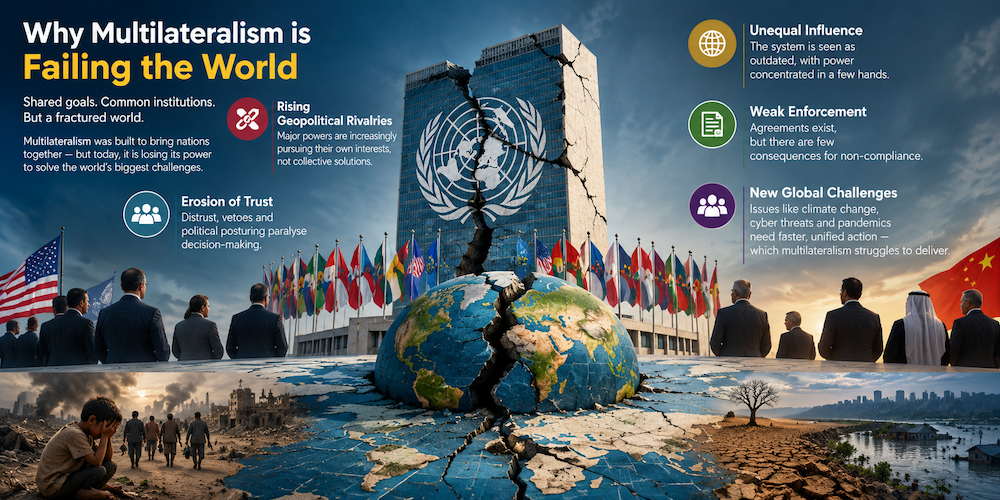
The answer lies partly in its structure. The Security Council was designed in the political circumstances of 1945. Five countries were given permanent membership and the power to veto substantive decisions. This arrangement was intended to bring the major powers into the system and make collective security possible. In practice, however, it has also created a situation in which the same powers that have extraordinary responsibility for maintaining international peace can prevent collective action when their own strategic interests, or those of their allies, are involved.
This is one of the fundamental contradictions at the heart of present-day multilateralism. A small country facing conflict therefore does not enter the international system with the same practical ability to influence the response as a major power. The principle of equality exists in the Charter, but power remains unequal.
The consequences have been visible repeatedly. In recent times, the Council was unable to adopt a resolution on Russia’s invasion of Ukraine in February 2022. The same structural problem has appeared in the Middle East, where divisions among permanent members have repeatedly prevented a unified response to the continuing conflict and humanitarian crisis. The point is not to place responsibility on one country alone. The deeper problem is that when a major power is itself a party to a conflict, or has vital strategic interests in it, the multilateral system can struggle to act against the conflict with the speed and authority that its purpose demands.
The same problem is now extending beyond military conflicts. Economic power, energy supplies, trade routes, technology, finance and access to critical resources are increasingly part of geopolitical competition. The United States, China, Russia and other major powers naturally pursue their national interests, as all states do. But when economic and technological strength becomes a means of coercion, pressure, or strategic dependence, the principle of multilateral cooperation weakens. Smaller and developing countries can find themselves caught between competing power centres, while their ability to protect their own economic and strategic interests becomes increasingly limited.
The danger is that this behaviour can become a precedent. If powerful countries can use military strength, economic influence, technology, energy, food, water, trade, or critical minerals to secure geopolitical advantage, other countries will eventually seek to do the same.
The consequences are already visible. UCDP recorded 65 conflicts involving at least one state in 2025, the highest number in its records since 1946, with 13 reaching the level of war. It also recorded approximately 244,600 deaths from organised violence during the year.
This is why the question is no longer simply whether the United Nations needs reform. The deeper question is what multilateralism should mean in the twenty-first century.
Multilateralism cannot become an arrangement in which the strongest countries negotiate among themselves, and the rest of the world is expected to adjust. It cannot mean that international principles are applied strongly when they serve one geopolitical interest and cautiously when they challenge another. It cannot allow resources essential for human survival to become instruments of blackmail. And it cannot allow the language of geopolitics to become a justification for violence, exploitation or the destruction of civilian life.
Multilateralism must return to that foundation. It needs a universally understood set of cardinal principles that apply to every international engagement, whether bilateral, regional or global.
Short-Term Interest Cannot Define Humanity’s Future
The permanent interest of humanity is peace. It cannot be one country’s short-term interest to become stronger by weakening another.
We have heard arguments that allowing one country to become economically powerful was a mistake and that the same mistake should not be repeated with another country. Such thinking itself shows how far we have moved from the spirit of multilateralism.
If economic development is good for one country, why should another country be prevented from achieving the same prosperity?
The same principle applies to resources.
Otherwise, what are we teaching the world?
Are we teaching every country to become selfish? Are we teaching that whatever resources a country possesses can be used to force others to agree to its terms? Are we teaching our children that bombing, destroying and blackmailing are legitimate ways of making another country accept our conditions?
After centuries of human wisdom, is this really the conclusion we have reached?
Five Principles of Meaningful Multilateralism
Multilateralism needs clearly defined principles which should become the basis of international engagement and international law.
First, we must define humanity’s permanent interest.
Second, every international law and agreement must remain consistent with basic human values.
Third, every human being’s existence and survival must be respected equally.
Fourth, resources essential for human existence must not become weapons of political supremacy.
Fifth, nations must respect each other’s religious, cultural and traditional practices.
Bilateral Agreements Within the Larger Framework
Multilateralism is not against bilateral agreements. Bilateral and regional arrangements will always have an important place in international relations.
But the larger multilateral principles must remain above them.
If a bilateral agreement violates fundamental principles of multilateralism, it should not automatically acquire legitimacy simply because two countries have agreed to it.
This becomes particularly important for smaller and poorer countries. Countries without large resources often have little say in how they will survive and serve their own people.
If one country gains control of a resource essential to another country’s survival, that resource can become a tool of blackmail.
Once one basic rule is broken, other rules become easier to break. Trust disappears, and every disagreement becomes another opportunity for geopolitical competition.
This is how differences become disputes, disputes become conflicts, and conflicts become wars.
Violence Cannot Have Two Definitions
The greatest weakness of the present international system is the double standard applied to violence. My violence is justified, but your violence is unacceptable. My use of force is necessary, but your use of force is aggression. If violence is wrong when used by one country, it cannot become right simply because another country uses it for a different political objective.
When children are killed in one part of the world, it cannot make less noise because they belong to a different nationality or community. Human suffering cannot be measured according to geopolitical convenience.
Non-violence must therefore stand at the centre of meaningful multilateralism. Those who use violence, terrorism or deliberate destruction as instruments of policy should not be allowed to make international engagement merely another platform for political justification.
When conflict begins, the international community should stop it before it becomes a catastrophe. The collective strength of countries committed to multilateralism should be used for dialogue, mediation, humanitarian protection and, where international law permits, collective action to prevent further violence.
Resources Must Become a Common Responsibility
The world must also rethink how it treats the resources humanity depends on. Water, food, energy and a stable climate cannot be treated simply as instruments of national power. They are conditions for human existence.
This is where the ancient Indian idea of Vasudhaiva Kutumbakam, the world as one family, becomes relevant. Its message is simple and powerful: humanity cannot ultimately be divided into isolated interests. If something is unacceptable when done to us, we should not do it to others. If something benefits our people, we should also ask whether it can contribute to humanity’s well-being.
This does not mean abandoning national interest. It means understanding national interest within humanity’s larger interest.
Cutting the Roots of the Tree on Which We Sit
The world is currently cutting the roots of the very tree on which humanity is standing. We are exhausting natural resources, destroying the environment, converting differences into disputes and disputes into geopolitical contests. If this continues, the result will be a world of hunger, displacement, environmental destruction and endless conflict.
Those who think the fire is far away should remember that fire eventually reaches the doorstep. Recent conflict data for 2025 shows 65 conflicts involving at least one state. The number itself should make us question where our present system is taking humanity.
Tomorrow there could be more.
The question is not whether multilateralism is necessary. It is the only viable framework for an interconnected world. The question is whether we have the wisdom to make it work.
World Needs to Get Its Act Together
World leaders need to come together and clearly define the cardinal principles of multilateralism. Non-violence. Non-exploitation. Respect for human dignity. Respect for cultural and religious diversity. Responsible and equitable use of resources—dialogue instead of destruction.
These principles must apply to every international engagement, whether bilateral, regional or global. The world cannot continue saying that the rules apply to others but not to us.
If multilateralism is to survive, it must become stronger than geopolitics, stronger than short-term political calculations and stronger than the temptation to use economic or military power against others.
The permanent interest of humanity is peace. That must become the permanent foundation of multilateralism. Otherwise, we are not protecting the world for the next generation. We are preparing a world in which the fire of one conflict will eventually reach everyone’s door.