


Introduction
A Tweet in September, a Podium in October
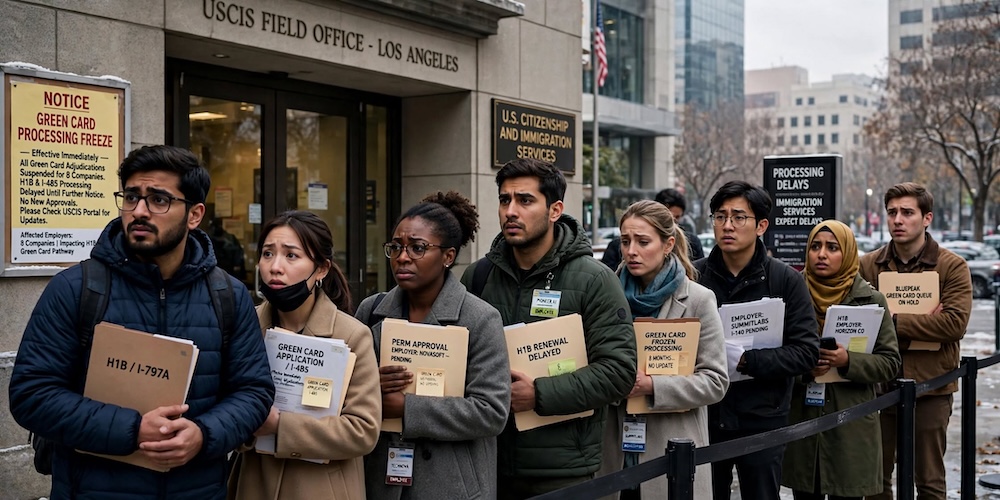
The chronology matters. In July, the administration opened a wide probe into alleged fraud in the H-1B and PERM programmes. On 8 September, the Labour Department’s Inspector General announced on X that the PERM filings of Cognizant and Cloudera were suspended; no allegation was spelt out, and Indian IT stocks lost some ₹55,000 crore in market value the next day. One month later, the method moved from a tweet to a podium, and the list grew from two names to eight.
Look closely at the list, because “Indian IT” is a loose description. Cognizant is American. Capgemini is French. Microsoft and Adobe are as American as companies come. Only four of the eight fly the Indian flag. What unites the eight is the passports of the people in their green-card queues.
The Arithmetic of Accusation
Mr Sonderling offered numbers. Since 2009, he said, these companies have requested almost three million foreign workers, received over 230,000 H-1B approvals, and received over 100,000 permanent labour certifications; he concluded these were jobs taken from Americans.
I have spent enough years reading departmental notes to distrust a figure that arrives without its denominator. A hundred thousand certifications, spread over seventeen years and eight of the largest technology employers on earth, comes to under 6,000 a year. That is a talking point, and nobody has yet turned it into a finding.
Mr Vance was more specific about Microsoft: 6,000 Americans laid off in 2025, over 6,000 H-1B approvals, 3,682 PERM applications, nearly a thousand of them for the very positions vacated. Microsoft replies that its remaining H-1B filings concern people already lawfully in America, “not new arrivals to our country”. If the Vice President’s charge is established, it is serious, and no Indian should defend it; the Indian majors carry old baggage of visa settlements, and must not pretend otherwise. But the charge has not been established. It has only been announced.
Verdict First, Trial Afterwards
Here I must be blunt about our friends in Washington. The United States has lectured the world, India included, on due process and the rule of law for three-quarters of a century. On Thursday, it handed down a collective penalty without notice, a hearing, or an order, and it did so from a political stage, in an election season. A magistrate in any Punjab tehsil who sealed a shop first and wrote his order later would be hauled up by the High Court within the week.
The Vice President called these workers “indentured servants”. The phrase lands differently in India. Our forebears who sailed to Fiji, Mauritius and Trinidad under the girmit, their word for the agreement they could not read, were indentured in the literal sense.
Mr Vance is not entirely wrong about the condition; he is wrong about its author. An Indian engineer on an H-1B is tied to his employer because the green card queue for Indians, under the per-country ceiling, runs into decades. American law built that tether. To cure the indenture by suspending the one process that ends it is to lengthen the girmit in the name of abolishing it. And these are not interlopers: the United States invited, vetted, and taxed them, and many are raising American children.
If the Engineer Cannot Go to the Lab
A commercial answer exists for all this, and it requires no one’s permission. If the engineer cannot settle beside the laboratory, the laboratory will come to the engineer.
In fact, it has been coming for years. India now hosts 2,117 global capability centres that employ 2.36 million people and earned $98.4 billion in the last financial year, according to Nasscom–Zinnov. They have long since graduated from back-office work to software development and research. Microsoft’s development centre in Hyderabad is among its largest outside its headquarters; Adobe’s engineers in Noida and Bengaluru build core products. Every such company has just been told that its best Indian researcher in Seattle may have no permanent future there. Its board will draw the obvious conclusion, and the next laboratory will be commissioned in Hyderabad, Bengaluru or Pune.
Two cautions. Laboratories do not migrate on patriotism: they need reliable power, deep research universities, a patent office that moves, and tax treatment of research that is settled law. That is homework for Delhi and for the States. And a laboratory in Hyderabad five years hence does nothing for the family in New Jersey whose clock is running today.
South Block’s Brief
For that family, the Government of India must act now. Nasscom’s statement that immigration and talent mobility are “two distinct issues” is tactically careful, but it is too polite by half. I would ask the Ministry of External Affairs for four things:
- Seek the order. Ask Washington, formally, for the written order, its legal basis, its duration and the fate of pending cases filed in good faith.
- Open a help desk. Every Indian consulate in the United States should run one for affected nationals and publish an advisory.
- Put it on the trade table. The movement of professionals is trade in services. An agreement that settles the tariff on American almonds and says nothing about Indian engineers is only half an agreement. No tranche should be signed without a mobility chapter: predictable rules, notice before suspension, and protection for cases already in the pipeline.
- Remind, without threatening. American technology companies earn handsomely from the Indian market, and run their global operations from Indian cities. Market access is a two-way street.
To the Indian professional reading this at an anxious hour: the H-1B programme has not been suspended, your present status runs to its stated date, and nobody is required to leave tomorrow. Those whose employer petition is already approved are the most secure; those nearing their sixth year with no filing are the most exposed. Get your own filing dates from your employer, in writing, and do not act on a forwarded message.
America can police its labour market and prosecute fraud. It is not entitled to punish the people in the queue for the alleged sins of those who manage it, and India should say so plainly, at the table where it counts.