

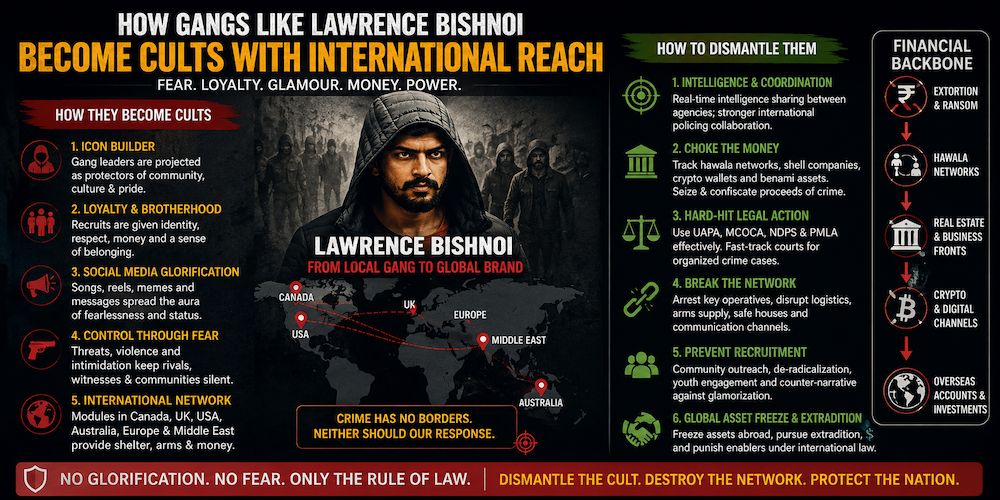
Scores of gangs and hundreds of their associates belonging to Punjab and Haryana in India’s north strike fear in communities in their home states and worldwide. The Lawrence Bishnoi gang is believed to have more than 300 associates in Punjab and 700 worldwide, committing all sorts of heinous crimes and contract killings. The gangster ecosystem thrives on unemployment, drugs, glorification of crime and gun culture, among others. In the following article, VN Rai, a noted commentator on these issues, suggests ways to end this crime.
Introduction
The emerging narrative of organised gangs in Punjab and Haryana resonates deeply in the region’s politics and popular culture. Too visible and too entrenched, uprooting these gangs is an uphill challenge for administrators and requires urgent policy monitoring. The Punjab and Haryana High Court has recently asked the Haryana government to place on record its policy framework and institutional measures to tackle the menace of organised criminal gangs. The affidavit should outline preventive, investigative, intelligence, and inter-agency coordination mechanisms, along with specific measures to curb organised crime activities.
A classified intelligence report of December 2025 by the Canada Border Services Agency (CBSA) titled ‘The Bishnoi Gang: An Emerging Threat in Canada’ was recently made public during court proceedings in that country. The report confirms the involvement of the gang in Canada in high-profile killings, extortion threats and shootings as their principal criminal activities. It revealed the gang manipulating Canada’s immigration pathways to recruit operatives from India to North America.
Cult Visibility
Lawrence Bishnoi has been lodged in the high-security Sabarmati Central Jail in Ahmedabad since 2023 under orders that prevent his transfer or physical custody by other state Police forces. His gang had claimed responsibility after the June 2023 sensational murder of pro-Khalistan activist Hardeep Singh Nijjar in Canada, parallel to a prolonged diplomatic flare-up between India and Canada.
Controversial video-conference interviews with Lawrence Bishnoi, while he was in Punjab and Rajasthan Police custody, emerged in late 2022. An investigation found that Police personnel facilitated these interviews by giving him access to communication devices, leading to the dismissal of a DSP and the suspension of six other officers. In the aftermath, not just the dreaded Bishnoi but the whole gamut of Punjab-Haryana brand of gang operations gained cult visibility across continents.
Visibility, a vital ‘high return’ tool weaponised by gangsters, has not worked in the same rewarding way for law enforcement. A target is hit, immediately chilling videos on behalf of a notorious gang, at times competing gangs, surface on social media to claim responsibility. It achieves the desired effect: laws are broken, rewards are collected, and the gang’s visibility is amplified. A huge hue and cry follows, particularly in political spaces, alleging broken law and order on one another. All this adds to the gang’s brand value and helps soften resistance from prospective targets.
Police move in, debate or confirm the involvement of a certain gang, video grabs of the individuals committing the crime are released, and more stories about the alluding gangsters get circulated via media. The front men identified as committing the crime, mostly low-paid first-timers, are captured after half or full ‘encounters’. Often a stage-managed show, a half encounter is the bullet in the leg, fracturing, whereas a full encounter is the bullet in the upper body, killing. The gang’s visibility is even more amplified; the scenario looks more menacing to potential targets and, empirically speaking, attracts even more first-timers to this desperate world, signalling easy money.
Challenge for Punjab and Haryana
Punjab and Haryana face a similar pattern since 2020. Gangsters based in Indian jails operate in tandem with associates in Canada/US/Central Asia, using social media for recruitment, extortion, contract killings, and drug-narcotics money laundering. Being lodged in an Indian jail works to their advantage; their presence in India is essential to oversee the domestic leg of international deals. They run the gangs from the jail’s safe sanctuary via phones and emissaries, without much concern for alibis, surveillance, or encounters outside.
Both Punjab Police and Haryana Police have raised dedicated special units, well supported by intelligence and coordination networks to tackle the growing phenomenon. Their records of arrests, surveillance, and prosecutions are impressive. It is fair to concede that the old ‘raid and arrest’ model was not enough to dismantle elaborate gang networks. Encounters and bulldozers create headlines but not deterrence. A trust deficit eats into public cooperation if, two weeks later, the gang is back to business. The bottom line: be tough on crime, be ruthless on due process.
Corporatisation of Crime
Organised crime is a business. You don’t shut a business by neutralising its delivery boys. Or by raiding its prospective agents. The task is multi-layered. You need to completely shut their two departments: Publicity (visibility) and HR (recruitment from villages). This will be realised through a robust community interface involving career coaches, social influencers, religious leaders and political activists. Next, challenge the gang leadership on two counts: Command (kill all communication lines) and Stability (shift frequently from jail to jail). This will require a seamless tech interface. Simultaneously, follow the money trail relentlessly, confiscate the cash and other assets, and set up a dedicated financial task force, as it is easier said than done.
Wider Reach and More Geography
The kidnapping-extortion jungle raj of Bihar in the 1990s was politically embedded- rooted in caste armies and ideological land wars. Politicians took cuts and used local gangs as vote muscle in lieu of their patronage. The mining, land, contract mafia of the UP 2000s, again local-political in character, went one step ahead; gangsters became MLAs and ran parallel administrations. Mumbai’s underworld in the 1980s-90s flourished on smuggling, Bollywood, and real estate. Dawood, Chhota Rajan, etc built a corporate-style syndicate with Hawala and international reach. The present-day Punjab-Haryana gangs feast on drugs and diaspora, are fluid, transnational, Instagram-glorified, and business-driven. Less ideology, more “pay or die” virality. The state is stronger now, but gangs operate from Canada/jail, making them harder to decapitate.
Speedy Trials & Rehab
A policy framework to break defiant gangs must prioritise speedy trials and witness protection alongside the expanded social reach of preventive policing. Another crucial question is how far the business of politics and popular culture aligns with the mission. In the epic Prakash Jha movie ‘Apharan’ (Kidnapping, 2005), on Bihar’s jungle raj, the young gangster who was tired of his gore existence responded in one sentence to the suggestion from his father to quit for a quiet life: in this profession there’s no way back. A game-changing rehabilitation program should prove him wrong.