

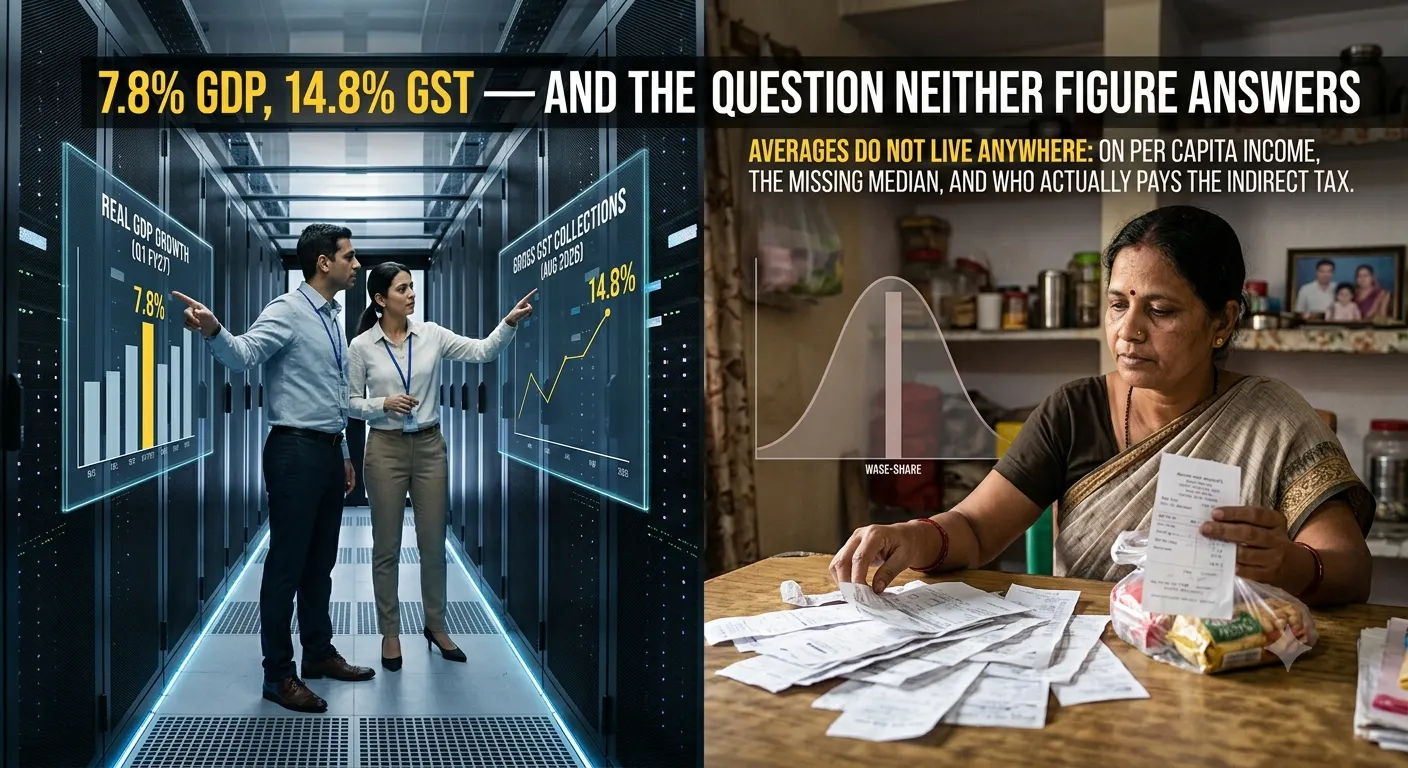
Averages don’t tell the whole story: per capita income, the missing median, and who actually pays the indirect tax.
On 31 August 2026 the National Statistics Office released the first-quarter estimates for FY 2026–27, and the very next morning the Ministry of Finance put out the August GST figures. Read together, over a single sitting, they make an unusually good file note. Real GDP grew 7.8 per cent in April–June, against the Reserve Bank’s projection of 7.0 and a median market expectation of 7.1. Gross GST collections touched ₹1,99,853 crore, up 14.8 per cent year-on-year.
Let me begin where the credit is due, because it usually is not given.
A quarter that reads well in the pink papers
Three features of the GDP release deserve appreciation, and I say this as someone who has sat on the other side of a revenue-estimation exercise and watched a Budget assumption come apart by August.
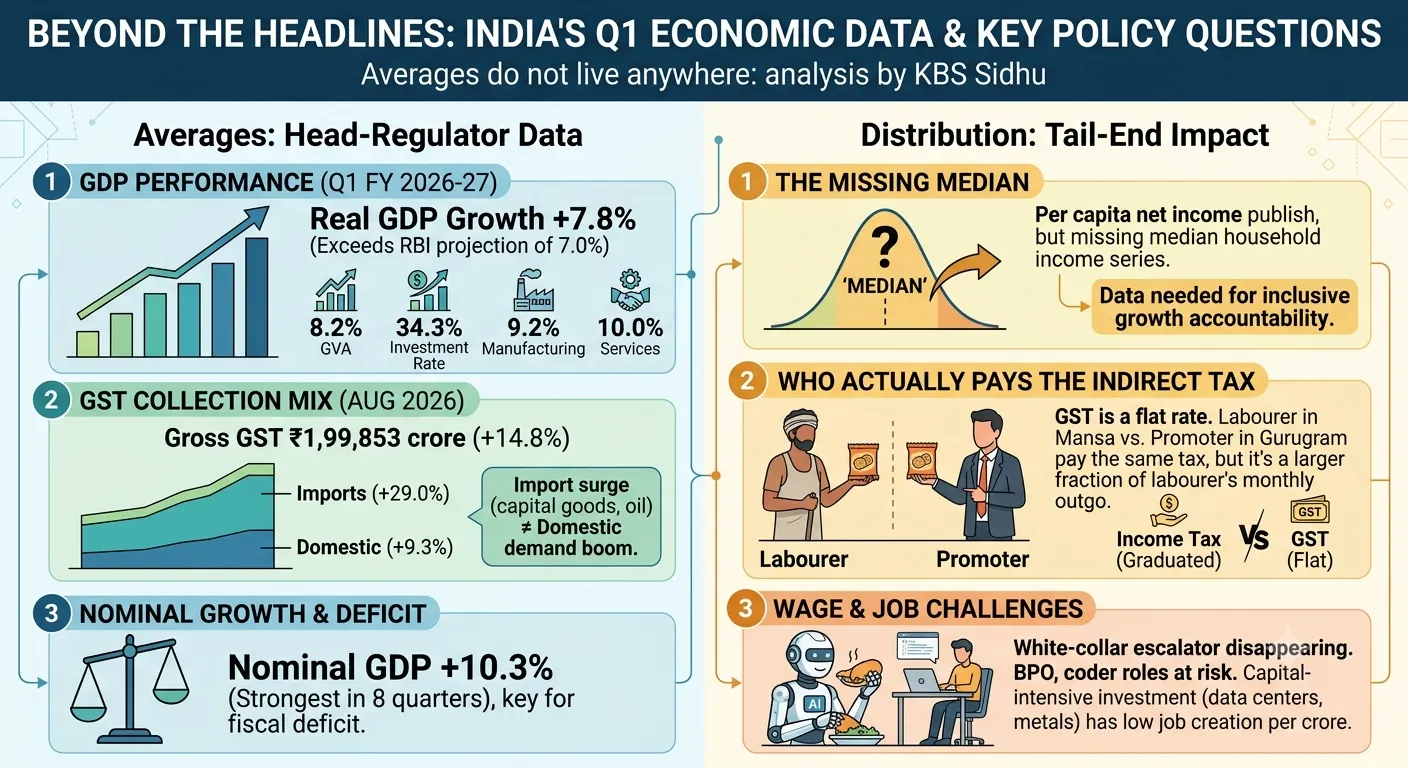
First, gross value added grew 8.2 per cent, faster than GDP itself. GVA measures what producers added; GDP then layers on product taxes net of subsidies; when the first outruns the second, the quarter is real output rather than an artefact of tax-and-subsidy arithmetic.
Second, the growth was investment-led rather than consumption-led. Gross fixed capital formation rose 11.9 per cent in real terms against 5.8 per cent a year earlier, lifting the investment rate to 34.3 per cent of GDP from 31.4. Manufacturing grew 9.2 per cent, services 10.0 per cent, and the financial, real-estate, IT and professional-services grouping 12.1 per cent. Capacity created this quarter is output available in 2029.
Third, nominal GDP grew 10.3 per cent, reportedly the strongest in eight quarters, and that is the number which decides whether the fiscal deficit ratio behaves itself. All of it was achieved amid the West Asian conflict, elevated energy prices, and disrupted supply chains. The macro-management has been competent. Say so plainly.
Now turn the page.
The fine print beneath ₹1.99 lakh crore
The GST release begins undermining its own headline by the third paragraph.
August 2026 Change Gross GST ₹1,99,853 cr +14.8% GST on imports ₹62,604 cr +29.0% Gross domestic GST ₹1,37,249 cr +9.3% Refunds ₹31,795 cr +67.9% Net domestic GST ₹1,18,759 cr +3.4%
Of the ₹25,737 crore by which gross collections rose over August 2025, more than half came from imports. Refunds jumped 67.9 per cent, so net revenue grew 8.3 per cent, not 14.8. For April–August cumulatively, net domestic GST is up 2.7 per cent, which, against consumer inflation, is a real-terms contraction.
Some of the import surge is benign. Capital goods and intermediates flowing in are the arithmetic counterpart of the investment boom, and a country importing machinery is a country building something. Some of it is oil at an uncomfortable price, on the roughly 85 per cent of crude we do not produce. Either way, the sentence “GST collections rose 14.8 per cent, proving domestic demand is booming” is not one the data support, and it will be written a hundred times this week.
In canal irrigation, we measure discharge at the head regulator, in cusecs, and the figure is honest: the water genuinely passed that point. It tells you nothing about whether the tail-end farmer in the last chak of the distributary got his warabandi turn. Headline GDP is a head-regulator reading. Elections are decided by what reaches the tail.
Which brings us to the median
Per capita income is a quotient. National income divided by population, and it rises perfectly well when the top decile captures the numerator; it rises fastest then, because that is where the marginal rupee is largest.
The median is the income of the household standing exactly in the middle of the queue. Ask yourself when you last saw an official Indian median household income series quoted in a Budget speech, a Council brief or an NSO press note. You have not, because we do not publish one. We publish per capita net national income and periodic consumption surveys, and we infer the rest from those two.
That absence is a choice about what the State wishes to be held accountable for. A government that publishes only averages can never be embarrassed by a distribution. Until we publish a regularly sampled median household income and a wage-share-of-GVA series alongside the quarterly GDP release, every claim about “inclusive growth” made from any podium, by any party, is unfalsifiable, and therefore worthless as policy.
Data centres, power, metals, financial services: the sectors named in this quarter’s commentary are among the most capital-intensive in the economy—crores of rupees per job created. Agriculture, which still carries the largest share of the workforce, grew 3.6 per cent. Rupees and people are not in the same sectors.
 Who actually pays
The income tax, whatever its administrative sins, is graduated. The incidence rises with capacity to pay. GST is a flat rate on a transaction and takes no interest in who is standing at the counter. The daily-wage labourer in Mansa and the promoter in Gurugram pay the same tax on the same packet of biscuits. Still, that tax is a much larger fraction of the labourer’s monthly outgo, because he saves almost nothing and consumes almost everything he earns. That is regressivity, and no amount of collection-buoyancy rhetoric alters it.
Two things follow. One, as the Union tax mix leans further on indirect taxation, the fiscal system’s distributional character shifts downward without any Bill, any debate, any recorded vote. Two, the refund architecture, ₹31,795 crore in a single month and growing at 67.9 per cent, flows to registered firms, exporters and those caught in inverted duty structures. That relief is legitimate and overdue. But the system has an efficient channel for returning money to enterprises and no channel at all for returning it to households.
The Council meets on 12 September. With collections holding, it has the room to fix the inverted duty structures, compress the refund cycle and rationalise slabs. It should also put on the agenda a question that is never on it: what is the effective GST rate borne by the bottom three deciles of consumption, and is it falling?
Growth without jobs, and now machines without jobs
We spent two decades worrying about jobless growth. The harder worry is arriving now.
The white-collar services ladder, the BPO seat, the entry-level analyst, the junior coder, the back-office processing job, was for twenty-five years the most reliable escalator out of the lower-middle class in this country, and it was reachable from a Tier-2 town with an ordinary degree and passable English. Generative AI eats those rungs first, the bottom of the profession rather than the top. And the capital-intensive investment we are rightly celebrating in data centres and metals employs a fraction, per crore invested, of what textiles or construction would.
So we may be building an economy whose output grows at eight per cent, whose corporate profits grow faster, whose per capita income chart looks magnificent, and whose median household finds its entry-level pathway closed at both ends. That is an arithmetic possibility our statistical apparatus cannot detect until it appears at a polling booth.
Three tests for the next quarter
Permit me a small framework, like a departmental checklist.
The median test. Does the middle household’s real income rise at anything like the pace of per capita income? Publish the number and let it be argued about.
The incidence test. Of every additional rupee of tax mobilised, what proportion came from graduated direct taxation and what from flat indirect taxation? Track the ratio quarterly, as we track the deficit.
The employment-elasticity test. How many jobs per crore of the 11.9 per cent investment surge, and in which sectors, at which wage levels, for which age cohorts?
None of this diminishes the quarter. 7.8 per cent is a fine number, honestly arrived at, and the officers who produced the conditions for it should sleep well. But laurels are perishable stock, and a headline in the pink papers has a shelf life of about one news cycle. The electorate does not experience GDP. It experiences the price of the packet, the tax on the packet, and whether the son who finished his B.Com. in June has anything to do in September.
(The article first appeared on the blog of the author. Views expressed are personal.)