


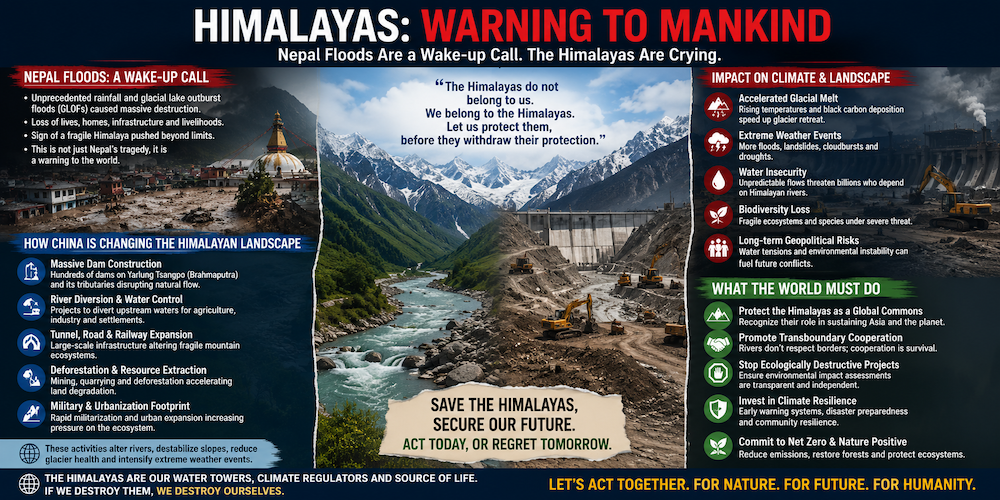
The Himalayas are warning us: when human greed disturbs nature’s balance, the consequences eventually return to humanity.
Introduction
The devastating glacial collapse and flash floods that have struck Nepal and the Himalayan region this week should not be dismissed as an isolated natural event. Scientists identified the immediate trigger as a glacial collapse and debris avalanche, but growing human pressure on an already fragile mountain system is intensifying the larger Himalayan vulnerability.
Nothing stands alone
When the glacier changes, the river changes. When the river changes, the valley changes. When the valley changes, human settlements are affected. When forests disappear, soil and water systems change. What appears to be a local intervention can eventually produce consequences far beyond the original point of intervention.
This is why the Himalayan ecological crisis cannot be separated from the choices human beings make.
Greed, consumption and the destruction of balance
The warning is clear: if we continue to disturb the natural balance of the Himalayas, disasters of greater intensity and frequency will continue to confront us.
This is not merely a climate question. It is a question of human behaviour.
For thousands of years, the people of the Himalayas understood something that modern development has increasingly forgotten: a mountain is not merely a resource, a river is not merely water, and a forest is not merely timber.
They are part of a living system.
For centuries, the Himalayas were protected not through modern environmental regulations, satellite monitoring or elaborate technological systems, but through a deeply embedded cultural and spiritual understanding: nature was not something to be conquered; it was something with which human beings had to live in harmony.
This understanding is deeply reflected in Buddha Dhamma.
The Buddha’s teaching of Pratītyasamutpāda—dependent origination—reminds us that nothing exists in isolation. Every action produces consequences, and every disturbance in one part of the natural order eventually affects another. The principle is as relevant to the environment today as it was to human conduct more than two millennia ago.
The Himalayan crisis, therefore, cannot be viewed merely as a crisis of climate change. It is very much a crisis of human behaviour.
From Contentment to Excessive Consumption
The Buddhist tradition recognised that greed, attachment and excessive desire are not merely personal weaknesses; when multiplied across society, they can alter the natural world itself.
The Aggañña Sutta offers a powerful reflection on how increasing greed, accumulation and consumption can lead to the deterioration of the natural environment. The message is remarkably contemporary: when human desire moves beyond need and becomes unlimited consumption, nature begins to suffer.
Today, the world has created an economic model driven increasingly by competition, excessive production and the relentless search for more resources, more energy and more consumption. Natural resources meant to be shared are increasingly extracted, controlled, and, in some cases, monopolised.
Water, minerals, forests, energy and land are treated primarily as commodities.
The consequences are now visible.
When rivers are diverted without understanding their natural systems, mountains are blasted for roads and tunnels, minerals are extracted without adequate ecological assessment, forests are cleared, and hydroelectric projects alter the natural movement of water, the consequences do not remain confined to one project or one valley.
The Himalayas respond.
The Himalayan Way of Living: A Civilisational Ethic of Coexistence
The Himalayan way of life is rooted in an ancient Indian civilisational understanding in which nature was never regarded as separate from human existence. From the Vedic age onwards, the forests, rivers, mountains, trees, animals and the elements were approached not merely as resources, but as living forces deserving reverence. The famous Shanti Mantras of the Vedic tradition invoke peace across the entire natural order: “Dyauh Shanti, Antariksham Shanti, Prithivi Shanti, Apah Shanti, Oshadhayah Shanti, Vanaspatayah Shanti…” —seeking peace in the heavens, the atmosphere, the earth, the waters, the herbs and the forests. It is a profound civilisational idea: human peace cannot exist in isolation; it must arise through harmony with the larger web of life.
Before beginning a ritual, they invoked and honoured the forces of nature, reflecting the belief that every human endeavour was part of a larger cosmic order. The mountain was therefore not merely a geographical formation or a storehouse of minerals; it was a sacred presence, a source of water, wisdom, life and spiritual awakening.
This ancient ethos continued to find expression in Himalayan Buddhist traditions. The Buddha’s teaching of Dhamma carried forward the deeper Indian principle of living in harmony with the natural and moral order. Across the Himalayas, monasteries, hermitages and meditation caves became centres where spiritual practice remained closely connected with mountains, forests, rivers and local communities. From the Hind Kush, Ladakh, Nepal, Himachal Pradesh, Uttarakhand, Arunachal Pradesh, Sikkim, to Bhutan and Tibet, religious life evolved not by imposing itself upon the landscape, but by adapting to it and respecting its rhythms.
In the Sanatan understanding, and in the continuing Buddhist articulation of Sanatan Dhamma, nature is not external to life—it is part of the same larger existence. To protect the forest, honour the river, preserve the mountain and seek peace for all beings is ultimately to protect the conditions of human life itself. This is perhaps the Himalayan message for the modern world: development need not mean conquering nature; true development begins when human progress learns to live in harmony with it.
From Nalanda to the Himalayas
This ecological consciousness also travelled with the transmission of Buddha Dhamma from India’s great centres of learning to the Himalayan world.
The Nalanda and Vikramashila traditions carried not merely philosophical teachings but a disciplined way of life. Acharya Shantarakshita, travelling from Nalanda to Tibet in the eighth Century, established Samye, the first Buddhist monastery in Tibet. Padmasambhava, Guru Rinpoche, further transformed the understanding of the Himalayan landscape by recognising mountains, valleys and wilderness areas as sacred spaces requiring reverence and protection.
The concept of Beyul, the hidden sacred valleys, and the recognition of mountains as the abode of protective forces created a cultural barrier against indiscriminate exploitation.
Later, Acharya Atisha Dipankara Srijnana reinforced the monastic discipline and the ethic of restraint, compassion and minimal consumption.
This is the great civilisational lesson of the Himalayan Buddhist tradition: development was never separated from restraint.
What We Take from Nature Must Return in Balance
Buddha Dhamma teaches us that what we take from nature without balance ultimately returns to us in another form.
Today, that return is increasingly visible as floods, landslides, cloudbursts, melting glaciers, soil erosion, water scarcity and ecological instability.
Water deserves particular attention.
The water that originates in the Himalayas is not the property of a single generation or a single community. It sustains millions of people downstream. Its natural course, flow and ecological rhythm have evolved over thousands of years.
When we construct dams, create artificial lakes, divert rivers, blast mountains, or alter natural drainage systems without fully understanding the cumulative consequences, we disrupt a balance that nature has maintained for millennia.
The growing instability of glaciers and mountain ecosystems should therefore make us humbler, not more confident.
From Climate Crisis to Crisis of Human Conduct
We therefore need to move beyond seeing every Himalayan disaster only through the lens of climate change.
Climate change is real, but the scale of destruction also depends on what human beings do to fragile ecosystems.
The traditional Buddhist ethic offers a simple corrective: move from ego to eco; from unlimited desire to contentment; from exploitation to stewardship; and from domination to coexistence.
The principle of Santuṭṭhi—contentment with sufficiency—has enormous relevance in today’s world.
We cannot continue believing that every resource must be extracted simply because technology makes extraction possible.
We cannot continue accepting products and practices whose real cost is ecological destruction.
A Common Himalayan Lesson & Responsibility
The lessons of the Himalayas must now move from reflection to action. The countries of the wider Himalayan and Asian region—from Afghanistan and Central Asia through South Asia, Nepal, Bhutan, Tibet, India, Bangladesh and the wider SAARC region—must urgently come together on a common platform to protect the Himalayan ecology and its ancient way of life. The Himalayas are not the concern of the mountains alone; they are Asia’s water tower, sustaining the rivers, drinking water, agriculture, livelihoods, and ecological security of the vast plains below. Protecting their glaciers, snow, forests and natural water systems is therefore a shared civilisational responsibility. The region needs a framework that combines the wisdom of ancient, nature-centred living with modern science and technology—continuous ecological monitoring, early-warning systems, responsible development, and rapid information sharing whenever critical changes occur. The objective should not be to reject modernisation, but to ensure that it works within nature’s limits. The Himalayan way of life offers precisely that lesson: progress must restore balance, not destroy it. If Asia can come together to preserve the Himalayas today, it will not only protect a mountain ecosystem; it will safeguard the future of generations across the continent.