

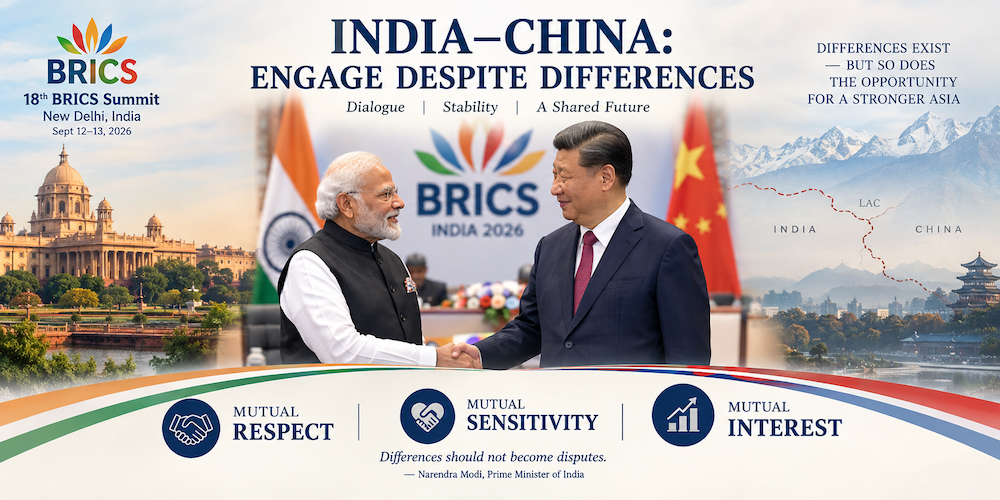
In his bilateral talks with Chinese President Xi Jinping, Prime Minister Narendra Modi stressed that both sides must show sensitivity to each other’s core issues and let relations be guided by “three mutuals” – mutual respect, mutual sensitivity and mutual interest. At the bilateral meeting, both the leaders echoed this spirit.
Introduction
Few aphorisms seem more relevant to India’s uneasy relationship with China today. Differences between nations are inevitable. They arise from history, geography, national interests, security perceptions, and competing aspirations. Disputes, however, are not inevitable. They arise when differences accumulate, mistrust replaces dialogue, and competition hardens into confrontation.
History of India-China Relations
Yet another dimension of the India-China story deserves at least equal attention: the extraordinary economic divergence between the two countries.
Two neighbours, two economic trajectories
At one time, the economic distance between India and China was far smaller than it is today. China then made a historic choice: to place industrialisation, infrastructure, exports, education, technology and manufacturing at the centre of its national strategy.
Whatever one’s assessment of China’s political system, the scale and consistency of its economic transformation are undeniable.
China built not merely factories but entire manufacturing ecosystems—ports, highways, power networks, industrial clusters, machine tools, component industries, logistics chains, research institutions and a huge skilled workforce.
Its investment in research and development has also been formidable. China’s R&D expenditure reached about 2.69% of GDP in 2024, whereas India’s latest official figure is around 0.84%.
That difference tells us something more important than a statistic: national priorities eventually become national capabilities.
India has enormous scientific and technological achievements of its own, particularly in space, nuclear technology, pharmaceuticals, information technology and engineering. But our R&D expenditure and manufacturing ecosystems remain insufficient for a country aspiring to become a global industrial power.
Paradox of Economic Interdependence
There is, however, an extraordinary irony in the present relationship. China is one of India’s principal economic competitors—and simultaneously one of the most important suppliers to Indian industry.
India imports from China machinery, electronics and components, APIs, chemicals, auto components and numerous intermediate and capital goods. Indeed, a significant part of the trade deficit reflects India’s dependence on Chinese inputs that Indian manufacturers themselves require.
This presents India with a difficult but intellectually important choice.
Should we regard China merely as a threat from which we must distance ourselves? Or should we recognise that strategic competition and economic interdependence can coexist?
The wiser answer, surely, is the latter.
India must reduce excessive dependence on China in strategically vulnerable sectors. But reducing dependence does not require economic hostility. In fact, better bilateral relations could make that transition easier.
The Paradox
India needs to become less dependent on China without becoming unnecessarily hostile.
That means, going beyond “screwdriver” technology and moving progressively from:
importing components → assembling products → designing products → manufacturing components → developing technology → exporting complete products.
This is the real road to becoming a manufacturing power.
Recent experience with semiconductors, pharmaceuticals, and rare-earth magnets illustrates the challenge. India may possess the talent and, in some cases, the natural resources, but it still lacks sufficient processing, technological and manufacturing depth.
China’s dominance of several rare-earth and permanent-magnet supply chains is a particularly powerful reminder that resources alone do not create industrial power; processing, technology and scale do.
India must therefore invest far more heavily in R&D, skills, infrastructure and industrial ecosystems.
If Make in India is to go beyond a mere slogan and become a transformative national project, it must eventually become:-
“Invent in India. Design in India. Manufacture in India. Scale in India. Export from India.”
Can competition coexist with cooperation?
This is where the aphorism acquires its larger significance. India and China need not agree on everything. They may continue to have differences over the border. They may compete for markets, technology, investment and influence. They may have different strategic perceptions of Asia.
But none of these differences necessarily requires economic confrontation.
Indeed, the modern world is full of such relationships. Countries can be competitors and trading partners at the same time. They can disagree politically while cooperating economically.
What India needs is neither naïve trust nor permanent hostility. It needs competitive coexistence. That means competing vigorously wherever our national interests require competition; cooperating wherever cooperation produces mutual benefit; diversifying wherever dependence creates vulnerability; and maintaining dialogue wherever differences threaten to become disputes.
The Opportunity before India
But if dialogue produces greater stability, predictable trade, better market access and more reliable supply chains, it can create an economic environment in which both countries gain.
For India, this matters even more. The world is looking for alternatives and additional manufacturing centres. India possesses a huge domestic market, a young workforce, expanding infrastructure, digital capabilities and a growing entrepreneurial ecosystem.
But becoming the world’s second manufacturing hub will not happen simply because some factories move out of China.
India must create the conditions that make the country competitive in its own right.
That requires reliable infrastructure, competitive energy, skilled manpower, efficient logistics, stable regulations, technological capability and—above all—a much greater commitment to research and development.
China’s rise should therefore be studied not merely as a challenge, but as a lesson.
The Larger Wisdom
Perhaps the most sensible approach to China is therefore neither confrontation nor capitulation.
It is strength without belligerence; self-reliance without isolation; competition without hostility; and cooperation without dependence. India does not need to become another China. Nor does India need to defeat China to succeed.
It needs to become sufficiently innovative, productive and technologically self-confident to engage China—and the world—from a position of strength.
And China, if it wishes to play the role of a responsible global power, must recognise that a prosperous and stable India need not be an adversary.
The future of Asia will not be determined merely by which country becomes stronger. It will also depend on whether its two largest civilisations can learn to manage their differences with maturity.
Differences are inevitable. Disputes are manageable. Conflict is avoidable. And cooperation need not mean surrender.
Conclusion
India’s real victory would be to build such economic and technological strength that it can look across the Himalayas without fear or hostility. For ultimately, the wisest way to ensure that differences do not become disputes is not to eliminate differences—but to become strong enough, confident enough, and wise enough to manage them.
It is heartening to note that the theme of BRICS —‘Resilience, Innovation, Cooperation & Sustainability’—resonates perfectly with our basic premise: “Differences should not be allowed to grow into disputes”.