

Introduction
Independence Day is not merely a celebration of the freedom India won in 1947. It is also a moment to remember what kind of India we fought to build and what kind of civilisational India we inherited. As we raise the Tricolour this Independence Day, we must ask ourselves a difficult question: does our public conduct, our political language and the manner in which we speak about women truly represent the India we claim to be?
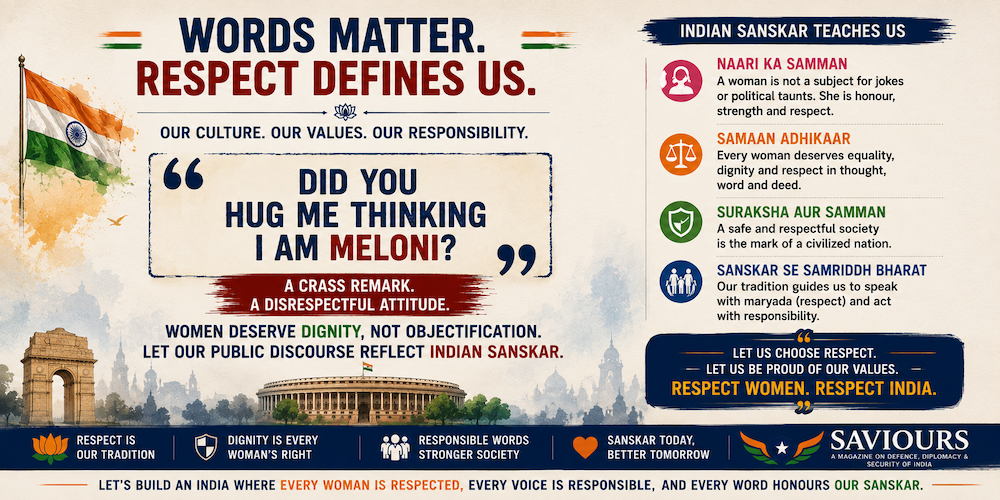
The recent unfortunate incident where a remark by a senior political leader led to an insulting remark by another politician about a woman who is the head of government of a friendly foreign country should make every Indian pause and introspect. Without turning it into a partisan controversy or naming any individual, the larger issue deserves attention. When any responsible public figure makes a demeaning remark about a woman in public life, it does not merely hurt the individual; it diminishes the dignity of our public discourse and can misrepresent India before the world.
Independence Reminds Us of the India We Inherited
India did not discover women’s dignity after Independence. It was embedded in our civilisational consciousness for thousands of years.
The Vedic tradition gives us the extraordinary example of Gargi Vachaknavi, who fearlessly questioned Yajnavalkya on the deepest mysteries of existence, and Maitreyi, whose philosophical dialogue explored the nature of immortality and the Self. Women were not merely subjects of discussion; they were participants in the search for truth.
The same civilisational stream runs through the great teachers and thinkers who shaped India. The teachings associated with Rama and Krishna, Buddha and Mahavira, and the wisdom of the Rishis placed enormous emphasis on dignity, self-restraint, compassion, duty, and individual conduct. Chanakya, whose political thought dealt with statecraft, governance and social order, understood that the strength of a state ultimately rests upon the well-being and security of its women power.
Our civilisational idea of Shakti takes this reverence even further. Saraswati represents knowledge, Lakshmi prosperity, Durga courage and Kali transformative power. Shiva himself is understood through Shakti. The image of Ardhanarishvara symbolises the complementarity of masculine and feminine energies. We call the Earth Mata and invoke rivers as mothers.
These are not merely religious images. They express a civilisation that placed the feminine principle at the heart of creation, knowledge, courage, and prosperity.
From Rani Lakshmibai to the Women of Modern India
Our freedom struggle further demonstrated that Indian women were not passive recipients of history. Rani Lakshmibai, Begum Hazrat Mahal, Sarojini Naidu, Aruna Asaf Ali, Captain Lakshmi Sahgal and countless unnamed women stood alongside men in the struggle against colonial rule.
After Independence, India again demonstrated remarkable confidence in women’s political equality. Universal adult franchise was granted from the very beginning. Indian women did not have to wait decades to secure the right to vote.
From political leaders to scientists, administrators, educators, astronauts and entrepreneurs, Indian women have continued to expand the boundaries of national achievement. Their accomplishments—from science and technology to public administration and national security—are part of the India we present to the world.
Our Words Must Represent Our Civilisation
India is a vast, diverse and argumentative democracy. We have every right to disagree fiercely. Political criticism is necessary. But disagreement cannot become an excuse for humiliation, particularly of women.
When any politician makes a derogatory or demeaning remark about a woman in public life, especially a foreign woman leader, the matter should not be reduced to whether the speaker belongs to one political party or another. It is an issue of public morality, democratic responsibility and India’s civilisational image.
Our children listen to our leaders. The world watches them. Every careless word can become a distorted representation of India.
An Independence Day Oath
Therefore, this Independence Day should become an occasion for a simple national introspection: let our political language reflect the civilisation we inherited.
Let every political party, every public representative and every citizen resolve that no woman will be demeaned for political advantage, electoral rhetoric or personal provocation.
Let us remember Gargi when we speak about a woman’s intellect; Lakshmibai when we speak about her courage; Saraswati when we speak about her knowledge; Durga when we speak about her strength; and Shakti when we speak about her place in our civilisation.
We do not need to borrow our respect for women from another culture. We need to rediscover our own.
Independence Day allows us to renew not only our commitment to the nation, but also our commitment to the values that define it.
Let us protect our motherland. Let us protect the dignity of our mothers and daughters. Let us protect the Shakti that has sustained India through the ages.
And above all, let our words and conduct ensure that when India speaks to the world, it speaks in the language of its own civilisation—of dignity, restraint, respect and Shakti.
Jai Hind.