

Introduction
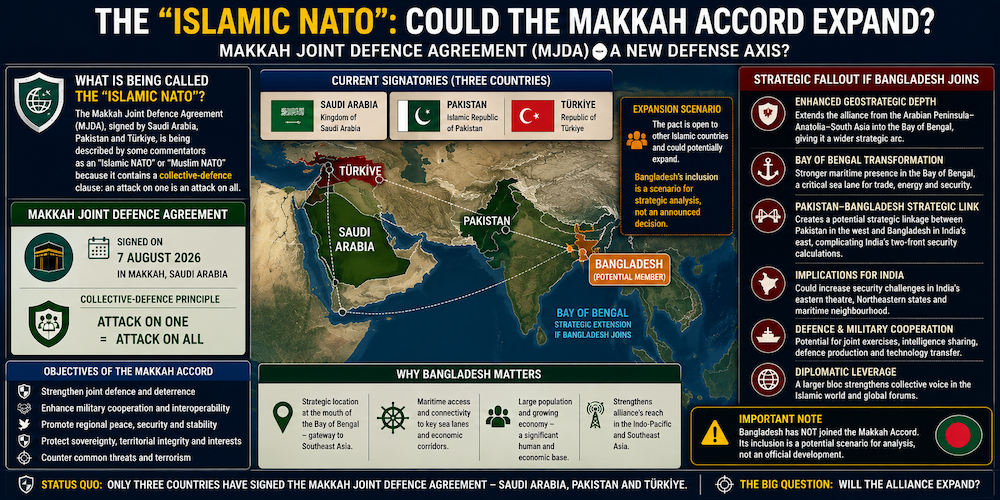
The much-publicised Makkah Joint Defence Agreement between Saudi Arabia, Türkiye and Pakistan was initially presented as a new security alignment in West Asia and, by some, even as an Islamic equivalent of NATO. The agreement stipulates that an armed attack against one member would be regarded as an attack against all. Yet, the three countries do not share a common border, have different strategic calculations, and the agreement does not clearly define the circumstances in which they would act collectively.
Therefore, India need not overreact. But the situation has now taken on a new and much more serious dimension, with Bangladesh voicing interest in, or being persuaded to, join this pact.
Bangladesh has indicated a willingness to consider joining the Makkah framework. This changes the arrangement’s geographical and strategic character. What began as a West Asian defence understanding could, if expanded to Bangladesh, acquire an indirect South Asian military dimension—bringing the influence of Pakistan and Türkiye closer to India’s eastern frontier and directly affecting India’s security concerns.
The question India must therefore ask is not simply what the Makkah Pact is today, but what it could become tomorrow.
Bangladesh: the new strategic dimension
Bangladesh is not Pakistan. Its historical, cultural and economic relationship with India is fundamentally different. Bangladesh shares more than 4,000 kilometres of border with India and is surrounded by seven Indian states. Its economic sustainability is deeply connected to India through electricity exports, transit, food supplies, border trade, connectivity, and access to the Indian market, in addition to people sharing day-to-day needs.
The two countries have built an economic relationship that has benefited both sides. Bangladesh has emerged as one of South Asia’s fastest-growing economies, while India has provided an important economic and logistical ecosystem for that growth.
Against this background, any Bangladeshi move towards a military understanding involving Pakistan cannot be treated as an ordinary diplomatic development.
The immediate question is: who benefits from extending the Makkah framework from West Asia into South Asia?
It is not difficult to see that Pakistan would gain considerably and through it those who control Pakistan, whether internally or internationally. It would create an opportunity to project its influence from India’s western border towards its eastern frontier. Türkiye, which has already developed defence cooperation with Pakistan and supplied advanced drones and other military technologies, could acquire a wider strategic role in India’s neighbourhood.
This possibility becomes particularly sensitive around the Siliguri Corridor—the Chicken’s Neck, India’s narrow strategic link to the Northeast. New Delhi would view any attempt to project external military influence on both India’s western and eastern sides as a national security matter.
China, too, would have little reason to object to such a development if it contributed to greater strategic pressure on India’s eastern sector, the Bay of Bengal and the Andaman and Nicobar region. The possibility of Chinese naval and strategic interests converging with Pakistani and Turkish defence cooperation in the eastern Indian Ocean cannot simply be ignored. This may also help those seeking favourable trade agreements with India.
From a perception game to a strategic arc
The original Makkah arrangement was, in many respects, a perception game for Pakistan. It allowed its military establishment to project a stronger regional role and seek financial and diplomatic support. The agreement also has wider American significance because Washington has appreciated the arrangement and may see strategic utility in Pakistan’s renewed role in future regional contingencies.
But if Bangladesh joins, the calculation changes.
A pact which initially had no common geographical frontier could begin to create an indirect strategic arc around India—from Pakistan in the west to Bangladesh in the east, with Türkiye providing defence technology and Saudi Arabia providing financial and strategic weight.
That would be a fundamentally different proposition.
India must therefore send Bangladesh a clear signal that its relationship with India is not merely another bilateral relationship. Bangladesh is an integral part of India’s wider security environment. Any military alignment involving Pakistan that extends towards India’s eastern frontier will inevitably affect the security calculations of the entire region.
The nuclear dimension
There is another aspect which makes Pakistan’s role different from that of an ordinary member of such an alliance: Pakistan is a nuclear-armed state.
Pakistan remains the only Muslim-majority country with an established nuclear weapons capability. Its nuclear arsenal gives Islamabad a strategic weight considerably greater than its economic strength would otherwise justify.
Therefore, when Pakistan enters a collective defence framework, the nuclear dimension inevitably becomes part of the larger strategic calculation.
This does not mean that the Makkah Pact automatically becomes a nuclear alliance. It does not. But the perception of collective deterrence involving a nuclear-armed Pakistan, Turkish military technology and Saudi financial resources is significant. If the arrangement expands geographically, its psychological and strategic impact will increase.
India should consequently examine not merely the military capabilities of the participating countries, but the strategic signalling created by their combined nuclear, technological, financial and geographical assets.
Iran and the American sanctions dimension
The Iran factor makes the entire development still more complicated.
The United States is now threatening extremely severe economic measures against Iran. On August 20, the US announced plans for what it described as the toughest sanctions in history against Tehran.
Iran’s two important land connections in this context are with Türkiye and Pakistan. Both countries have substantial economic and border interactions with Iran. Türkiye’s bilateral trade with Iran is around $5–6 billion annually and includes significant energy trade, while Pakistan and Iran are seeking to increase bilateral trade towards $10 billion.
Pakistan’s border trade with Iran is particularly important for its western regions, while Türkiye remains an important energy and commercial partner of Iran. Therefore, any American attempt to economically isolate Iran will inevitably place pressure on these two neighbours.
This creates a strategic paradox.
The Makkah Pact may not officially identify Iran as an enemy—Türkiye has specifically said that no common threat, including Iran, is written into the agreement. Yet the pact emerged precisely as the United States and Iran are in an increasingly severe confrontation.
The arrangement therefore must be assessed within the wider contest around Iran, sanctions, energy routes, the Strait of Hormuz, and the future architecture of West Asian security.
Do not turn religion into the basis of military blocs
The religious dimension also deserves careful consideration.
The Makkah Pact is based partly on historical ties, Islamic solidarity and shared strategic interests. But an international military architecture built principally around religious identity would be an unhealthy precedent.
The Muslim world itself is not homogeneous. Pakistan has a substantial Shia population and has historically faced sectarian and ethnic divisions. Iran represents a major Shia power, while Saudi Arabia and Pakistan are predominantly Sunni. Any attempt to create an “Islamic NATO” therefore carries the danger of deepening sectarian divisions rather than creating stability.
If such small military alliances begin to emerge elsewhere on religious or ideological lines, major powers—whether Western, Russian, American or Chinese—could eventually use them as instruments of strategic pressure and arm-twisting.
That would not make the world safer.
India must speak clearly to Bangladesh
India should therefore convey to Bangladesh, in clear but friendly terms, that its relationship with India is mutually beneficial and has evolved far beyond temporary political dispensations.
Dhaka must understand that joining a military arrangement involving Pakistan would affect India’s security calculations.
India’s position should be that an attack against one cannot automatically become a military alignment against another’s legitimate security interests.
A better strategy for both countries would be deeper economic integration, greater connectivity, energy cooperation, and sustained political engagement.
Bangladesh’s Natural Affinity with India
Having spent more than four years in Bangladesh, the writer has seen closely how deeply friendly and culturally connected ordinary Bangladeshis remain with India. The shared and dominant Bengali cultural ethos—with its richness, intellectual depth and civilisational bonds—naturally creates a greater affinity with India. Bangladeshis instinctively look towards India for many of their immediate needs and solutions, as well as for stability in the region. Irrespective of the political dispensation in Dhaka, there has never been a genuine popular desire for confrontation with India. Indian policymakers must therefore recognise that this new dimension of Bangladesh’s possible alignment with the Makkah agreement may be more a result of external persuasion than a natural impulse from within Bangladesh.
Therefore, India owes much more to the average Bangladeshi who has been subjected to political upheaval for a long time now.
India must look beyond the perception game
The Makkah Pact does not fundamentally alter the geopolitical balance. Pakistan cannot replace American power in the Gulf, nor can a Pakistan-led arrangement match India’s economic and military scale.
But an expanding Makkah framework is a different proposition from the original pact.
If its influence moves from Saudi Arabia, Türkiye and Pakistan towards Bangladesh or, for that matter, with any other immediate or extended neighbour, and if Pakistan’s nuclear capability, Turkish defence technology, Saudi financial power, Chinese strategic interests and American pressure on Iran begin interacting within the same geopolitical space, India cannot afford to treat the development merely as another diplomatic headline. India must be included in any security alliance shaping the region’s future, either directly or indirectly.
India’s response should therefore be neither anxiety nor confrontation. It should be strategic clarity.
India must strengthen its relationships with Saudi Arabia and all six GCC countries—UAE, Saudi Arabia, Qatar, Bahrain, Kuwait and Oman—while maintaining its deep relationship with Iran and engaging all regional stakeholders. India’s economic strength, human capital, historical connections and strategic autonomy remain its greatest assets.
The Makkah Pact may remain primarily a perception game. But if Bangladesh becomes part of it, the game acquires an eastern front.
That is the new danger India must recognise—not because Pakistan has suddenly become powerful enough to challenge India, but because larger powers may find value in using Pakistan and potentially Bangladesh as instruments of strategic pressure.
India must ensure that neither its western nor eastern neighbourhood becomes an instrument in the strategic designs of bigger powers. For Bangladesh, too, the choice is clear: its economic future lies in stability, connectivity and growth—not in becoming an instrument of military rivalry in South Asia.