

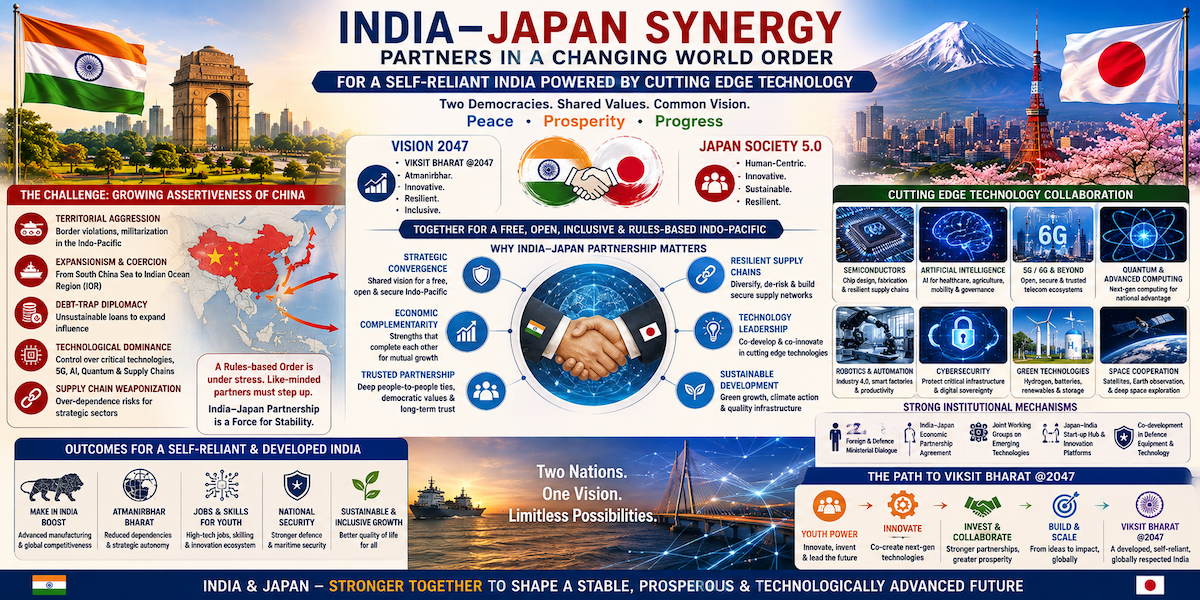
While the world is engrossed and worried about the US and Israeli invasion of Iran and the subsequent events impacting global peace, trade, and development, Saviours looks at the possibility of a convergence of interests between India and Japan to mitigate the trade and geopolitical headwinds. The Japanese Prime Minister’s visit to India comes at a pivotal moment in regional geopolitics, as Tokyo strengthens its defence posture and diversifies its strategic partnerships. At the same time, New Delhi and Tokyo deepen cooperation to promote security, economic resilience, and a rules-based regional order.
Introduction
The visit of the Prime Minister of Japan to India assumes significance at a time when the Indo-Pacific region is witnessing profound geopolitical transformation and an increasingly complex security environment. China’s growing military assertiveness in the East and South China Seas, its expanding influence across the Indo-Pacific, and its strategic partnership with Russia have heightened concerns among regional powers. Simultaneously, North Korea’s continued development of nuclear weapons and ballistic missiles remains a persistent threat to regional peace and stability. Adding to these challenges is the evolving debate over the long-term reliability of traditional alliance structures, particularly amid renewed discussions in the United States regarding burden-sharing and security commitments to allies. Growing uncertainty over the long-term reliability of the U.S. security umbrella, particularly following President Donald Trump’s criticism of NATO allies and suggestions that American security commitments could become more conditional, has prompted Japan to strengthen its own defence capabilities and diversify its strategic partnerships. Against this backdrop, India and Japan, two major Asian democracies committed to a rules-based international order, are steadily deepening their partnership beyond economic cooperation. Their collaboration today encompasses defence, maritime security, advanced technology, resilient supply chains, and strategic connectivity, reflecting a shared determination to promote peace, stability and prosperity across the Indo-Pacific region.
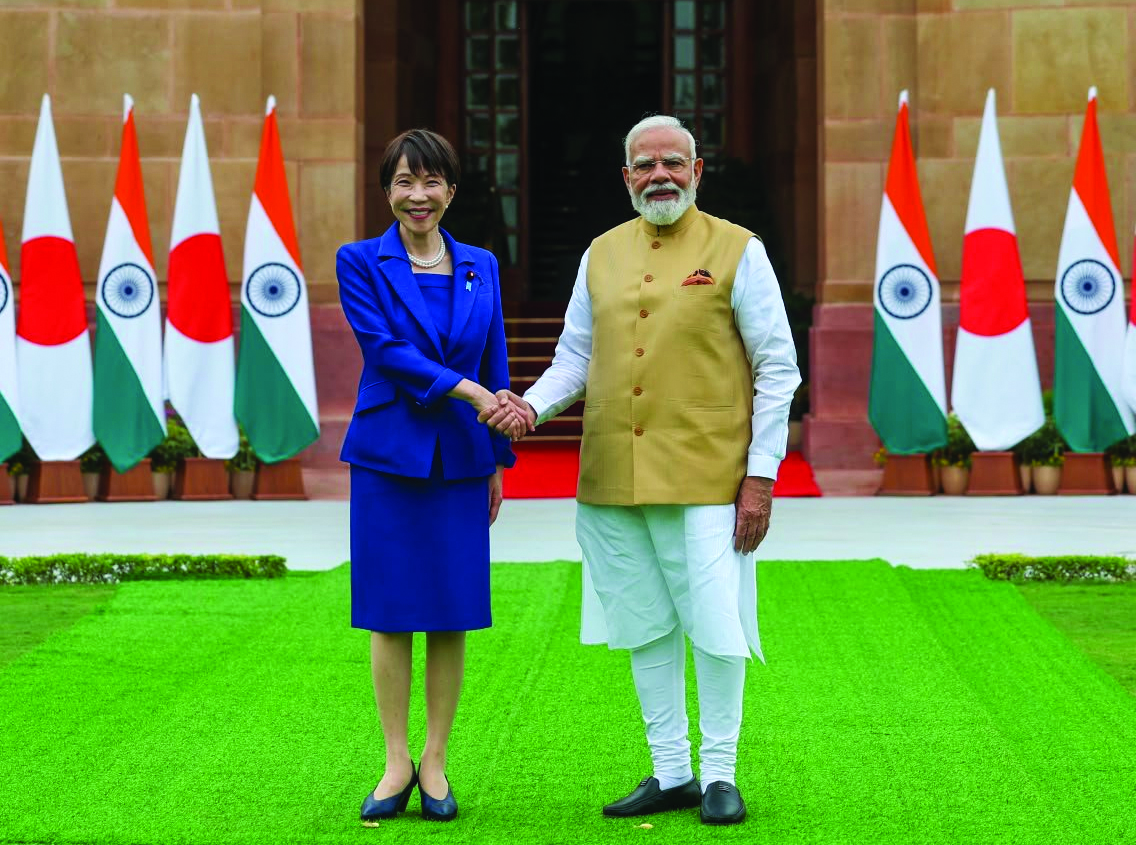 Against this evolving strategic landscape, the Japanese Prime Minister’s visit to India transcends routine bilateral diplomacy. It underscores the growing recognition in both New Delhi and Tokyo that their partnership is central to preserving stability, security and economic resilience in the Indo-Pacific. As the regional security architecture undergoes significant realignment, India and Japan increasingly regard each other as indispensable strategic partners, bound by shared democratic values, converging security interests and a common vision of a free, open and rules-based Indo-Pacific.
Historical Evolution of India–Japan Relations
India and Japan share a relationship rooted in centuries-old civilisational ties, with Buddhism serving as a lasting cultural bridge. Following the Second World War, India supported Japan’s reintegration into the international community by renouncing war reparations and signing the 1952 Peace Treaty. Since the 1980s, Japan has become one of India’s foremost development partners through concessional loans, infrastructure projects and technology cooperation. The relationship acquired a strategic dimension in the twenty-first century and was elevated to a Special Strategic and Global Partnership in 2014. Today, both democracies cooperate closely on defence, connectivity, critical technologies, resilient supply chains, and advancing a free, open, and inclusive Indo-Pacific.
Changing Global Security Environment
The Indo-Pacific has emerged as the principal arena of geopolitical competition, compelling both India and Japan to reassess their strategic priorities. China’s rapid military modernisation, expanding naval capabilities and increasingly assertive behaviour have transformed the regional security landscape. Its activities in the East China Sea around the Senkaku Islands, the militarisation of the South China Sea, and growing military pressure across the Taiwan Strait have raised concerns about freedom of navigation, regional stability, and adherence to international law. Many regional states view these developments as attempts to alter the status quo through coercion.
The implications extend beyond East Asia. Japan depends heavily on secure maritime trade routes through the East and South China Seas, making regional stability vital to its economic and national security. India, meanwhile, continues to face an unresolved boundary dispute with China, heightened military deployments along the Line of Actual Control and expanding Chinese naval activity in the Indian Ocean Region. Both countries also share concerns regarding economic coercion, grey-zone tactics and vulnerabilities in critical supply chains. Consequently, New Delhi and Tokyo have deepened cooperation in maritime security, defence technology, intelligence sharing, and supply-chain resilience, while working together through platforms such as the Quad to promote a free, open, and inclusive Indo-Pacific based on international law. Their expanding partnership reflects a broader convergence of strategic interests amid an increasingly uncertain regional and global security environment.
Japan’s Security Concerns
Japan today confronts a complex security environment shaped by simultaneous challenges from China, North Korea and Russia. The principal concern remains China’s expanding military power and assertive regional posture. Frequent Chinese incursions around the Senkaku Islands, the rapid expansion of the People’s Liberation Army Navy and the possibility of a conflict in the Taiwan Strait have heightened Japanese security concerns. Former Prime Minister Shinzo Abe’s observation that “a Taiwan contingency is a Japan contingency” has significantly influenced Japanese strategic thinking. The current government has stated that a serious Taiwan crisis could constitute a “survival-threatening situation” for Japan, potentially permitting the exercise of collective self-defence under existing security legislation, depending on the circumstances.
Japan also faces persistent threats from North Korea’s advancing nuclear and ballistic missile programmes. Repeated missile launches over or near Japanese territory have reinforced Tokyo’s determination to strengthen missile defence, surveillance and military preparedness. Simultaneously, Russia’s enhanced military activities around the disputed Northern Territories and growing strategic cooperation with China, including joint naval and air patrols near Japan, have added further complexity to its security environment. In response, Japan has undertaken its most significant defence transformation since the Second World War by substantially increasing defence expenditure, acquiring counter-strike capabilities, strengthening its defence industrial base and expanding strategic partnerships with trusted democracies, including India, the United States and Australia. These measures reflect Tokyo’s determination to enhance deterrence and preserve peace, stability and the rules-based order in the Indo-Pacific.
Uncertainty Regarding the U.S. Security Umbrella
The U.S.–Japan Security Treaty remains the cornerstone of Japan’s national defence, and the United States continues to be Tokyo’s most important strategic ally. However, growing uncertainty over the long-term reliability of American security commitments, reinforced by President Donald Trump’s emphasis on greater burden-sharing by allies, the “America First” approach and questions surrounding U.S. responses to regional contingencies, has encouraged Japan to strengthen its own defence capabilities. Rather than reducing its reliance on the alliance, Japan is complementing it by increasing defence spending, expanding its defence industrial base and investing in advanced military technologies. Simultaneously, Tokyo is deepening strategic partnerships with countries such as India, Australia, and European democracies to enhance regional stability, resilience, and a free, open, and rules-based Indo-Pacific.
Japan’s Historic Defence Policy Shift
Japan is undergoing its most significant defence policy transformation since the end of the Second World War. Departing from decades of post-war strategic restraint, Tokyo has adopted a new National Security Strategy, substantially increased defence expenditure, acquired counter-strike capabilities and initiated the procurement of long-range missiles to strengthen deterrence. Equally significant, Japan has gradually eased long-standing restrictions on defence exports, permitting the transfer of specified defence equipment under defined conditions. While this does not amount to unrestricted exports of lethal weapons, it marks a historic shift in Japan’s security policy. It opens new avenues for defence industrial cooperation with trusted partners, including India.
Following the gradual relaxation of its defence export policy, Japan has emerged as a potential supplier of advanced military equipment to trusted partners. Countries including Australia, the Philippines, Indonesia, New Zealand, India and Ukraine have expressed interest in Japanese defence platforms ranging from warships, radars and missiles to drones and other advanced defence technologies. This marks a significant departure from Japan’s long-standing post-war restrictions on defence exports and reflects Tokyo’s growing role in strengthening regional and global security partnerships.
Why India Matters to Japan
India has emerged as one of Japan’s most important strategic partners because of its geopolitical significance and expanding economic potential. Its strategic location in the Indian Ocean is central to ensuring secure sea lanes and advancing a free, open and rules-based Indo-Pacific. As the world’s largest democracy, India shares Japan’s commitment to the rule of law, regional stability and a rules-based international order. Its large domestic market, youthful workforce, expanding manufacturing base and growing role in resilient global supply chains further enhance its strategic importance.
For decades, China was the primary destination for Japanese investment. However, slowing economic growth, rising costs and geopolitical uncertainties have encouraged Japanese businesses to diversify. Alongside countries such as Vietnam and the Philippines, India has emerged as a preferred investment destination owing to its improving business environment, manufacturing initiatives, skilled workforce and strong long-term growth prospects.
Why Japan Matters to India
Japan is one of India’s most important economic and strategic partners, playing a vital role in the country’s infrastructure development, industrial modernisation and technological advancement. It is among India’s leading sources of foreign investment, Official Development Assistance (ODA) and advanced technology, supporting flagship projects such as the Mumbai–Ahmedabad High-Speed Rail, metro rail systems, industrial corridors and urban infrastructure. The partnership has expanded into emerging sectors, including semiconductors, digital technologies, clean energy and resilient supply chains. In the strategic sphere, Japan has become a trusted defence and maritime partner, strengthening cooperation in defence technology, maritime security and Indo-Pacific security. Its long-term commitment is reflected in highly concessional ODA financing, including the bullet train project, which carries an exceptionally low 0.1% interest rate, a 50-year repayment period and a 15-year grace period.
Complementary Strengths
India and Japan possess highly complementary strengths that make their partnership strategically significant. Japan contributes world-class technology, precision manufacturing, robotics, shipbuilding expertise, defence technologies, and capital. At the same time, India offers a demographic dividend, a strategic geography, strong digital capabilities, a large military, expanding manufacturing capacity, and a rapidly growing defence-industrial ecosystem. Together, these strengths create a mutually beneficial partnership driven by synergy rather than competition.
Resource Constraints Facing Japan and Technology as Its Strategic Asset
Despite being the world’s fourth-largest economy, Japan faces significant structural constraints, including limited natural resources, heavy dependence on imported energy, scarce critical minerals, mountainous terrain and limited arable land. An ageing population and a shrinking workforce further intensify these challenges. To overcome these limitations, Japan has leveraged innovation and technological excellence to become a global leader in robotics, artificial intelligence, semiconductors, high-speed rail, space technology, defence electronics, maritime systems and precision engineering. Its technological capabilities have become a key strategic asset, strengthening economic competitiveness, national security and international partnerships, including its expanding collaboration with India.
Defence Cooperation Between India and Japan
The two countries have deepened military interoperability through regular bilateral and multilateral exercises, including Malabar, Dharma Guardian, and JIMEX. Cooperation has also expanded in defence logistics, maritime domain awareness, Coast Guard coordination, and resilient supply chains. Increasing collaboration in defence technology and industrial cooperation reflects their shared commitment to strengthening regional security and promoting a free, open, and rules-based Indo-Pacific.
Economic Security
Economic security has become one of the fastest-growing pillars of the India–Japan partnership as both countries seek to reduce strategic vulnerabilities and strengthen resilience. Cooperation now extends to semiconductors, critical minerals, trusted supply chains, resilient manufacturing, and secure digital infrastructure. Both are also collaborating in clean energy, green hydrogen, and the diversification of rare earth supply chains to reduce excessive dependence on any single source. These initiatives reinforce long-term economic resilience while supporting sustainable growth and technological competitiveness.
China Factor
Although India and Japan consistently emphasise that their partnership is not directed against any third country, China’s increasingly assertive regional posture has strengthened their strategic convergence. Shared concerns over border tensions, maritime security, freedom of navigation, resilient supply chains and adherence to international law have encouraged closer cooperation in defence, maritime security and the Indo-Pacific. Both countries continue to advocate for a free, open, and inclusive Indo-Pacific while maintaining that their collaboration is based on shared interests rather than on containment. Reacting to the recent India–Japan summit, China reiterated that bilateral cooperation should not target any third country or undermine others’ interests and criticised initiatives under the “free and open Indo-Pacific” framework, reflecting Beijing’s sensitivity to the growing strategic partnership between New Delhi and Tokyo.
Importance of the Quad
The Quad has emerged as one of the most significant strategic groupings in the Indo-Pacific, with Japan playing a central role in its conceptualisation under former Prime Minister Shinzo Abe and its revival in 2017. Comprising India, the United States, Japan and Australia, the Quad is not a military alliance but a flexible partnership committed to a free, open, inclusive and rules-based Indo-Pacific. Its cooperation now extends well beyond maritime security to humanitarian assistance and disaster relief, cybersecurity, critical and emerging technologies, resilient supply chains, vaccine partnerships, maritime domain awareness, and quality infrastructure, thereby contributing to regional stability, economic resilience and adherence to international law.
Outcomes of the Recent Visit
The recent India–Japan summit marked another significant milestone in the evolving Special Strategic and Global Partnership, yielding substantial outcomes across investment, technology, defence and economic security. Japan announced a commitment to invest ₹1 trillion (₹1 lakh crore) in India, while both countries adopted an ambitious roadmap to mobilise 10 trillion yen in Japanese investment over the next decade. More than 100 business agreements concluded over the past year are expected to facilitate investments exceeding US$10 billion, particularly in infrastructure, manufacturing, semiconductors, artificial intelligence, clean energy and other advanced technologies. Building on its long-standing role as India’s leading development partner through highly concessional Official Development Assistance (ODA), Japan reaffirmed its commitment to supporting India’s infrastructure and industrial transformation.
The summit also broadened cooperation in defence, economic security and emerging technologies. The two countries signed their first defence co-development project, issued a Joint Statement on Artificial Intelligence, and adopted an Economic Security Declaration to strengthen resilient supply chains and cooperation on critical minerals. New initiatives were launched in pharmaceuticals, medical devices, strategic petroleum reserves, maritime energy security and capacity building. Japan also committed to supporting the establishment of 1,000 biogas and organic fertiliser plants across India. Prime Minister Narendra Modi’s warm reception of Prime Minister Sanae Takaichi, whom he described as his “younger sister,” reflected the exceptional goodwill underpinning bilateral ties. The leaders reaffirmed their shared commitment to a free, open and inclusive Indo-Pacific, designated 2027 as the India–Japan Year of Shared Horizons to commemorate 75 years of diplomatic relations. They outlined a ten-year vision for deeper strategic cooperation, enhanced youth exchanges and stronger people-to-people ties. Nevertheless, challenges such as delays in project implementation, modest bilateral trade, bureaucratic hurdles, geopolitical uncertainties and domestic political constraints continue to limit the partnership’s full potential.
The India–Japan partnership has evolved far beyond its traditional economic foundations into one of the Indo-Pacific’s most significant strategic relationships. As geopolitical uncertainty intensifies amid China’s growing assertiveness and the evolving strategic posture of the United States, both countries increasingly recognise the value of a trusted democratic partnership. Japan views India as a reliable partner with strategic depth, a large market and growing global influence. At the same time, India benefits from Japanese investment, advanced technology, infrastructure financing and expanding defence cooperation. Together, they are well placed to strengthen resilient supply chains, promote maritime security and uphold a free, open and rules-based Indo-Pacific.
At the same time, the partnership must navigate an increasingly complex global environment marked by intensifying U.S.–China strategic competition. Although calls for economic decoupling have become more pronounced, the extensive trade, investment and financial interdependence between Washington and Beijing suggests that complete decoupling remains unlikely in the foreseeable future. In this evolving geopolitical landscape, India and Japan are pursuing a pragmatic strategy that combines economic resilience with strategic autonomy. The recent summit should therefore be viewed not merely as another diplomatic engagement but as an important milestone in building a durable partnership capable of contributing to regional stability, sustainable development and an inclusive international order.