

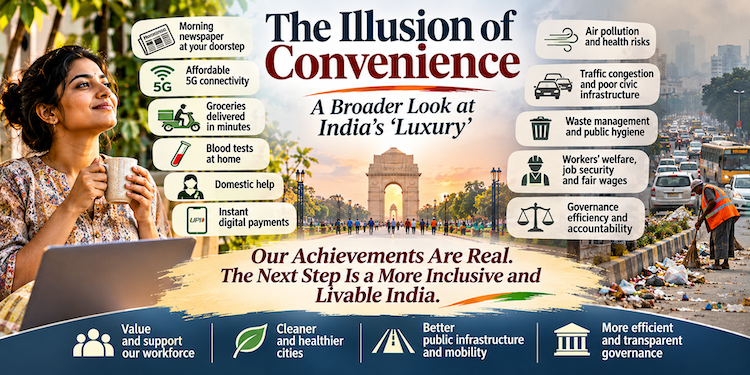
An infographic on social media celebrates India’s achievements in several fields, including gig work, health, and the digital economy. There is no doubt that these achievements are, to borrow a catchphrase from an ad, Owners’ pride, neighbours’ envy. There is also no denying that East or West, Home is best. But should we break into a congratulatory spree as yet, when 800 million have to be supported with food, cash handouts and other subsidies?
Introduction
A cheerful infographic currently doing the rounds on social media presents an appealing picture of a new reality: “Indian Luxury: Why the West Is Actually Jealous”.
Through a series of cartoons, it highlights conveniences enjoyed by many in India’s urban middle class: a ₹2 morning newspaper delivered to the doorstep, affordable 5G connectivity, groceries arriving within ten minutes, blood samples collected at home, domestic help, instant digital payments and even freshly ironed clothes at modest prices. These are contrasted with the everyday challenges faced by people in some Western countries, such as expensive internet, less convenient shopping hours, household chores and insurance-related delays.
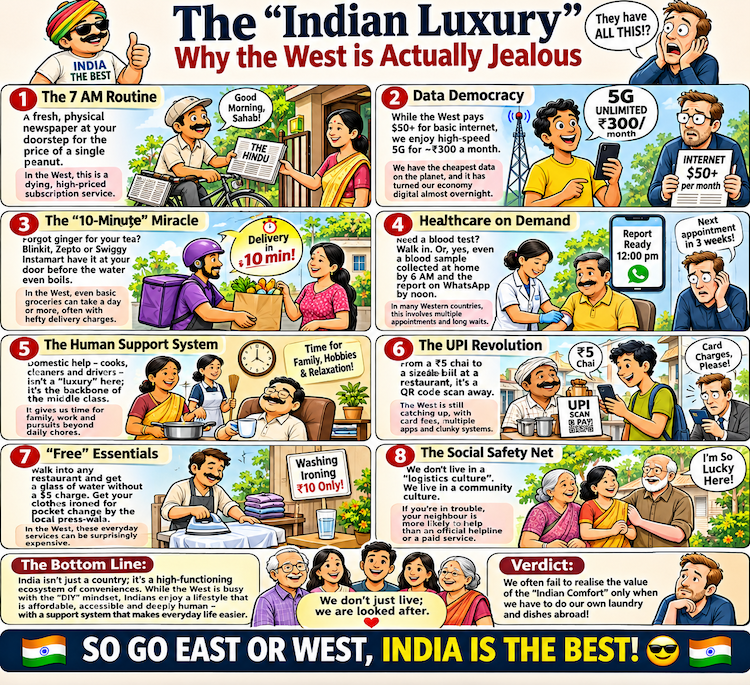 The concluding line is upbeat and unmistakably patriotic: “So go east or west, India is the best!”
There is much to appreciate in this picture, and there is every reason to take pride in India’s achievements. At the same time, perhaps we can look at the subject from a slightly wider perspective. Convenient services are a welcome part of modern life, but they tell only one part of the story of national progress. Alongside the comforts we enjoy as consumers, it is worth considering the well-being of the people who provide these services, the quality of our shared public spaces and the opportunities available to citizens across the country.
The Economics of Convenience
Let us begin by recognising what India has genuinely achieved. Our Digital Public Infrastructure, particularly the Unified Payments Interface (UPI), has transformed everyday financial transactions. Affordable mobile data and widespread digital connectivity have opened up opportunities that many countries are still striving to replicate. These are substantial accomplishments and a source of considerable national pride.
The other conveniences celebrated in the infographic are also worth appreciating. They become even more meaningful, however, when we consider the wider economic and social context in which they are made possible.
A ten-minute delivery of a forgotten ingredient—for instance, a piece of ginger while preparing tea—can be wonderfully useful. So can the domestic worker who helps with cooking and cleaning, the driver who navigates the city’s traffic and the local press-wallah who irons clothes at an affordable price. These services make daily life easier for many households. Their affordability is also connected, in part, to India’s large workforce, comparatively low wages and differences in income.
In many Western economies, washing one’s own dishes, mowing one’s lawn or walking to a neighbourhood store is simply part of everyday life. Higher labour costs and stronger wage protections mean that employing someone to perform these tasks can be expensive. Neither arrangement is inherently better in every respect; they reflect different economic and social conditions. The important question is whether convenience can be made compatible with fair wages and decent working conditions.
In India, the relative affordability of personal services can sometimes mean that the people providing them have limited bargaining power or financial security. Consider the delivery executive working to meet a ten-minute deadline, sometimes in difficult traffic and at considerable risk. The convenience experienced by the customer should also prompt us to think about the safety and welfare of the person making the delivery.
There is a useful distinction between an affordable service and a fair deal for the person providing it.
The infographic naturally focuses on the consumer’s experience. A fuller picture would also include the delivery rider’s access to insurance, paid leave, social security and a fair income, as well as the working conditions of domestic workers. Recognising their contribution need not diminish the convenience we enjoy. On the contrary, it can help us aspire to a more inclusive model of progress.
Perhaps one measure of a society’s progress should be how well it balances affordable services for consumers with dignity, security and fair opportunities for those who provide them.
Private Convenience and the Quality of Public Life
One limitation of the “Indian Luxury” argument is that it understandably focuses on the comforts available within a middle-class home. Yet our experience of a city or a country extends well beyond our front door.
A developed society is shaped not only by the comforts its citizens can purchase privately, but also by the quality of its public spaces, civic amenities and institutions. These are shared assets, and improvements to them benefit everyone.
India has made impressive strides in private and digital convenience. The next opportunity is to bring the same energy and innovation to the quality of everyday public life.
We may appreciate receiving a blood report on WhatsApp by noon, while also recognising the importance of clean air. Across large parts of northern India, particularly during winter, air pollution remains a serious public-health concern. It is worth asking how we can ensure that the convenience of home delivery and digital services is matched by the simple pleasure of stepping outdoors and breathing clean air.
Similarly, household help can make daily routines easier, but it cannot replace well-planned cities, reliable public transport, safe footpaths and better traffic management. In many urban areas, a five-kilometre journey can still take an hour. Improving these everyday experiences would make a significant difference to quality of life.
Civic hygiene is another area where small changes in public behaviour, supported by effective municipal services, can have a visible impact. Better waste management, clean drains and accessible public conveniences would improve our neighbourhoods. We should also work towards discouraging habits such as spitting paan and gutkha in public places. The problem is not confined to India: according to a report, the London Borough of Brent spends over £30,000 annually cleaning paan and gutkha stains from streets, pavements, shopfronts and public infrastructure. It is a reminder that civic habits can travel with people, and that public cleanliness requires both awareness and consistent effort.
These may appear to be everyday matters, but they have a real bearing on public health, civic pride and the quality of urban life. They call for a combination of responsible citizenship, responsive municipal governance and sustained public investment.
The contrast is easy to recognise. A household may enjoy modern appliances and a range of convenient services, yet still face difficulties in the public environment outside its building. Bridging this gap would make the benefits of development more complete.
Cities such as Zurich, Tokyo and Toronto have their own challenges, but aspects of their public infrastructure, urban management and civic practices offer useful examples. We can learn from such experiences while developing solutions suited to Indian conditions.
The Unequal Reach of Convenience
The conveniences described in the infographic are largely those of an urban, digitally connected and relatively affluent middle class. They are part of India’s changing consumption landscape, but they do not yet reflect the everyday experience of all Indians.
A ten-minute grocery delivery may be useful to a busy household, but it is less relevant to a family facing uncertain employment or limited purchasing power. Home blood collection is a valuable service, though access to affordable diagnostic tests remains equally important. Affordable internet creates possibilities, but it must be accompanied by quality education, meaningful employment and reliable information if those possibilities are to be realised.
Likewise, the availability of domestic help is a convenience for many households. It is also worth asking whether the people providing that assistance have adequate access to healthcare, education and social security.
It is therefore helpful to distinguish the consumption patterns of a relatively privileged segment from the standard of living of the country as a whole. Development is most meaningful when the benefits reach more people, and when every citizen can live with security, opportunity and dignity.
Everyday Governance and Public Trust
Another part of the development conversation concerns the everyday experience of dealing with public institutions. In some areas, citizens continue to encounter opaque procedures, delays and instances of petty corruption.
Whether it involves clearing a municipal file, obtaining a routine certificate or dealing with a traffic violation, people can sometimes find that personal influence or informal payments appear to offer a quicker route than established procedures. Such experiences can weaken public trust and make ordinary tasks unnecessarily difficult.
It is important not to place the entire responsibility on individual citizens. Institutional complexity and delays can create conditions in which corruption takes root. Simplifying procedures, making services transparent and ensuring timely accountability can help reduce these opportunities. Citizens, too, have a role to play by supporting fair processes and resisting the temptation to seek preferential treatment.
A system works best when people who follow the rules are not placed at a disadvantage, and when every citizen can expect consistent and fair treatment.
Digital convenience is a valuable achievement, but it works best when supported by institutional integrity. A developed country should enable citizens to approach a public office with confidence that decisions will be guided by the law and established procedures, rather than personal influence or unofficial payments.
Convenience and the Need for a Social Safety Net
The warmth of neighbourhood relationships and the informal networks of mutual assistance remain important strengths of Indian society. They are part of what makes communities resilient, and deserve to be cherished.
At the same time, community support and institutional social security serve different, complementary purposes.
A neighbour bringing food to an ailing household is a generous human gesture. Alongside such acts of kindness, people also need dependable healthcare, reliable insurance, unemployment protection and effective systems of social welfare.
Informal support networks are valuable precisely because they complement formal institutions. Similarly, domestic assistance can make life easier for households, while the people providing that assistance should also have access to the protections and opportunities that a modern economy ought to offer.
A More Inclusive Sense of Patriotism
The infographic’s celebration of India is understandable. Its comparisons, however, invite us to look at only one side of the picture. We can take pride in the conveniences and innovations that have improved our lives while remaining open to a broader discussion about the areas where further progress is possible.
India has much to be proud of: its civilisational inheritance, democratic resilience, scientific achievements, entrepreneurial energy, technological innovation and extraordinary social diversity. Our digital public infrastructure, in particular, is a remarkable contribution to the contemporary world.
We can celebrate these achievements without needing to suggest that other societies have little to offer or that India has nothing left to learn.
Equally, we can acknowledge the benefits of affordable services while continuing to improve working conditions, public amenities and access to opportunity. These goals are not in conflict. They are different parts of the same aspiration for a better society.
The ultimate measure of a nation’s progress lies not only in the convenience available to its consumers, but also in how fairly, securely and humanely it enables all its citizens to live.
Perhaps the real luxury India should aspire to is not merely a society in which almost everything can be delivered to one’s doorstep, but one in which every citizen can live with dignity, security and equal opportunity. I am reminded of these lines from Gitanjali:
“Where the mind is led forward by thee
Into ever-widening thought and action
Into that heaven of freedom, my Father, let my country awake.”
A little more appreciation of what we have achieved, combined with a willingness to learn and improve, could take us considerably closer to the India we aspire to become.
(The views expressed are personal to the author.)