

Introduction
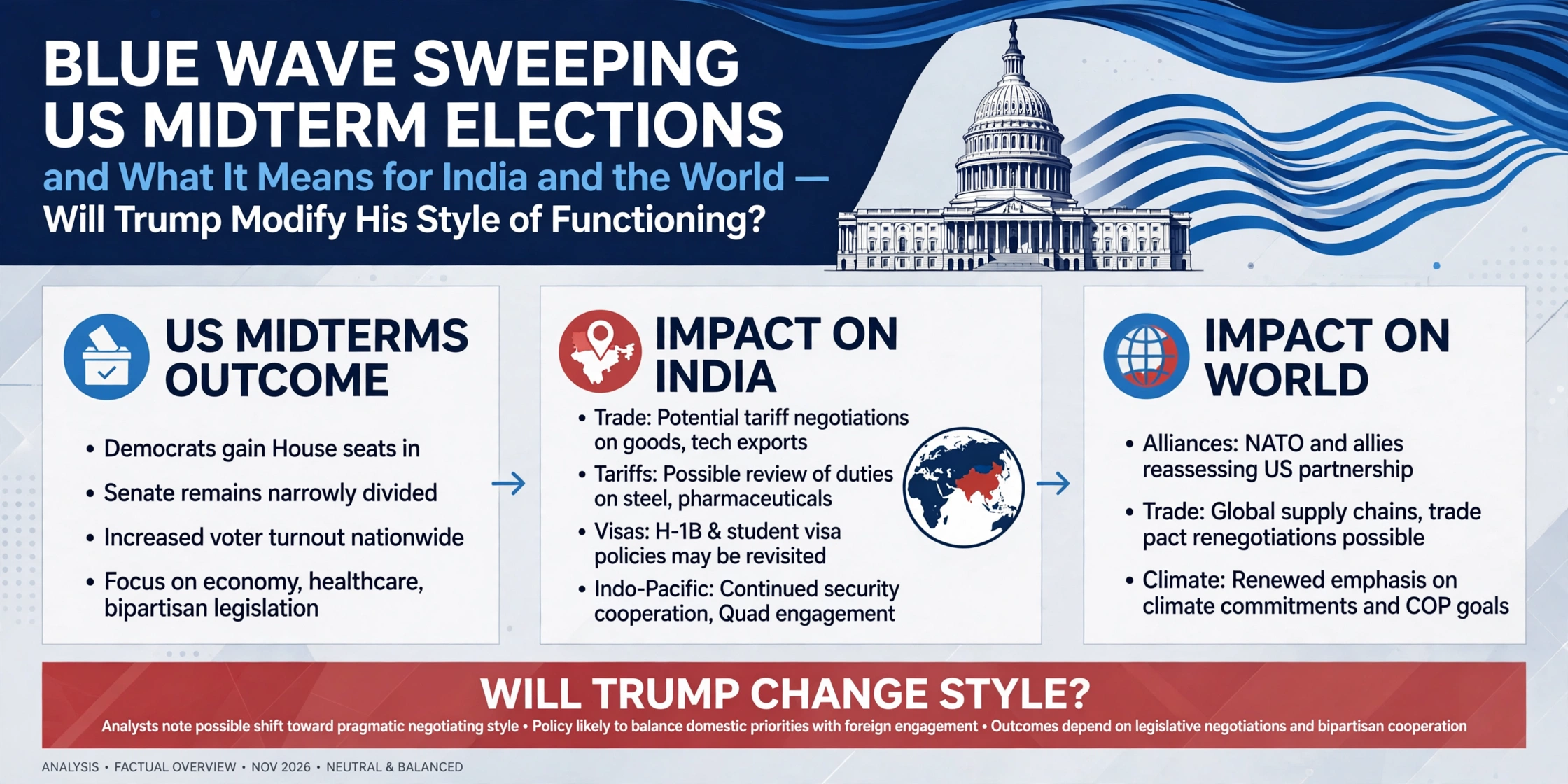
Americans decisively demonstrated at the ballot box that they reject the Trumpian policies they believe have increased their hardships. Trump attributed the result to voters’ unwillingness to endure short-term difficulties for a greater cause. He conceded that the consequences of the Iran war had contributed to the political tsunami in the Democrats’ favour, yet remained adamant, in his characteristic style, that he was right. His own Vice President, who had opposed the war, attributed the Republican defeat to four concerns voiced by voters:
- Iran war,
- Cost of living/inflation,
- America First, and
- Relationship with Israel
“Our voters showed up. And the above four reasons are why many of them voted for Democrats”, said the Vice President.
These priorities point to a broader electoral message: voters were judging the administration not only on its domestic record, but also on the costs and consequences of its foreign policy.
Ted Cruz further elaborated: “We lost in historically red states like South Carolina, North Carolina, Kansas and Iowa. We lost in purple states like Michigan, New Hampshire and Georgia. And we just barely won by a single point in bright-red states like Florida and Louisiana, and then there’s Texas.”
Multiple Firsts
The breadth of these losses suggests that Republican difficulties extended beyond a handful of competitive states. The election also produced several firsts, including Muslim leaders becoming senators and leaders in the House of Representatives, as well as the election of the first gay, Latino and non-white representatives. Several politicians of Indian origin performed well across the political divide. Taken together, these results reflect both a shift in voter sentiment and the growing diversity of political representation in the United States.
Voter Expectation
In domestic politics, Democrats will be expected to address voters’ concerns quickly. President Trump has expressed a desire to work with them, albeit grudgingly, as investigations and obstacles to his executive agenda are likely to follow. Control of the House and Senate gives Democrats significant power to check the administration, and Trump could find himself acting as a “veto man.” Impeaching him would require substantial effort and a two-thirds majority in the Senate. The new balance of power may therefore constrain the administration without necessarily bringing its agenda to a halt.
Foreign Policy: Iran War
On foreign policy, however, the President retains considerable latitude. Whether Trump will use these powers freely remains uncertain: he may prefer to avoid inflicting further damage on himself and the Republican Party. The contrast between domestic constraints and executive discretion abroad could become a defining feature of this period.
For Democrats, one of the key priorities is ending the Iran war. Trump was drawn into the conflict largely by Israeli Prime Minister Benjamin Netanyahu and his own yes-men, and now appears to be seeking a symbolic victory that would allow him to call it quits. Moreover, if Netanyahu himself comes under pressure, continuing along the war path could entail enormous costs for Trump. At this stage, despite Republican pressure, Trump does not appear ready to sacrifice his Secretary of War, Pete Hegseth, although Hegseth’s exit may happen regardless.
This week, the Israeli Ambassador to the UN disclaimed Israel’s role in triggering the conflict, stating: “The decision to attack Iran was the decision of the United States. It wasn’t our decision.” He said that Israel supported the war and considered it the right decision.
Meanwhile, Trump announced that the United States would stop providing nearly $4 billion in military aid to Israel. In Tel Aviv, this is being presented as a move to loosen the United States’ strategic hold over Israel. The announcement nonetheless carries important implications, particularly amid policy disagreements that have been widening for some time over Israel’s continued intransigence in the Middle East conflicts. AIPAC and Israel itself have also faced growing criticism in the United States. The debate over aid may therefore become part of a larger reassessment of the political and strategic terms of the US–Israel relationship.
Arab and Gulf countries oppose further escalation and are working hard to find a deal. Under pressure, Iranians hope to secure reasonable terms despite their public posturing of bravado. Russia and China, while prioritising their strategic partnership with Iran, are also engaging in efforts to bring the war to an early end. A visit by a high-level defence and security delegation from the Mecca Agreement countries, together with Qatar’s intensive mediation efforts, could give President Trump the off-ramp he is seeking.
Ironically, some commentators argue that Iran is the only country to have defeated America militarily, economically and politically by changing America’s regime. In the worst-case scenario, Trump may carry out his threat to strike Iranian strategic targets. Such strikes are unlikely to advance any of his strategic objectives, if there are any. The central question is whether a limited action could offer Trump a face-saving exit or instead draw the United States into a wider, more costly confrontation.
Russia- Ukraine War
As for the Russia–Ukraine war, Trump’s efforts have led to the resumption of talks in Abu Dhabi on November 9–10 at the envoy and technical levels, with Witcoff in attendance. President Putin has also expressed hope that the US election results will not dampen peace efforts. Democrats, for their part, have opposed Trump abandoning Zelenskyy and moving closer to Moscow. They could prompt a course correction unless a ceasefire deal is completed before the new Congress takes office on January 3 next year.
In any case, President Trump is likely to meet President Xi Jinping and President Putin in China in a G3 format and may pursue an early ceasefire. Zelenskyy, meanwhile, may feel that Democratic pressure could strengthen his leverage over the Trump administration. This assumption may be misplaced: any change in Washington’s approach will depend not only on political pressure, but also on the terms of a possible ceasefire and the administration’s own calculations.
Tariffs Twister
As for the Lindsey Graham Act, which would authorise the President to impose 100% tariffs on countries importing Russian oil, it is currently on hold, as the United States has started importing Russian diesel to meet local demand and address shortages. Democrats have little sympathy for Russia or China, so any action by either country that provides grounds for confrontation may be seized upon by the new legislative dispensation. The measure’s future will therefore depend on how domestic energy needs, trade policy and the political appetite for further pressure on Russia are weighed against one another.
Looking beyond the US Shores
The Republicans’ electoral defeat weakens Trump at home but leaves him considerable freedom of action in foreign policy. Toward the end of their second terms, American presidents have often focused on international affairs to demonstrate their ability to deliver results. Bill Clinton sought an Israeli–Palestinian peace agreement; Barack Obama concluded the nuclear deal with Iran and restored relations with Cuba; and George W. Bush increased the US military presence in Iraq after the Republicans’ defeat in the 2006 elections. Trump, too, may step up his foreign policy initiatives in pursuit of quick wins.
Such initiatives could give the President an opportunity to demonstrate momentum abroad at a time when his domestic room for manoeuvre has narrowed. But the search for quick wins also carries risks: diplomatic initiatives could produce results, while escalation could deepen the turbulence already surrounding US policy.
Trump has already created a degree of turbulence in US foreign policy. Let us hope it does not turn into a nosedive.
India-USA Relations
As for India, one may not expect much change, even though Secretary Rubio will continue to pursue the US trade and investment agenda, and the remainder of Trump’s term could help alleviate some of India’s concerns. Phase I of the trade deal could be finalised if India’s concerns about the unpredictability of Trumpian tariffs are duly addressed.
In any case, Prime Minister Modi is slated to visit the United States for the G20 Summit. A QUAD meeting could take place there, on the sidelines of this week’s ASEAN Summit in Manila, or at another summit in the interim. The issues of professional mobility and H-1B visas are unlikely to be resolved, and neither is President Trump’s fondness for General Asim Munir. However, there is considerable bipartisan support for enhancing the strategic partnership. New Delhi must therefore deploy its diplomatic tools, including its lobbying networks and diaspora influence, while remaining engaged with the White House. The challenge will be to sustain that engagement while navigating the unpredictability of US policy.