

While the world is consumed by wars and geostrategic and geoeconomic competition, the Indraprastha Communiqué creates an alternative global platform for civilisational leadership, shared wisdom, and harmony. An infographic circulating on social media traces India’s global cultural footprint.
Introduction
Bringing together representatives of 22 countries, the three-day gathering recognised that the historical connections, philosophical traditions and shared heritage of societies deserve a greater place in contemporary international relations.
The adoption of the Indraprastha Communiqué provides an initial framework for cooperation through joint cultural projects, preservation and digitisation of manuscripts, artificial intelligence, academic exchanges, heritage protection and youth participation. India’s proposal for biennial meetings offers an opportunity to sustain this engagement.
However, the significance of this initiative goes beyond cultural diplomacy. It raises a larger question: can the accumulated wisdom of human civilisations provide direction to a world increasingly divided by strategic competition, conflicts and competing political interests?
India’s Historical Position in Civilisational Connectivity
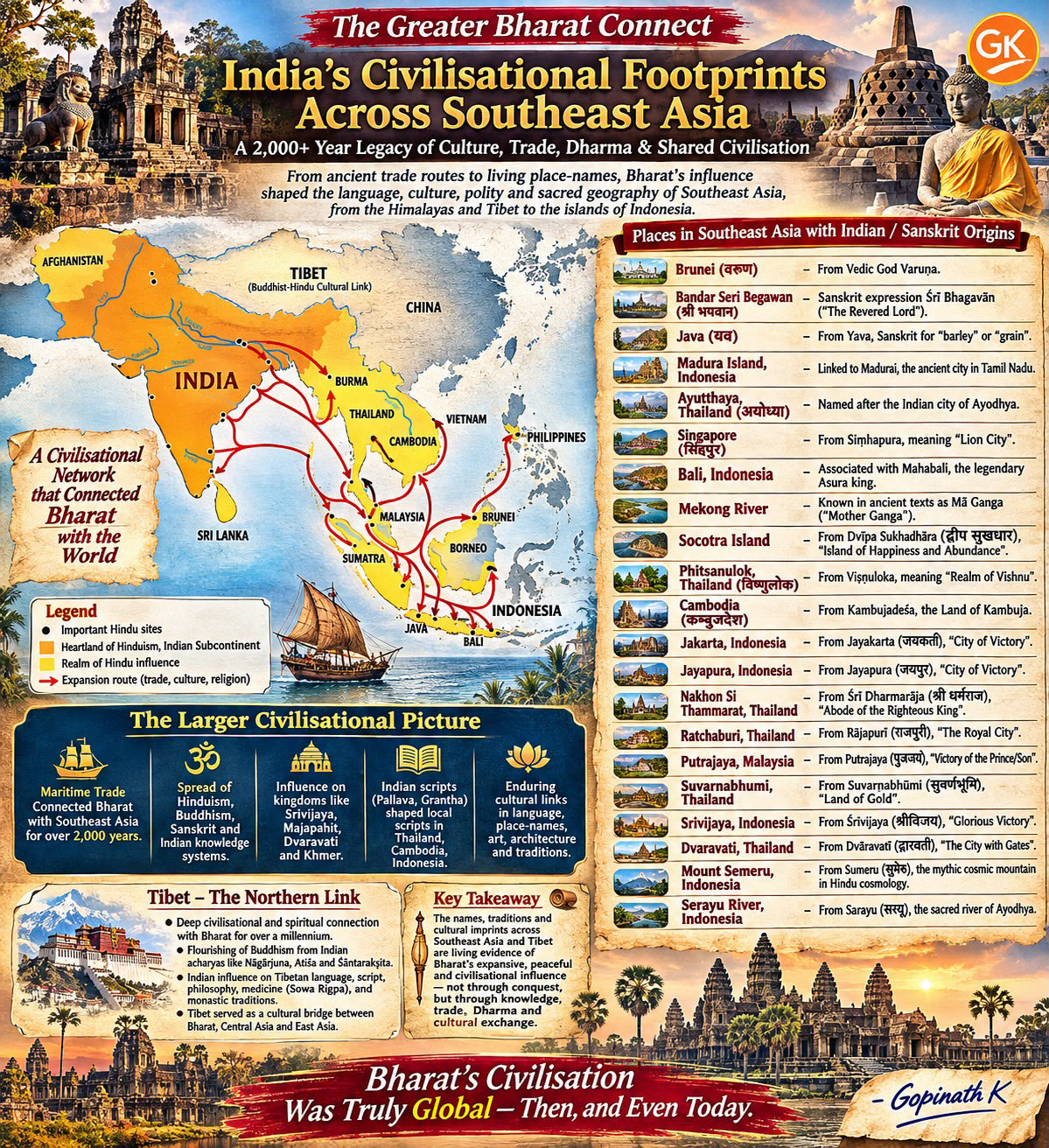
India occupies a distinctive historical position because its civilisational connections extend across South Asia, Central Asia, East Asia, Southeast Asia and West Asia, reaching the wider Eurasian world.
The ancient Silk Routes were more than commercial corridors. They carried philosophy, mathematics, medicine, literature, languages, artistic traditions and religious thought. The journeys of Faxian, Xuanzang, and Yijing to Indian centres of learning, particularly Nalanda, demonstrate the importance of international intellectual exchange. Kumarajiva connected Central Asian and Chinese Buddhist scholarship, while Indian mathematical knowledge travelled westwards. The Panchatantra found new expressions in Persian and Arabic literature, and the Ramayana became part of Southeast Asian cultural traditions.
These exchanges demonstrate that civilisations developed through encounters, adaptation and mutual learning. They retained their distinctive identities while contributing to a wider human experience. India’s contribution should therefore be understood as that of a historical facilitator of intellectual and cultural connectivity, not as a claim to the superiority of one civilisation over another.
Chanakya’s Raj Rishi Concept: Moving from Knowing to Understanding
Chanakya’s concept of Raj Rishi emphasises that effective leadership and governance must be guided by wisdom, self-discipline and a sense of responsibility towards society. This principle of ruling with wisdom also provides an important foundation for civilisational dialogue, which must move beyond the accumulation of information towards a deeper understanding of different perspectives, cultures and philosophies. Indian philosophical traditions offer valuable insights into this distinction. Jainism’s Anekantavada reminds us that reality has multiple dimensions and that no single perspective can claim to capture the whole truth, as illustrated by the parable of the blind men and the elephant. Advaita Vedanta, through the concepts of Maya and Avidya, explains how ignorance and misconceptions can veil reality and distort our perceptions. These traditions encourage intellectual humility, openness to different viewpoints and the willingness to revise our own assumptions. Information provides facts, knowledge connects them, but understanding enables us to recognise their deeper meaning and implications. In an increasingly divided world, this wisdom is particularly relevant: it calls for dialogue instead of judgement, empathy instead of prejudice, and informed action instead of impulsive reactions. True civilisational understanding therefore lies in looking beyond inherited filters, recognising the limitations of our own perceptions and remaining receptive to the wisdom of other traditions.
Nalanda: A Global Museum of Civilisational Wisdom
One of India’s most significant contributions to the future of this dialogue could be establishing a permanent SCO Museum and Research Centre for Civilisational Connectivity at Nalanda. Historically an international centre of learning, Nalanda provides an appropriate setting for an institution connecting its intellectual legacy with contemporary global challenges.
It should not become a conventional museum displaying monuments and artefacts behind glass. It should be a living institution that documents the evolution of human thought, philosophical traditions, religions, art, architecture, languages, scientific knowledge, social practices, and everyday life across civilisations.
Although the SCO countries could provide its initial institutional framework, the museum should progressively invite representatives of civilisations from Africa, Europe, the Americas and other parts of Asia. Hindu, Buddhist, Jain, Sikh, Islamic, Christian, Jewish, Zoroastrian, indigenous and other philosophical and spiritual traditions should find an inclusive place. The objective should be to bring together the wisdom of different traditions, recognising their contributions to human values, coexistence and harmony with nature.
For its presentation and learning systems, India could draw inspiration from the Canadian Museum for Human Rights in Winnipeg. Its thematic storytelling, interactive digital testimony and integration of research with public education offer useful models. Nalanda could adapt these approaches through artificial intelligence, multilingual digital archives, interactive historical personalities and virtual experiences. Visitors should be able to engage with the ideas of philosophers, scholars, and cultural practitioners; compare different approaches to justice, compassion, governance, and human dignity; and understand how societies have responded to common human challenges.
A digital scriptorium could preserve and translate manuscripts in Sanskrit, Pali, Persian, Chinese and Central Asian languages. An integrated international research centre, reference library and network of partner institutions in Samarkand, Bishkek, Dunhuang and other historical centres could support collaborative scholarship and exhibitions.
An Opportunity for India and the World
The real achievement of the First SCO Civilisational Dialogue will depend on what follows the declaration. India has an opportunity to transform this initiative into a lasting global platform for civilisational exchange, research and learning. The next international order will require more than military strength, economic resources or technological superiority. Through India’s philosophical ideals of Vasudhaiva Kutumbakam, let us offer a foundation for such leadership.
To translate this vision into action, India could consider the following initiatives:
- An International Civilisational Dialogue and Research Centre at Nalanda: Develop a modern museum, research and learning institution at Nalanda, reflecting its historic recognition across Asia, particularly in China, Southeast Asia and the Buddhist world, as one of the great seats of learning. Through modern museum technology, digital archives, research and international exchanges, it could bring together the philosophical, intellectual and cultural contributions of civilisations worldwide.
- A National Civilisational and Cultural Centre in South India: Establish a complementary centre, preferably in Tamil Nadu or another historically suitable location, integrating and showcasing India’s diverse civilisational evolution, including its philosophical, cultural, scientific, artistic, architectural and spiritual traditions from the South, Northeast, Himalayan regions and other parts of the country. South has more preserved historical sites from the Chola and other dynasties, which influenced and built many cultural structures in Southeast Asia.
- Connect the two centres through research and learning: The Nalanda International Centre and the proposed southern centre should function as complementary institutions, connecting India’s civilisational heritage with Asian and global traditions through research, exhibitions, digital learning and academic exchanges.
India has the historical depth, intellectual resources, and diplomatic opportunity to give this dialogue an enduring institutional legacy and contribute meaningfully to shaping the global civilisational discourse.