


The nature of counter-terrorism (CT) is changing, and so is India’s stance on it. The newly launched PRAHAAR policy reflects a cycle of evolution (Ministry of Home Affairs [MHA], 2026). India’s CT architecture has historically evolved in a reactive manner: reform followed a crisis. Today, terrorism moves faster than such a cycle can respond, through drones, online platforms and decentralised networks. PRAHAAR recognises this shift. However, the central argument of this article is that the priority is to make the measures work: they must be standardised, measurable and consistent with constitutional safeguards.
The History: India’s Counter-Terrorism Cycle of Reforms
After the Kargil War in 1999, the Kargil Review Committee exposed a critical gap in intelligence-sharing and coordination. This was further addressed by the Group of Ministers’ Report (Group of Ministers, 2001; Kargil Review Committee, 2000). This led to the formation of the Multi-Agency Centre in 2001. The Prevention of Terrorism Act (POTA), 2002, was repealed in 2004 following criticism relating to human rights abuses and alleged misuse (MHA, 2004). However, the UAPA, 1967, was amended as part of a process of recalibration, incorporating counter-terrorism provisions rather than leaving a legal void (Unlawful Activities (Prevention) Act, 1967).
The 2008 Mumbai attacks, which were launched by sea, highlighted the further need for institutional strengthening. The NIA Act, 2008, established a national investigative agency (National Investigation Agency Act, 2008), while NATGRID was conceived as an intelligence-sharing grid. This shifted counter-terrorism from information collection alone to integrated information systems. The reform cycle can be summarised as follows:
Figure 1
The Reform Cycle Following the Kargil War (1999)

India possesses a counter-terrorism architecture comprising statutes, central and state institutions, financial controls and technological tools. PRAHAAR consolidates these existing legal, institutional and operational capabilities into a seven-pillar national framework. Its significance lies in this doctrinal consolidation.
Legislative
India’s legal capacity rests on the UAPA, which defines terrorist acts (Section 15), criminalises fund-raising (Section 17) and conspiracy (Section 18), and empowers the Centre to designate organisations and, since 2019, individuals (Section 35) (Unlawful Activities (Prevention) Act, 1967). The NIA Act allows the NIA to investigate scheduled offences across states, concurrently with state police forces, and to address the wider enabling ecosystem, with the Centre able to take over an investigation under Section 6 (National Investigation Agency Act, 2008).
Institutional
India’s counter-terrorism architecture is layered. The Intelligence Bureau-led Multi-Agency Centre (MAC) shares intelligence; the NIA, alongside state police forces, investigates cases, while state Anti-Terrorism Squads (ATS) and the NSG handle tactical responses (MHA, 2024). The government reports an upgraded MAC-to-SMAC network with AI/ML software, district-level connectivity, NATGRID tools and the NIA’s National Terror Database Fusion and Analysis Centre (NTDFAC) (Press Information Bureau [PIB], 2025). PRAHAAR itself identifies cooperation and structural uniformity across state ATS units as ongoing requirements (MHA, 2026).
Financial
India’s AML/CFT framework is technically strong. In its 2024 evaluation, the FATF rated India as compliant or largely compliant with 37 of the 40 recommendations and recognised the strength of its financial intelligence. Case studies also show that the NIA and ED can trace complex money trails (Financial Action Task Force [FATF], 2024). The FATF’s comprehensive update of 8 July 2025 found that terrorist groups now combine older methods, such as physically moving cash and using hawala, with newer channels such as virtual assets, social media and crowdfunding (FATF, 2025). Its follow-up report of 26 June 2026 shows that online platforms are being used to raise funds through fake humanitarian appeals and tipping on creator platforms, with rotating wallets and QR codes (FATF, 2026). Yet fewer than 30% of reporting jurisdictions cover these risks in their national risk assessments (FATF, 2026). Terrorist financing therefore operates across several interconnected channels, directly challenging enforcement systems built around conventional financial transactions.
Decentralisation
CTED’s September 2026 trends report points to the growing decentralisation of terrorist propaganda. It now functions less as messaging and more as an established operational infrastructure for recruitment, financing, operational planning and governance (CTED, 2026). These groups exploit different online environments, including gaming-adjacent spaces. Europol’s EU TE-SAT 2025 report records instances in 2024 of minors networking online, becoming radicalised together and planning attacks (Europol, 2025). This decentralised mobilisation undermines an exclusive reliance on traditional, clearly identifiable organisational structures.
Financial Intelligence and Disruption
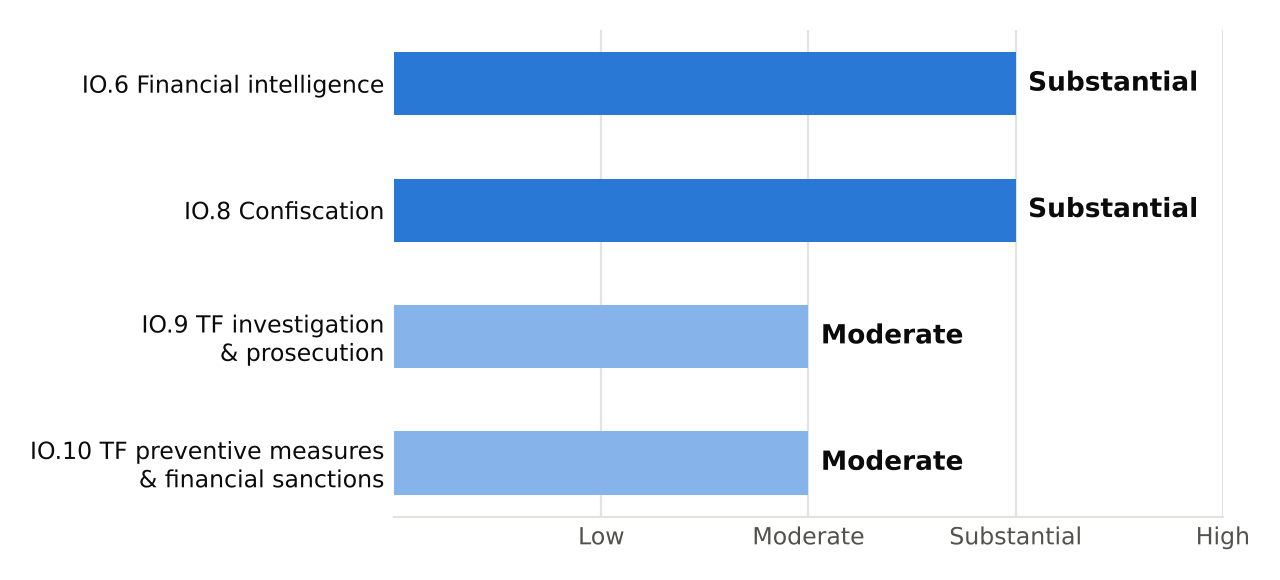
India’s weakness lies less in finding money than in converting financial intelligence into outcomes. The FATF’s 2024 evaluation rated financial intelligence (IO.6) and confiscation (IO.8) as Substantial, but terrorist-financing investigation and prosecution (IO.9), and preventive measures and sanctions (IO.10), as only Moderate (FATF, 2024; Figure 2). The FATF recommends structured public-private dialogue and the integration of financial and digital intelligence (FATF, 2026). India should explicitly address platform-enabled financing in its next national risk assessment, give FIU-IND and investigators the capacity to trace virtual assets, establish a lawful channel for sharing information with platforms, and expedite cross-border tracing requests. Suspicious patterns should be examined, not presumed to demonstrate intent. The number of suspicious transaction reports leading to investigations, the time taken to trace funds and the value of assets restrained should be tracked, with each stage measured independently.
Figure 2
FATF Effectiveness Ratings for India’s Selected Immediate Outcomes (2024) (FATF, 2024)
Prevention and Decentralised Mobilisation
Online platforms have made extremist mobilisation less dependent on formal terrorist organisations, making prevention more complex. Graded police intervention and community engagement (MHA, 2026) are key to addressing this challenge. The government must, however, put specific, measurable indicators in place to assess their outcomes. A 2024 review of 74 international evaluations found that most programmes had either limited success or, in some cases, contributed to stigma and alienation (Charkawi et al., 2024). India should therefore make programme outcomes more transparent and subject these interventions to independent evaluation.
International Cooperation and Accountability
PRAHAAR recognises that terrorist financing and online mobilisation across borders require provisions for extradition, mutual legal assistance treaties (MLATs) and information exchange (MHA, 2026). The gap is speed. ORF reports that MLAT requests to obtain data from US service providers have taken at least 10 months on average (based on a 2013 estimate covering all countries) (Swire et al., 2020). India should therefore prioritise terrorism-related data-preservation and financial-information requests through designated officers, set targets for handling times, and pursue a CLOUD Act agreement. India should also publish an annual summary of non-sensitive indicators, including training, preparedness, investigation outcomes, financial disruption and safeguards for rights.
Conclusion
India certainly has counter-terrorism mechanisms in place. PRAHAAR brings together existing capabilities and identifies the major threats. On the basis of the available public evidence, India’s architecture is substantial. The need now is for an operational framework that sets objectives, assigns responsibilities, and establishes standards, indicators and timelines against which delivery can be assessed.
The real test is what happens after a threat is identified: whether the alert reaches the district police; whether forensic and financial capabilities can turn intelligence into prosecutions; whether radicalisation can be prevented; and whether cross-border cooperation happens quickly enough to make a difference.