

While the world is engrossed and worried about the US and Israeli invasion of Iran and subsequent events impacting the global peace, trade and development, Russia seems to be pushing for the RIC Framework first propounded back in the nineties by the Russian Prime Minister, Primakov. In an exclusive article for the Saviours, we analyse the pros and cons of the RIC gambit.
Introduction
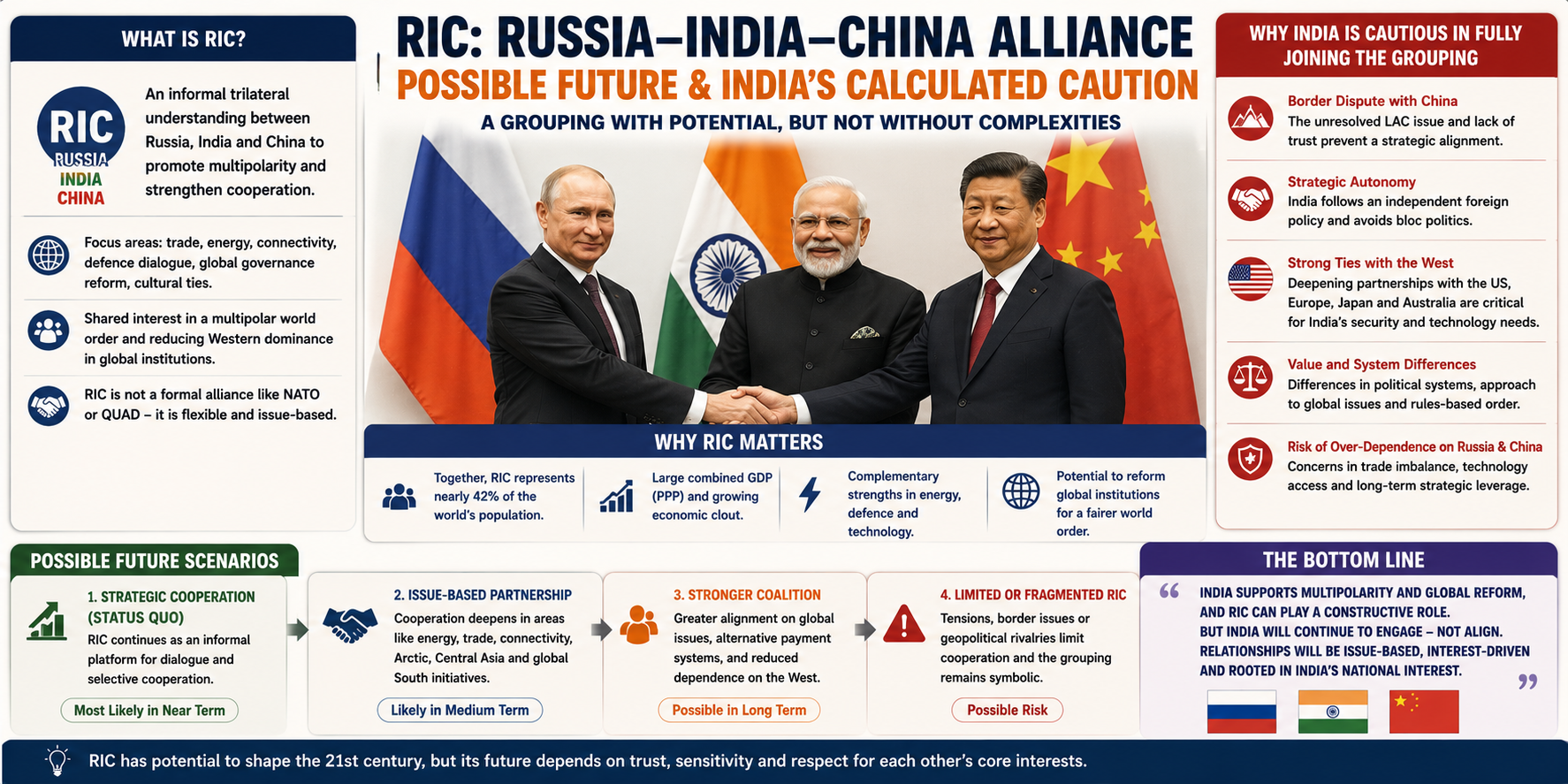
The Russia-India-China (RIC) framework dates back to the late 1990s, when former Russian Prime Minister and strategic thinker Yevgeny Primakov conceptualised it. Yevgeny Primakov served as Russia’s Foreign Minister from 1996 to 1998 and subsequently as Prime Minister from 1998 to 1999. He was the architect of the RIC strategic triangle, a core component of his foreign-policy doctrine, known as the Primakov Doctrine. Primakov was one of the strongest advocates of a multipolar world order, in which power would be shared among several major countries rather than dominated by a single superpower. During a visit to New Delhi in December 1998, he publicly proposed closer strategic cooperation among Russia, India and China. Primakov believed that such a partnership could help maintain global balance and provide an alternative centre of influence in international affairs. His idea later evolved into the Russia-India-China (RIC) framework and also helped shape the thinking behind larger groupings such as BRICS. The proposal reflected a broader shift in Russian foreign policy away from the strongly pro-Western approach of the early post-Cold War years. Instead, Moscow increasingly looked towards Asia and Eurasia, seeking a more independent role in world politics and stronger partnerships with major regional powers.
At a time when the international system appeared increasingly dominated by the United States after the end of the Cold War, Primakov proposed closer cooperation among the three major Eurasian powers. His idea was to create a strategic triangle that could promote a more balanced and multipolar world order. The concept was not directed against any particular country but sought to strengthen dialogue and cooperation among Russia, India and China on global political, economic and security issues. Over the years, the RIC format provided a useful platform for consultations among the three nations. Also, it helped lay the foundation for broader groupings such as BRICS and the Shanghai Cooperation Organisation, where the three countries continue to engage on matters of mutual interest.
The RIC framework has long functioned as an important platform for dialogue among three major Eurasian powers. Despite differences in their strategic interests, the mechanism facilitated consultations on regional and global issues and encouraged cooperation among emerging economies. However, the framework’s effectiveness declined significantly after the Galwan Valley clash in June 2020, which led to fatalities on both sides and triggered the most serious India–China border crisis in decades.
The Galwan Hit
The Galwan Valley clash severely undermined political trust between New Delhi and Beijing and created major obstacles to bilateral engagement. As border tensions continued, prospects for meaningful trilateral cooperation within the RIC framework diminished. Although Russia maintained strong relations with both countries, it became increasingly difficult to sustain the grouping’s momentum amid growing India–China tensions. As a result, RIC activities gradually became dormant, with limited high-level engagement. India has consistently maintained that lasting peace and stability along the Line of Actual Control (LAC) are essential for improving broader relations with China and revitalising cooperation in multilateral forums.
In 2025, Russia renewed efforts to revive the RIC mechanism, arguing that closer coordination among the three countries could contribute to global stability amid increasing geopolitical uncertainty. China publicly welcomed the proposal and expressed its readiness to resume trilateral discussions. India has indicated that it remains open to multilateral engagement in principle; however, it has not committed to any specific roadmap for reviving the forum. Indian policymakers continue to maintain that progress in resolving border-related concerns and improving overall bilateral relations with China will play a decisive role in determining the future of RIC cooperation. As a result, the revival of the framework remains a subject of discussion rather than a confirmed diplomatic development.
Russian Perspective
From Russia’s perspective, the RIC framework carries significance beyond routine diplomatic consultations. Moscow views India and China as two of Asia’s most influential rising powers and believes that cooperation among the three countries is crucial for strengthening Eurasia as an independent centre of global influence. The platform is also regarded as an important instrument for amplifying the Global South’s voice and promoting a more balanced international order that reflects the interests of emerging economies rather than being dominated by Western powers.
Russia’s interest in reviving the grouping has taken on greater urgency since the outbreak of the conflict in Ukraine. Western sanctions and political isolation efforts have encouraged Moscow to deepen its economic and diplomatic engagement with Asia. In this context, RIC offers Russia an opportunity to demonstrate its continued relevance in international affairs and to maintain strategic partnerships with two of the world’s major powers. Furthermore, Russia seeks to leverage its longstanding relationships with both India and China to facilitate dialogue and reduce tensions between them. By positioning itself as a bridge between New Delhi and Beijing, Moscow aims to preserve regional stability, maintain its influence in Asia, and promote greater cooperation across Eurasia.
China’s Interests
China’s support for reviving the RIC grouping is largely driven by its concerns about India’s growing participation in U.S.-led strategic arrangements, such as the Quad and the broader Indo-Pacific framework. Beijing has often viewed these initiatives with suspicion, believing that they are aimed at limiting China’s influence. From China’s perspective, a stronger RIC mechanism could encourage India to place greater emphasis on continental Eurasian cooperation rather than on maritime partnerships involving the United States and its allies. Chinese and Russian commentators have frequently criticised the Indo-Pacific concept, describing it as a source of bloc politics and geopolitical competition. At the same time, China presents RIC as a platform to improve regional stability. Beijing argues that Asia’s major powers should resolve their differences through dialogue rather than confrontation. Regular interaction among Russia, India and China, it believes, can reduce tensions, build confidence and contribute to a more stable regional environment.
Another important reason for China’s interest in RIC is its broader objective of strengthening non-Western institutions and promoting a more balanced international order. Beijing views the grouping as a useful complement to existing organisations such as BRICS and the Shanghai Cooperation Organisation. While these forums already provide opportunities for cooperation, China believes that RIC can serve as an additional channel for policy coordination among three of Eurasia’s most influential countries. The platform could facilitate discussions on a wide range of issues, including trade, technology, climate change and reforms of global governance institutions. China has consistently argued that developing countries and emerging economies should have a greater voice in international decision-making. Through closer coordination within RIC, Beijing hopes to advance common positions on important global issues and strengthen cooperation among major non-Western powers. In this way, the grouping supports China’s long-term vision of a more representative and multipolar world order.
China has a strong economic incentive to maintain stable relations with India, given the scale of bilateral trade. In FY 2024–25, India- China trade reached approximately US$127.7 billion, making China one of India’s largest trading partners. However, the relationship remains heavily imbalanced: India’s imports from China stood at about US$113.45 billion, while its exports were only US$14.25 billion, resulting in a trade deficit of roughly US$99.2 billion in China’s favour. This significant economic interdependence provides Beijing with a strong incentive to seek stable, predictable ties with New Delhi despite broader geopolitical differences.
India is Cautious
The principal reason for India’s hesitation to fully embrace the RIC framework is the deep trust deficit with China, which has widened manifold after the 2020 Galwan Valley clash. The incident, which resulted in the first fatalities along the India–China border in over four decades, fundamentally altered Indian perceptions of China and severely damaged political confidence between the two countries. Although subsequent diplomatic and military negotiations have led to disengagement in certain sectors of the Line of Actual Control (LAC), several underlying issues remain unresolved, preventing a complete normalisation of bilateral relations. Consequently, Indian policymakers have consistently maintained that normal relations cannot coexist with abnormal border conditions. This position reflects the belief that meaningful cooperation in broader political and strategic forums becomes difficult when core security concerns remain unsettled. Against this backdrop, deeper engagement within the RIC framework presents significant political and diplomatic challenges for India. Until lasting stability and mutual trust are restored along the border, New Delhi is likely to remain cautious about advancing trilateral cooperation with China through mechanisms such as RIC.
India’s hesitation toward the RIC framework is also shaped by China’s expanding strategic partnership with Pakistan, which New Delhi views as a direct security concern. China has become Pakistan’s largest source of external financing, providing tens of billions of dollars in investments and loans under the China–Pakistan Economic Corridor (CPEC), a flagship component of the Belt and Road Initiative. Beyond economic assistance, Beijing has emerged as Pakistan’s principal defence supplier, providing fighter aircraft such as the JF-17 Thunder, naval vessels, air-defence systems, armed drones, and missile-related technology. India argues that this extensive military cooperation significantly enhances Pakistan’s conventional and strategic capabilities. Additionally, the passage of CPEC through Indian territories in Jammu and Kashmir is viewed in New Delhi as a challenge to Indian sovereignty. These developments reinforce Indian concerns that China’s regional policies are not strategically neutral but are increasingly aligned with Pakistan’s interests.
The issue becomes even more sensitive because Pakistan-based terrorist organisations such as Lashkar-e-Taiba and Jaish-e-Mohammed are involved in terrorist attacks in India, including the 2008 Mumbai attacks and the 2019 Pulwama attack. Consequently, India remains sceptical about whether a stable and genuinely cooperative RIC arrangement is feasible, even as China continues its close strategic partnership with Pakistan.
Altered Symmetry
Another factor contributing to India’s caution is the growing power asymmetry within the RIC framework. When Primakov first proposed the idea in the late 1990s, Russia, India, and China were expected to function as relatively independent poles in a multipolar world. Today, however, China’s economic and technological capabilities far exceed those of the other two members. At the same time, Russia’s growing dependence on China—particularly after Western sanctions and geopolitical isolation—has altered the internal balance of the grouping. As a result, many Indian strategists fear that RIC could increasingly operate as a China-dominated platform, with Russia aligning more closely with Beijing’s preferences. This raises concerns that the original vision of an equitable and balanced strategic triangle no longer corresponds to contemporary geopolitical realities.
Strategic Autonomy
India’s contemporary foreign policy is anchored in the principle of strategic autonomy, which emphasises maintaining productive relations with multiple major powers rather than aligning exclusively with any one bloc. This approach, often described as “multi-alignment,” enables India to simultaneously deepen partnerships with Russia, the United States, Europe, Japan, ASEAN countries, and key Middle Eastern states while preserving its independent decision-making capacity. Such flexibility has become increasingly important in a fragmented international environment marked by great-power competition. Consequently, New Delhi is cautious about initiatives that could create the perception of India joining an anti-Western or anti-U.S. coalition. Although RIC is formally presented as a platform for multipolar cooperation rather than bloc politics, its revival amid growing tensions between Russia, China, and the West could generate adverse strategic perceptions. India, therefore, remains careful to ensure that participation in RIC does not constrain its broader diplomatic and economic partnerships.
India’s approach to the RIC framework is also influenced by its growing engagement with the Quad, comprising India, the United States, Japan and Australia. While India views the Quad as a flexible platform for cooperation in areas such as maritime security, technology, supply chains and disaster relief, China and Russia often regard it as a mechanism aimed at containing China. This difference in perception presents a diplomatic challenge for New Delhi. Greater participation in both the Quad and a revived RIC framework could create competing expectations, requiring India to carefully balance its strategic partnerships while preserving its policy of strategic autonomy.
The differing geopolitical visions of Russia and India also influence India’s cautious approach to reviving the RIC framework. Russia has increasingly emphasised the concept of “Greater Eurasia,” which prioritises continental integration, overland connectivity, and the development of institutions that can reduce Western influence across the Eurasian landmass. India, by contrast, places significant importance on a free, open, inclusive, and rules-based Indo-Pacific, with a strong focus on maritime security, freedom of navigation, resilient supply chains, and diversified strategic partnerships. While the two visions are not entirely incompatible and share certain areas of cooperation, their primary strategic priorities differ considerably. As a result, India must carefully balance its Indo-Pacific commitments with its Eurasian initiatives, contributing to a measured, cautious stance toward deeper engagement within the RIC framework.
Economic considerations also influence India’s reservations regarding deeper engagement within the RIC framework. Despite substantial bilateral trade, India continues to face a significant trade deficit with China, alongside concerns relating to limited market access for Indian firms and excessive dependence on Chinese technology and supply chains. Consequently, New Delhi may be hesitant to expand political and strategic cooperation without meaningful progress in addressing these longstanding economic imbalances and commercial grievances.
India is also mindful of the strategic signals that greater enthusiasm for RIC could send to its international partners. Given its expanding ties with the United States, Europe, Japan, and other Indo-Pacific partners, a visible shift toward RIC could be interpreted as India moving closer to a Russia–China axis. Such perceptions could create uncertainty regarding India’s commitment to the Indo-Pacific framework and broader strategic partnerships. As a result, New Delhi carefully calibrates its diplomacy to avoid unintended geopolitical messaging and preserve confidence among all major partners while maintaining its policy of strategic autonomy.
India Reserves the Right
Despite its reservations, India has not ruled out reviving the RIC framework. Official statements from the Ministry of External Affairs have consistently left the door open to engagement in a “mutually convenient manner,” reflecting New Delhi’s preference for diplomatic flexibility rather than outright opposition. This approach is closely linked to India’s commitment to strategic autonomy and its longstanding practice of maintaining relationships across competing geopolitical groupings. Furthermore, Russia continues to occupy an important place in India’s foreign policy as a key partner in defence cooperation, energy security, and connectivity initiatives across Eurasia. At the same time, India recognises that sustained dialogue with China remains necessary even amid unresolved disputes, particularly to prevent misunderstandings and manage tensions along the border. Consequently, New Delhi views RIC not as a preferred strategic platform at present, but as a potentially useful diplomatic mechanism that should be preserved rather than abandoned entirely.
Future of RIC
Looking ahead, the future of the RIC framework is likely to fall somewhere between limited engagement and selective functional cooperation rather than a full strategic revival. The most plausible scenario is a limited revival, with occasional meetings among foreign ministers and coordination on issues such as global governance, development, and multilateral reform, without significant strategic convergence. A more substantive form of cooperation could emerge in specific areas, including climate change, BRICS coordination, Global South initiatives, United Nations reform, and counterterrorism. However, a comprehensive strategic revival remains the least likely outcome. Such a development would require sustained improvement in India–China relations, a durable reduction in border tensions, and greater confidence regarding China’s relationship with Pakistan. Since these conditions are currently absent, RIC is more likely to function as a pragmatic diplomatic forum than as a cohesive geopolitical partnership.
Conclusion
India’s hesitation to revive the Russia–India–China (RIC) framework should not be interpreted as a rejection of multipolarity, strategic dialogue, or cooperative regionalism. Rather, it reflects a careful and pragmatic assessment of the contemporary geopolitical environment. The deterioration of trust following the Galwan Valley clash, China’s deep strategic partnership with Pakistan, persistent economic asymmetries, and concerns regarding an increasingly China-centric regional order have significantly altered the context in which RIC was originally conceived. At the same time, India’s expanding engagement with the Indo-Pacific, the Quad, Europe, the United States, Japan, and other strategic partners has increased the complexity of its foreign policy choices. While Russia continues to view RIC as an important pillar of a multipolar international system and China regards it as a mechanism for reducing strategic polarisation, India remains unwilling to pursue trilateral cooperation at the expense of its security interests, territorial concerns, or strategic autonomy. Consequently, New Delhi is likely to continue adopting a calibrated approach—remaining open to dialogue while avoiding commitments that could constrain its broader diplomatic objectives. The future of RIC will therefore depend largely on the trajectory of India–China relations and the extent to which existing sources of mistrust can be meaningfully addressed. Until such conditions emerge, any revival of the framework is likely to remain gradual, limited, and issue-specific rather than transformational.