

Introduction
The recent unrest in Pakistan-Occupied Jammu and Kashmir (POJK) has emerged as one of the most serious internal challenges confronting Pakistan in recent years. What began as protests against rising electricity tariffs, inflation and the soaring cost of essential commodities has evolved into a broader movement questioning governance, political accountability and administrative neglect. Led by the Joint Awami Action Committee (JAAC), demonstrations, strikes and shutdowns spread across several towns, drawing widespread public participation. The deployment of additional security forces and their excessive use of force against protesters, arrests of activists and restrictions on communications have further intensified public anger and invited international scrutiny. Violent clashes, casualties and restrictions on public gatherings underscored the gravity of the crisis, attracting attention not only within Pakistan but also across South Asia and the wider international community.
The trouble extends far beyond economic hardship. It reflects years of accumulated public dissatisfaction with unemployment, underdevelopment, limited political representation, and the perception that the region’s resources have yielded few benefits for its residents. As the movement gathered momentum, demands expanded to include greater administrative accountability, institutional reforms and protection of civil liberties. The protests have therefore exposed deeper structural weaknesses in Pakistan’s governance of the POJK, with implications that extend beyond domestic politics to regional stability and India’s security environment. It is against this broader political and strategic backdrop that the present crisis must be understood.
Understanding POJK: Political & Administrative Context
Following the events of 1947–48, Pakistan-backed tribal militias, supported by the Pakistani Army, occupied parts of the erstwhile princely state of Jammu and Kashmir. India regards these territories, collectively referred to as Pakistan-Occupied Jammu and Kashmir (POJK), as an integral part of its sovereign territory. Pakistan administers them separately as the so-called ‘Azad Jammu and Kashmir’ and Gilgit-Baltistan. Although POJK has an elected Legislative Assembly and local government, Islamabad retains significant control over key political, financial, and administrative matters, thereby limiting its autonomy. Given its strategic location along the Line of Control and near China, POJK remains central to South Asia’s security dynamics. It is within this political and administrative context that the current wave of public disgruntlement must be understood.
The Road to Unrest: From Economic Grievances to Political Mobilisation
The present turbulence in POJK did not emerge suddenly but was the culmination of years of mounting public dissatisfaction over deteriorating economic conditions, governance deficits and limited political autonomy. Rising inflation, unemployment and the increasing cost of essential commodities placed severe pressure on ordinary households. Sharp increases in electricity tariffs, despite the region’s considerable hydropower potential, became a particular source of resentment. At the same time, higher prices of wheat flour, fuel and other essential goods further intensified public hardship. Gilgit-Baltistan is endowed with abundant natural resources, including globally recognised gemstones such as rubies, emeralds, sapphires, aquamarine, and peridot, as well as deposits of gold, copper, lead, zinc, marble, granite, and other industrial minerals. Despite this considerable resource wealth, critics argue that the region has derived limited economic benefits, reinforcing perceptions of neglect and resource exploitation. These concerns gradually created an atmosphere of frustration and distrust. The POJK citizens allege that the resources of POJK are exploited by Punjab province.
Longstanding governance challenges compounded economic grievances. Limited industrial development, inadequate employment opportunities and poor infrastructure constrained economic growth, particularly for the younger generation. Public dissatisfaction was further fuelled by the widespread perception that major political, financial and administrative decisions were still largely shaped by Islamabad rather than by locally elected institutions. Over time, these concerns strengthened demands for greater transparency, administrative accountability and meaningful political participation.
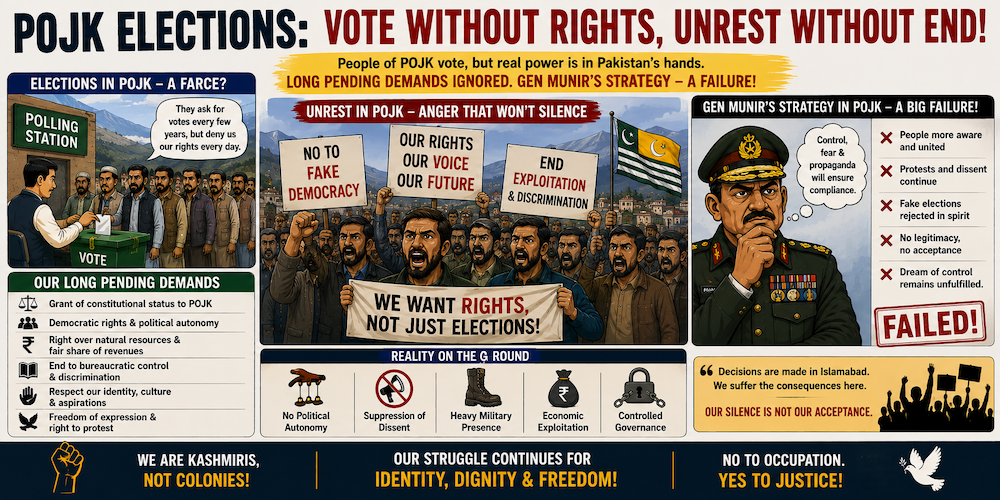
Against this backdrop, protests initially focused on affordable electricity, the restoration of subsidies, and lower prices for essential commodities. However, under the leadership of the JAAC, comprising traders, lawyers, transport operators and civil society groups, the agitation gradually evolved into a wider movement seeking governance reforms, greater accountability and stronger protection of civil liberties. The movement reflected growing frustration that economic hardships could not be separated from deeper structural issues relating to governance and political representation.
From Protest to Confrontation
The protest movement first gathered significant momentum during 2024 before entering a far more confrontational phase in 2025–26. Large demonstrations, market shutdowns, road blockades and sit-ins were organised across Muzaffarabad, Rawalakot, Mirpur, Kotli and several other towns, attracting widespread participation from people of all walks of life. The breadth of participation demonstrated that the movement had expanded well beyond a limited pressure group and had become one of the largest public mobilisations witnessed in POJK in recent years.
As the protests expanded, demonstrators increasingly questioned the region’s political and constitutional arrangements. Among their principal grievances were allegations of electoral manipulation and excessive political influence exercised by Islamabad over local institutions. Protesters also criticised the composition of the 53-member Legislative Assembly, arguing that representatives elected by refugees residing in different parts of Pakistan should not determine the formation of governments in POJK. These demands reflected broader calls for greater democratic accountability, institutional transparency and meaningful local decision-making.
Repeated negotiations failed to produce a durable settlement, leading to further escalation. The situation reached a decisive stage in early June 2026 when the authorities declared the JAAC a proscribed organisation under anti-terrorism legislation and initiated action against several of its leaders. Tensions escalated further on 8 June, when security forces attempted to disperse protesters in Rawalakot. Clashes involving baton charges, firing and violence resulted in multiple casualties and injuries. Official figures acknowledged 11 deaths and more than 70 injuries, while JAAC leaders alleged that the actual civilian toll was considerably higher. On 9 June, a region-wide strike brought normal life to a standstill across Muzaffarabad and several other towns. As the situation deteriorated, Rangers and additional paramilitary forces were deployed in support of the civil administration. Protesters alleged that excessive force, arbitrary arrests and communication restrictions were used to suppress the movement, whereas the authorities maintained that the measures were necessary to restore law and order. In the days that followed, negotiations continued alongside intermittent protests and shutdowns. While official sources reported a substantially lower death toll, JAAC leaders and activist networks alleged that civilian casualties were significantly higher, with some estimates exceeding 100 deaths. Owing to restrictions on media access and the absence of independent verification, these figures remain contested.
In several areas, internet and mobile communication services were suspended or disrupted, reportedly to prevent mobilisation and the spread of information. Protesters alleged that these measures were intended to suppress peaceful demonstrations, whereas the authorities maintained that they were necessary to preserve law and order and protect public property.
The authorities subsequently announced concessions, including revisions to electricity tariffs and subsidies on essential commodities. Although these measures temporarily eased tensions, they failed to address the deeper concerns relating to governance, political representation and public trust. Consequently, the movement retained its broader political significance and continued intermittently despite official relief measures.
Security Response and Human Rights Concerns
The authorities responded to the escalating unrest with an increasingly forceful security operation aimed at restoring administrative control. Police and security personnel employed baton charges, tear gas and, on several occasions, live ammunition to disperse demonstrators in Rawalakot, Muzaffarabad and other towns. Following the proscription of the JAAC, numerous leaders and activists were arrested under anti-terrorism legislation or placed in preventive detention. Public gatherings were restricted, security checkpoints were established, and communication services were reportedly disrupted in several areas to limit mobilisation.
The conduct of the security forces became one of the most contentious aspects of the crisis. Protest organisers, lawyers’ bodies and sections of civil society alleged disproportionate use of force, arbitrary arrests, intimidation of political activists and restrictions on peaceful assembly and media access. The authorities rejected many of these allegations, maintaining that the measures were necessary to restore law and order and protect public property amid escalating violence.
Casualty figures also became a subject of dispute. Official sources acknowledged fatalities among both civilians and security personnel, while JAAC leaders and activist networks claimed that the civilian death toll was substantially higher. Owing to restrictions on media access and the absence of independent verification, the precise human cost of the disturbance remains contested. The conflicting narratives themselves became a defining feature of the crisis, highlighting the difficulty of establishing an authoritative account of events and intensifying concerns regarding transparency, accountability and adherence to internationally recognised human rights standards.
Why This Crisis is Different
Unlike earlier episodes of turbulence in POJK, the 2026 protests evolved into a broad-based socio-economic movement cutting across political, occupational and generational divides. Participation extended beyond traditional political activists to include traders, transport operators, lawyers, students, women and youth organisations, reflecting widespread dissatisfaction with both economic conditions and governance. Social media and local community networks facilitated rapid mobilisation across multiple districts, giving the movement an unprecedented geographical reach and organisational coherence.
Equally significant was the transformation of the agitation from a campaign centred on electricity tariffs and subsidies into a wider movement questioning governance, political accountability and the existing administrative framework. The persistence of demonstrations despite official concessions suggested that public dissatisfaction had acquired a deeper political dimension that could not be addressed through economic relief measures alone.
For India, these developments merit close attention. Instability in Pakistan-administered territories adjoining the Line of Control carries implications for regional security, cross-border dynamics and Pakistan’s internal political stability. The discontent has also renewed debate over governance and human rights in territories that India regards as an integral part of the erstwhile princely state of Jammu and Kashmir. Consequently, the present crisis represents not merely an episode of economic protest but a significant political development with broader regional and strategic implications.
Implications for Pakistan
The turmoil in POJK has exposed deeper structural governance challenges extending beyond immediate economic grievances. The protests reflected growing public dissatisfaction with inflation, electricity tariffs, taxation and perceptions of administrative inefficiency. More significantly, they highlighted the limitations of relying primarily on coercive measures to manage socio-economic discontent. The scale and persistence of the agitation have inevitably raised questions about the responsiveness of local institutions and the federal government’s capacity to address public grievances through dialogue and effective governance. The episode may also encourage similar socio-economic mobilisations in other regions facing comparable economic pressures.
The crisis has also imposed additional economic and security burdens on Pakistan. Prolonged strikes, transport disruptions and market closures adversely affected commercial activity and public services, while the deployment of additional Police and Rangers required substantial administrative and financial resources. Simultaneously, the disturbance compelled security agencies to divert attention towards internal stability at a time when Pakistan continues to confront terrorism, sectarian violence and cross-border security challenges. Managing multiple internal security priorities simultaneously further strains already constrained state institutions and resources.
Beyond its domestic consequences, the crisis carries wider political and diplomatic implications. Allegations of disproportionate use of force, communication restrictions and mass arrests attracted international attention and renewed scrutiny of governance practices in Pakistan-administered Kashmir. Although Islamabad maintained that its actions were necessary to restore public order, the disturbances gave critics additional grounds to question Pakistan’s human rights record and its administrative management of the region. More broadly, the episode underscores the importance of responsive governance, institutional accountability and timely socio-economic reforms in preserving political legitimacy and preventing localised economic grievances from evolving into wider political crises. For the federal authorities, the episode serves as a reminder that long-term stability in POJK cannot rest solely on security measures but requires sustained economic reforms, transparent governance and credible political engagement with local stakeholders.
As the ground situation shows no sign of coming under control, the Federal Government is reportedly considering invoking Article 56 of the Azad Jammu and Kashmir Interim Constitution Act, 1974, which could give Islamabad far-reaching powers over the administration of POK. The provision empowers the Government of Pakistan to take such action as it deems necessary or expedient to discharge its constitutional responsibilities, potentially enabling it to override or substantially curtail the authority of POK’s elected government and to strengthen direct federal control.
Invocation of Article 56 could have serious political and constitutional consequences. It could weaken the authority of POK’s elected institutions, reduce the scope of its administrative autonomy and pave the way for a greater federal role in governance and security. Such an intervention, however, may prove counterproductive if it is perceived as an attempt by Islamabad to suppress popular grievances rather than address them. It could further alienate the population and strengthen demands for greater political and administrative autonomy.
Meanwhile, Pakistan has taken a significant step towards granting Gilgit-Baltistan the status of its fifth province, with the regional assembly unanimously backing the proposal. The move has wider strategic implications, particularly for China, whose economic and security interests in the region are closely linked to CPEC and the Karakoram corridor. Any constitutional restructuring of Gilgit-Baltistan, therefore, must also be viewed against the backdrop of Pakistan’s efforts to consolidate administrative control over territories of strategic importance to China.
Implications for India
The developments in POJK have important implications for India’s security, diplomatic and strategic calculus. While the protests have been triggered by local socio-economic grievances, instability in the region cannot be viewed in isolation from Pakistan’s broader security environment and its continued support to cross-border terrorism directed against India. Historically, periods of internal political and economic turbulence in Pakistan have increased security concerns for India, as Pakistan’s security establishment has often attempted to divert domestic attention through hostile postures along the Line of Control (LoC) and by allowing terrorist networks to exploit instability. India will therefore need to maintain sustained operational readiness, strengthen intelligence coordination and closely monitor developments across the LoC.
The unrest also highlights the continuing importance of information warfare in the India-Pakistan rivalry. Competing narratives regarding casualties, the conduct of security forces and the nature of the protests have circulated widely, often without independent verification. Pakistan’s restrictions on sections of the media, including the reported blocking of Al Jazeera’s coverage, have further underscored the challenge of obtaining reliable information during periods of disturbance, making it clear that transparency is lacking. India’s measured response has allowed New Delhi to highlight developments through established diplomatic channels while countering attempts to attribute internal grievances in POJK to external factors.
From a diplomatic perspective, the protests have once again drawn attention to governance failures, political marginalisation and a lack of accountability in POJK. Consistent with India’s position that the entire erstwhile princely state of Jammu and Kashmir legally acceded to India in 1947, New Delhi can continue to highlight concerns regarding democratic rights, freedom of assembly, and administrative accountability. However, India must also remain cautious, as any direct involvement could provide Pakistan an opportunity to shift attention away from genuine public grievances and accuse India of interference.
The developments also underscore the stark contrast between governance trajectories on both sides of the LoC. Improvements in infrastructure, connectivity, tourism and democratic participation in Jammu & Kashmir demonstrate the importance of accountable governance and economic development in maintaining stability. In contrast, recurring unrest in POJK reflects continuing dissatisfaction among sections of the population regarding governance and political representation.
At the strategic level, the unrest reinforces the importance of a calibrated policy that combines robust border management with sustained diplomatic engagement. Alongside maintaining vigilance against infiltration and cross-border terrorism, India can continue to call upon Pakistan to dismantle terrorist infrastructure operating from territories under its control, including POJK, in fulfilment of its international obligations.
Finally, allegations by leaders of the JAAC regarding electoral irregularities, juxtaposed with the ruling party’s strong performance in the initial phases of elections despite widespread protests, are likely to invite greater scrutiny of the electoral process and political legitimacy in Pakistan-administered Kashmir. Whether these allegations are substantiated or not, they add another dimension to the broader debate on governance, public trust and representative institutions in the region.
Conclusion
The discontent in Pakistan-administered Kashmir is not merely an economic protest but a reflection of deeper governance, political and administrative challenges confronting Pakistan. While immediate grievances related to prices, subsidies and economic hardships triggered public anger, the persistence of such movements indicates broader concerns about political representation, accountability and public trust. Without meaningful dialogue and economic and institutional reforms, periodic unrest is likely to continue.
The crisis has emerged at a time when Pakistan is facing severe economic difficulties, mounting debt obligations and increasing pressure on public finances. However, the challenges are not confined to POJK. Growing dissatisfaction in Balochistan, which constitutes a significant part of Pakistan’s territory, and concerns about development projects such as the China-Pakistan Economic Corridor (CPEC) reflect broader questions about governance, local participation, and equitable development.
For Pakistan, the developments underline the need to address internal grievances rather than attribute domestic discontent primarily to external factors. A stable neighbourhood requires political inclusion, economic opportunity and accountable governance. For India, the situation reinforces the importance of maintaining vigilance along the LoC while highlighting the contrast between democratic governance and development outcomes in Jammu & Kashmir and the POJK. Ultimately, lasting stability in the region will depend not only on security measures but also on addressing the aspirations and concerns of the people.