


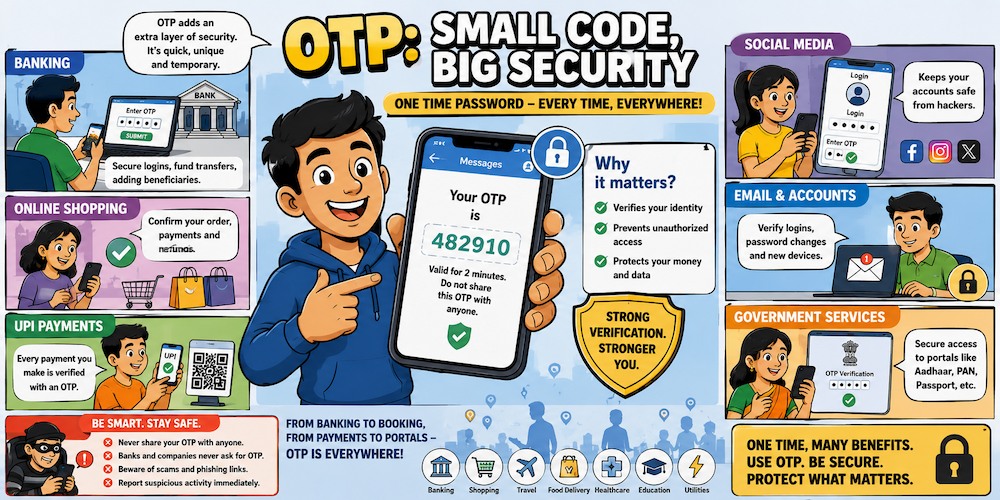
UPI payments have seen exponential growth in India. Emphasis on multi-layered security is built on a one-time use password, popularly known as an OTP. It seems access to the digital world is dependent on one thing that keeps your phone busy – the OTP.
“Kindly enter the OTP sent to your registered mobile number.” Simple. Except where do I look for it? SMS? WhatsApp? Email? By the time I figured out where it had actually landed, the website politely informed me, “Your OTP has expired!”
Resend OTP.
This time, the OTP arrived after I’d already clicked “Resend”. Now, I had two OTPs, neither of which worked. To make matters worse, my session expired, so I had to fill in all the information again. It wasn’t about filling e-return anymore. It had become a speed-typing, patience-testing competition in which the prize was access to my own account. After successfully proving I wasn’t a robot through CAPTCHA (it only took three attempts this time), entering my PAN number, Aadhaar card details, password and date of birth, I still couldn’t prove I was… me without the correct OTP. So much importance does one-time password have in our daily lives now!
Earlier, OTPs were largely confined to Banking. Today, they’re everywhere. Online Shopping? OTP. Amazon delivery? OTP. IT Returns? OTP. Changing password? OTP. Utility bill payments? OTP.
And then there is the OTP you never asked for.
You could be sitting peacefully with your tea when your phone suddenly buzzes. “Your OTP is 482913.” You haven’t logged into anything. You haven’t ordered anything. You haven’t changed your password. For a few seconds, you mentally scan your entire digital existence. Who is trying to do what? The OTP that was supposed to make us feel secure has also given us a new kind of anxiety.
The other day, my house-help suddenly abandoned half-washed utensils and said, Didi main abhi aayi, ghar pe cylinder wala aaya hai, OTP dena hai”. The utensils could wait; OTP couldn’t. Receiving a courier has now become a family activity. “Didi courier wala OTP maang raha hai.” Acha, kiska courier hai?” “Bhaiya ka”. “Bhaiya ko phone karti hoon” and unfortunately, Bhaiya ji hasn’t received the OTP yet. “OTP aaya”. “Kitna hai”, “Jaldi batao!”. Even when you’re out for school pick up, the most common calls from home are “Ek OTP aaya hoga, …batana.” These four or six random digits have somehow acquired the urgency of a medical emergency.
And then comes the great contradiction. The very number we are repeatedly told never to share with anyone is often shouted across the balconies for everyone to hear!
There is also the challenge of actually remembering the OTP. You read it in your SMS—482913. Easy enough. You switch back to the app to enter it, and suddenly… nothing. Was it 482913 or 482193? You go back to check, return to the app, and by then the whole sequence has vanished from your memory. You type what you think you remember and, of course, the website says, “Invalid OTP.” You try again, but now you’re not even sure whether you’re entering the OTP or recreating it from memory. Sometimes I feel the real security feature isn’t the OTP at all; it is my brain’s remarkable ability to forget six digits within five seconds.
These four (or six) random digits have quietly entered our everyday vocabulary and routines. Of course, all this is for the safety of our bank accounts, and yet, news of online frauds and bank scams continues to make headlines.
We have passwords for our accounts, OTPs for our passwords and CAPTCHAs to prove that we are human. At this rate, I won’t be surprised if one day a website asks me to produce a character certificate before allowing me to log in!
Just like an OTP authenticates so many transactions every day, how much I wish it could verify real-life situations, too! A simple “Verify it’s really true” would have saved us from much more than online fraud. Not because people are untrustworthy, but because certainty itself has become a luxury. Imagine how convenient life would become if every important claim comes with an OTP! Meeting someone from a matrimonial site? OTP please. Government promising ‘ache din’? OTP please. Iran announcing, “No more air strikes.” OTP please. Guaranteed transformation in 21 days, OTP please. “NEET exam is completely secure.” OTP please.
The funny thing is that we have become so accustomed to verifying everything digitally that we almost expect the little code to settle every doubt. A six-digit number appears on our screen, and suddenly we feel reassured. No explanation required. No lengthy conversation. Just enter the numbers and proceed.
Maybe that is what makes OTPs so fascinating. They are tiny, temporary and completely meaningless on their own. Yet, for those few seconds, they carry enormous importance. And then, just as quickly as they arrive, they expire. Much like some of the passwords, promises and assurances we encounter in real life!
Since OTPs have become such an inseparable part of our lives, I have also generated an OTP system with my house didi: “Sunita, OTP”. “Lai didi”, and here is my OTP: One Tea Please! This is the only OTP I don’t mind receiving anytime, anywhere, and the one which never expires!