

Three Pens at Turtle Bay
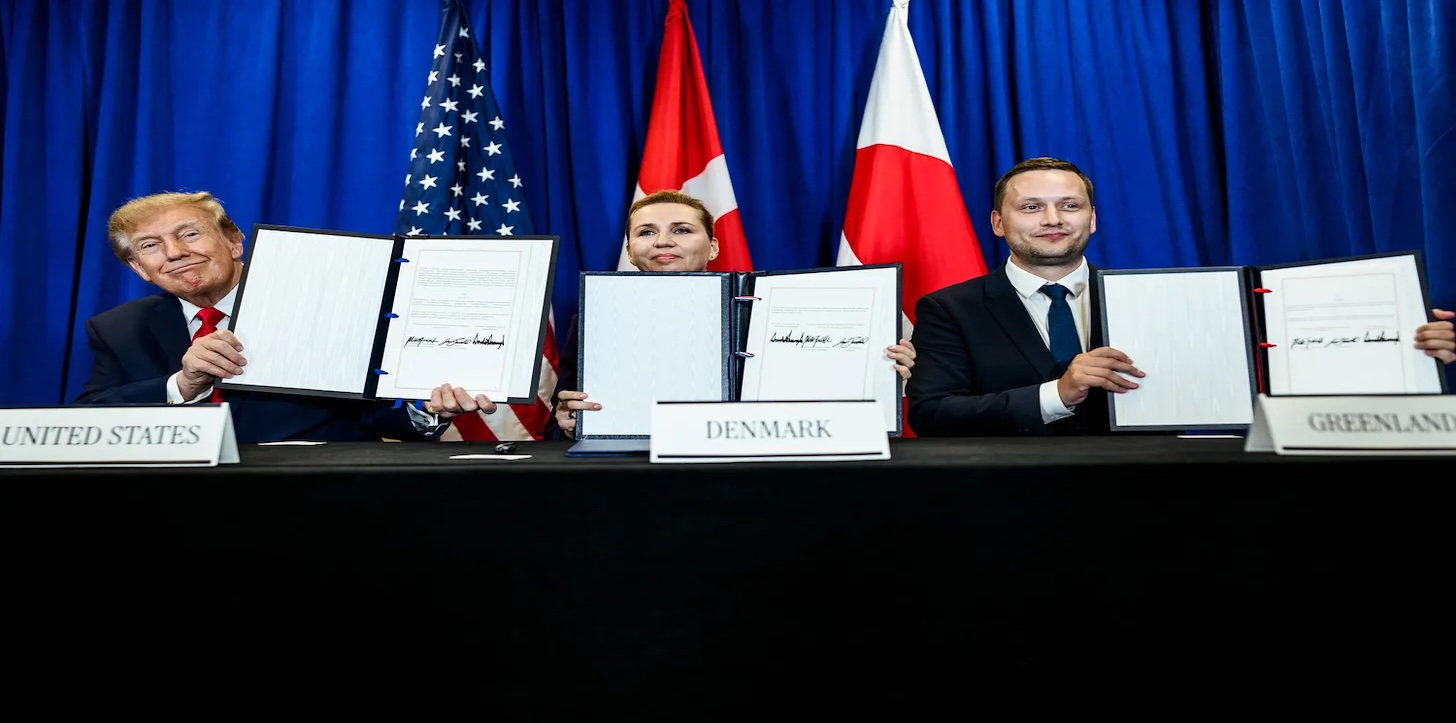
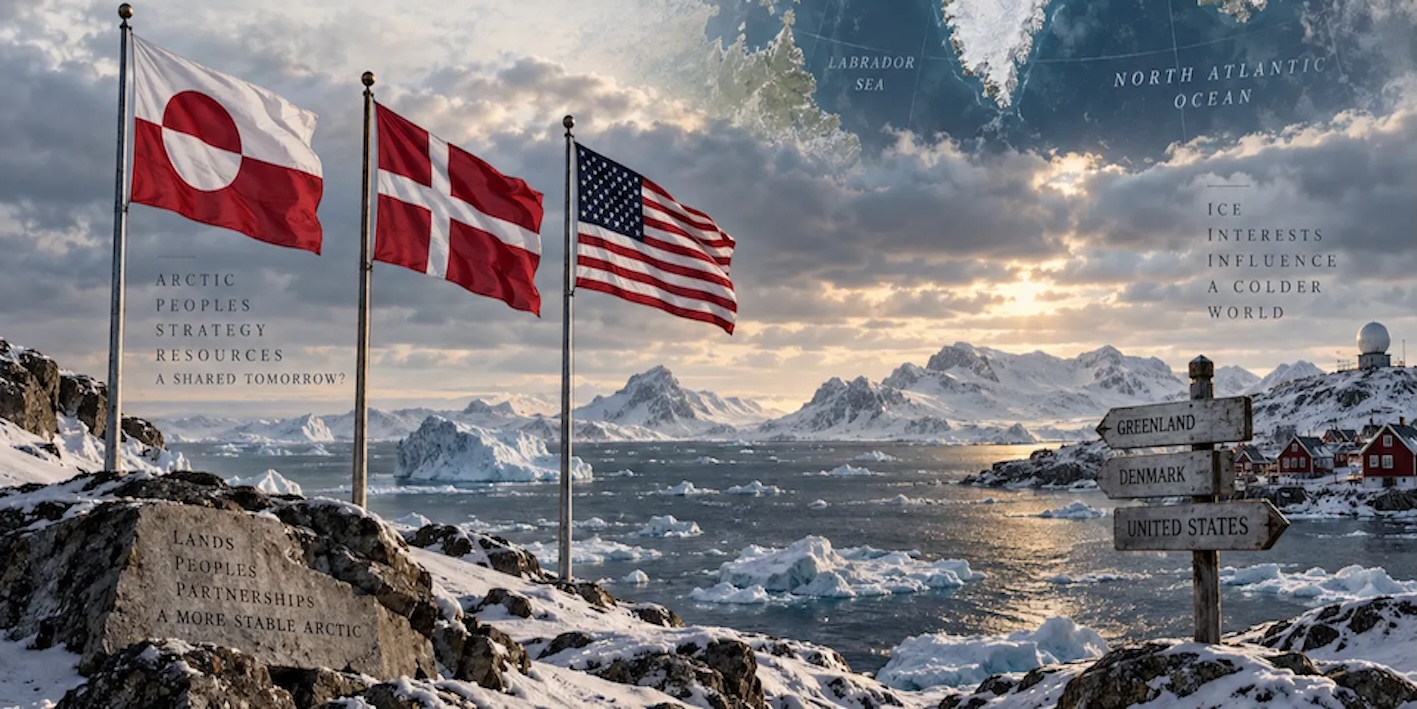
Minutes after addressing the 81st session of the General Assembly on 22 September 2026, President Donald Trump sat down at United Nations headquarters with Prime Minister Mette Frederiksen of Denmark and Prime Minister Jens-Frederik Nielsen of Greenland, beneath three flags, and signed an Arctic security agreement. Each government keeps a signed copy in English, Danish and Greenlandic. It enters into force only after parliamentary procedures in Copenhagen and Nuuk.
Eight months earlier, Danish special forces had deployed to Greenland carrying explosives intended to turn off the airstrips at Nuuk and Kangerlussuaq, and blood supplies for casualties, against the possibility of an American landing. Measured from there, a signing ceremony with three pens is an extraordinary de-escalation. Measured against Washington’s initial demand, it is a modest gain.
What Was Actually Signed
The instrument’s own title states its modest legal character. It amends and supplements the Defence of Greenland Agreement of 27 April 1951 and the arrangements built on it since, most importantly the 2004 Igaliku amendment that brought Greenland’s own government into the framework.
Its salient features are these. The United States may modernise and expand Pituffik Space Base, the former Thule, which watches the polar missile approaches. It may establish additional defence areas at Narsarsuaq in the south and Mestersvig on the east coast, roughly 950 miles apart. It may propose further areas subject to the agreement of the other parties. The preamble records a shared interest in American military access, including for a Golden Dome missile-defence system, and states that the amendments reinforce the permanent character of the arrangements. No state outside NATO may establish military installations on the island without the agreement of all three parties. Investment screening is tightened against control or ownership originating outside NATO, its partners and the European Union, with China and Russia the evident targets. The agreement carries no expiry date, may be amended only by mutual consent, and continues in force even if Greenland becomes independent.
Nielsen summed it up by saying that the world has changed a great deal since 1951.
The Sovereignty Column
Nothing in the text moves the title. Sovereignty remains with the Kingdom of Denmark, Greenland’s self-government continues, and the right of the Greenlandic people to self-determination is recorded in the document rather than promised at a podium.
Greenland also signs as a party in its own right. In 1951, it was not at the table at all; Washington and Copenhagen made the agreement governing its territory. In 2026, its premier holds one of the three pens. The investment screen, too, is drawn as a membership test rather than an American discretion. The excluded category is defined by who sits outside NATO, its partnerships and the EU, which is an objective criterion capable of legal application, rather than a list that Washington may revise at will.
Set that against the opening demand. In January the President said he wanted Greenland, including right, title and ownership. What he has is a widened and formalised right of use over territory belonging to somebody else.
The Lock Nobody Advertised
The 1951 agreement was concluded to implement the North Atlantic Treaty, and it allowed the United States to operate in Greenland under a NATO framework as long as both Denmark and the United States remain members of the alliance. Washington holds exclusive jurisdiction over its own facilities there, with the Danish flag flying beside the American one and a Danish liaison officer at the base; since 2004, it has also had a Greenlandic flag and a Greenlandic liaison officer. Everything signed in New York hangs from that parent instrument.
The new text adds a further provision. If Greenland exercises its right to self-determination and becomes independent, Denmark and Greenland must ensure that the new state agrees to remain in NATO, apply for membership if necessary, and assume the rights and obligations of the agreement from the date of independence.
An administration that spent twenty months treating the alliance as optional, and that at one point suggested it might be a choice between seizing Greenland and preserving NATO, has written alliance membership into a treaty as the condition of its own Arctic position. It has also made a future independent Greenland a prospective NATO member before anyone has put the independence question to a vote.
NATO supplies the legal frame, not the chain of command. American forces in Greenland answer to American commanders, as they always have; the US Space Force runs Pituffik and feeds American warning systems. The alliance provides the authority for the presence. Remove the alliance and the authority goes with it.
How It Came to This
The demand was made on 22 December 2024, when the President-elect declared American ownership and control of Greenland an absolute necessity, and Greenland’s then premier replied that his country was not for sale and never would be.
Through 2025, the pressure took every form short of force. A tariff threat against Denmark in January. A private visit by the President’s son, whose entourage handed out MAGA caps in Nuuk. A bill in Congress to annex the island and rename it Red, White and Blueland. An uninvited visit by the Vice President to Pituffik to explain how Denmark had failed Greenlanders, after which the base’s American commander, who had told her people that the threats did not reflect Pituffik, was removed. Danish intelligence placed three Americans connected to the President under surveillance for attempting to create discord in the territory. In December, a special envoy for Greenland was appointed who said he would work to make the island American.
In January 2026, the apprehensions became planning documents. Days after the American intervention in Venezuela, a senior White House official asserted a right to take Greenland. Asked on 7 January whether anything limited his power, the President said his own morality did, adding “I don’t need international law.” On 17 January he announced a 10 per cent tariff from 1 February on goods from Denmark, Norway, Sweden, France, Germany, the United Kingdom, the Netherlands and Finland, rising to 25 per cent on 1 June and payable until a deal was reached for “the Complete and Total purchase of Greenland.” In a message to the Norwegian prime minister, circulated at his own request, he tied his change of temper to not having received the Nobel Peace Prize.
Europe answered with soldiers. Denmark began reinforcing the island on 14 January; Sweden and Norway followed the same day; a French contingent landed on 15 January; and within four days eleven European states were involved in what became Operation Arctic Endurance. Denmark’s intelligence service had already listed the United States, for the first time in its history, alongside Russia and China as a national security threat. The chairman of the Danish defence committee said Denmark would invoke Article 5 if the United States attacked it, and the defence ministry confirmed that a standing order from 1952 requires Danish troops to return fire immediately, without waiting for orders.
Thousands marched in Copenhagen and Nuuk under the banner “Hands off Greenland”. The European Parliament suspended approval of the pending trade agreement with Washington, and member states moved towards the Anti-Coercion Instrument. A YouGov poll found 8 per cent of Americans supported taking the island by force and 73 per cent opposed; Pew found 58 per cent opposed to any takeover. In Congress, the Republican Speaker called the threats completely inappropriate, and bipartisan bills were filed to bar federal funds for occupying the territory of a NATO ally.
On 21 January the President asked the chairman of the Joint Chiefs for the military options and their consequences, and decided against invasion. At Davos the same day he ruled out force, dropped the tariffs, and announced a framework agreed with NATO’s Secretary-General, who said their conversation had not covered control of Greenland at all. Technical talks among the three governments opened on 28 January. They ran for eight months, through a proposal to send a hospital ship that Nuuk declined with thanks, through protests at the opening of an American consulate in May, and through a restatement at the Ankara NATO summit in July that Washington would better control the island than Copenhagen.
The crisis also cost its manager at home. Frederiksen called an early election expecting to bank her standing, and her Social Democrats returned their worst result in more than a century, 38 seats out of the 175 available in metropolitan Denmark, leaving her to form a four-party coalition holding 82 of the Folketing’s 179 seats. Danish voters had been thinking about immigration, living costs and the pension age.
The Ledger
Washington gains formalisation of access it largely held, two new defence areas, a Golden Dome node, and a screen against rival powers, delivered six weeks before midterm elections, at a moment when the Federal Reserve has just raised rates to 3.75–4.00 per cent, inflation is running at 3.4 per cent and presidential approval sits near 38 per cent. A signing ceremony costs nothing at the pump and photographs well.
Copenhagen keeps sovereignty in writing, has institutionalised January’s improvised European deployments into a standing NATO Arctic presence, and sits on an Arctic defence build-out exceeding 88 billion kroner committed by 19 January 2026.
Nuuk gains standing as a party, recognition of self-determination, and two constraints: an independence path now routed through NATO membership, and an investment screen to be reconciled with its own control of the subsoil since 2010.
Moscow and Beijing lose a spectacle. The Kremlin had greeted the January tariffs as evidence that the transatlantic alliance was breaking apart. That argument is harder to make this week.
The unrecoverable cost is trust. An allied intelligence service has formally named the United States a threat, and no ceremony deletes that assessment.
India’s Reading
Three points travel to New Delhi.
The first is that coercion between treaty allies has re-entered the toolkit, and the durable defence against it is a tight text. Denmark held its ground because the 1951 instrument, the 2004 amendment and its own constitutional position gave its lawyers firm footing, and because it insisted that anything new be written down.
The second is that access and sovereignty are separable, and the separation is ordinary strategic currency rather than surrender. India already works this way, through logistics arrangements with partner navies and facilities developed abroad by agreement with host states. The Greenland text shows how such arrangements should be bounded: sites named, expansion by mutual agreement, exclusions defined by an objective test.
The third is Arctic and directly Indian. India has been party to the Svalbard Treaty since 1920, has run the Himadri station at Ny-Ålesund since 2008, has been an observer at the Arctic Council since 2013, and published its Arctic Policy in 2022, with the Eastern Maritime Corridor to the Russian Far East as its commercial bet on polar routes. That bet will now be settled in a militarised, NATO-anchored Arctic with an attached screening regime. India’s own foothold there rests, as it happens, on a century-old treaty conferring rights of use in territory belonging to someone else.
An Alliance That Might Outlive Its Doubters
Ratification comes next, in a Folketing where the government holds 82 of 179 seats and an Inatsisartut where the coalition holds 19 of 31. Nobody has costed the Golden Dome works or said who pays. The screening regime still has to be squared with Greenland’s mineral competence.
Beyond those lies a larger possibility. The chief threat to NATO over the past two years has not been Russian armour. It has been the prospect of American disengagement: funding withdrawn, commitments described as conditional, the alliance treated as a subscription service whose value Washington reserved the right to dispute. An alliance can survive adversaries more easily than it can survive indifference from the state that underwrites it.
What was signed on Tuesday changes that calculus. The largest American strategic asset in the Arctic now rests on an instrument made under the North Atlantic Treaty, and the text obliges a future independent Greenland to be in NATO. Washington has given itself a property interest in the alliance’s continuation. Leaving NATO would no longer be a political gesture alone; it would put at risk the legal foundation of the radars, runways and overflight rights that the administration has just spent twenty months demanding.
Two cautions belong here. Treaties bind only so far as consent lasts, and another would not detain an administration that disregarded one. The Suez Canal Company’s concession was to run for ninety-nine years and ended in its eighty-seventh, on a morning when Cairo decided otherwise. And Denmark’s intelligence assessment of its principal ally has not been withdrawn, nor will it be soon.
The direction of travel has still changed. Twenty months of coercion to acquire an island have ended in a document that leaves the island where it was and fastens its occupant more firmly to the alliance it had threatened to leave. Denmark entered the crisis defending its own territory. It has come out having written an American stake in NATO’s survival into a treaty.