


Introduction
Several IT companies are pursuing growth aligned with the broader national ambition of Viksit Bharat 2047, building indigenous capabilities in cybersecurity and AI-driven solutions. Their experience demonstrates how Indian IT companies can help convert India’s talent and innovation into globally relevant technological capabilities.
Prime Minister Narendra Modi’s call for India’s next technological leap is, at its core, a call to the young minds of India. His emphasis on a ₹1 lakh crore mechanism to better support ideas and innovation from the country’s youth sends a powerful message: India’s future will be built not merely by adopting technology, but by creating it.
The real challenge now is to take young Indians’ ideas from paper to the ground. India has no shortage of talent, imagination or entrepreneurial energy. What young innovators need is financial support, technological ecosystems, industry mentorship and institutional platforms that can transform an idea into a product, a product into an enterprise and an enterprise into a globally competitive success story.
Shared Responsibility
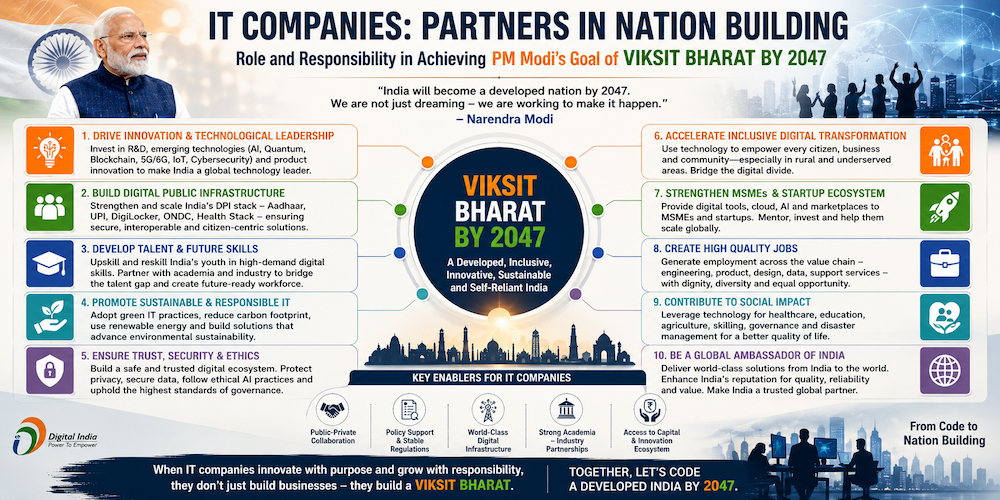
This is where India’s private sector, particularly its IT and technology companies, plays a defining role. The Prime Minister’s vision of a Viksit Bharat by 2047 cannot be achieved by government alone. It requires industry to bridge young talent and real-world technology, helping convert innovation into solutions for India and the world.
Indian IT companies are already demonstrating what is possible. SvelteTech Technologies is one such emerging example. Its work across cybersecurity and AI-driven solutions shows how indigenous capabilities can support India’s broader innovation ambitions. Its portfolio includes solutions like AI-driven automated IT/OT Red Teaming and VAPT, Smart Security Operations Centre, cloud and infrastructure security, and digital forensics, along with a sovereign cybersecurity-focused AI Model that can become a lifeline for cyber defence and offence.
Other companies also have reach across government and public-sector institutions, railways, telecom, infrastructure, financial services, healthcare, education, logistics, manufacturing, and technology enterprises. SvelteTech alone works with more than 100 client organisations across 10-plus industry verticals and has engagements across India and international markets including Singapore, UAE, Bahrain, Saudi Arabia, Mauritius, etc.
These companies continue to create opportunities for young talent from small-town colleges, bringing fresh graduates into their innovation facilities, where training, exposure, and mentorship help turn aspirations into skills, innovation, and meaningful careers.
The responsibility of IT companies now goes beyond developing products. They must create an ecosystem that absorbs young talent, nurtures their ideas and gives them the platforms to build solutions. This becomes even more important as technology itself becomes an arena of global competition and technological warfare. Advanced AI solutions can be expensive, but India possesses an unparalleled pool of young technical talent capable of developing innovative, cost-effective solutions. Industry must give that talent opportunity, mentorship, infrastructure, and market access—empowering young Indians to become creators rather than merely consumers of technology.
Leveraging Talent
The larger lesson is significant. India’s technological journey must move from talent to technology, technology to enterprise and enterprise to global leadership. Cybersecurity, AI, cloud computing, digital forensics, advanced computing, robotics and other emerging technologies will increasingly determine the competitiveness and security of nations.
The ₹1 lakh crore innovation mechanism can therefore become much more than a financial initiative. It can become a launchpad for a new generation of Indian innovators—provided industry steps forward to identify promising ideas, provide technology platforms, mentor young entrepreneurs and help take their innovations into actual deployment.
India’s IT companies must see this as both an opportunity and a national responsibility. The world is increasingly looking towards India not merely for its talent, but for Indian solutions to global technological challenges.
Conclusion
Viksit Bharat 2047 will ultimately stand on the ingenuity of Young India. The government can provide the vision and financial foundation; industry must provide the technology, experience and scale. Together, they can ensure that the Prime Minister’s call for innovation does not remain an idea on paper—but becomes technology on the ground; Indian solutions in global markets are a defining pillar of a technologically advanced Viksit Bharat.