

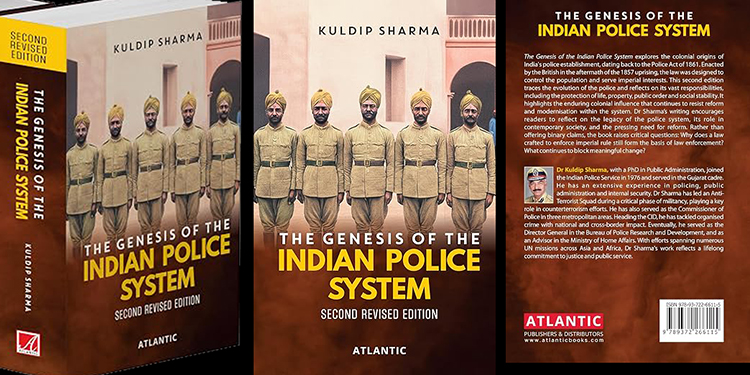
Books on the Police and policing are few. Most are autobiographical in nature. Here is a book by Dr Kuldip Sharma that delves into the evolution of the Indian Police. The expanse of thought and narration makes this book a must-have for every Police library, if not every policeman. A very detailed review of the book is done by none other than Vappala Balachandran, respected globally for his critical writings on intelligence, geopolitics, security, etc.
This is the second and revised edition of Dr Kuldip Sharma’s book “Heaven’s Light Our Guide: The Genesis of Indian Police”, which was published in 2006. I had read that book and was amazed by the depth of the author’s encyclopaedic research into the origins of our Police structure, its difficulties in adapting itself through the Vedic system, the Chanakya and Empire epochs, then traversing through the Sultanate and Mughal empires and navigating through the British era to finally attempting to align with free, independent India’s security objectives.
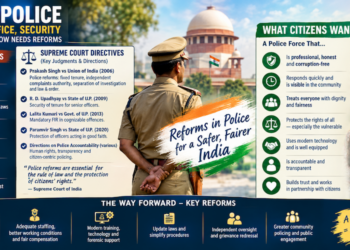
The second edition, which also reveals the author’s admirable ability to theorise archival data into the present context dynamically, was necessitated by what was believed to be a tectonic development in the history of Indian Police reforms in 2006. That was when our Supreme Court pronounced the judgment in the Prakash Singh case on 22 September 2006, establishing the famous “7 directives” on Police reforms. This was the culmination of ten years of tireless efforts since 1996 through a Public Interest Litigation (PIL) by senior Police officers Prakash Singh and N K Singh, along with “Common Cause”, the NGO that works for probity in public life and governance reforms.
This euphoric development was recalled by “Common Cause” in its January-March 2026 issue through a piece “20 years of Prakash Singh Verdict”: “While the Police veterans exposed the internal distortions of the force, ‘Common Cause’ brought in the citizens’ perspectives, showing how unchecked Police power had led to custodial torture, arbitrary arrests, fabricated cases, and widespread denial of justice, especially for the poor and marginalised”.
Sadly, twenty years later, what remained of that commendable initiative was a total disappointment. The author says: “This second edition of the book has been revised to discuss the above developments, the reasons why there is no improvement and if, at all, there is any solution in sight. The Police forces across the country are in the clutches of the political executive”.
Again, to quote ‘Common Cause’: “But optimism gradually gave way to cynicism when it was honoured more in the breach than in observance. The implementation by the states met with reluctance, defiance or half-hearted compliance”. Thus, the author’s primary objective in this book is to investigate why it happened as it did.
Dr Sharma’s central theme in this book is to prove that the basis of law enforcement and our Police system is still grounded on a law created in 1861 for an “imperial society” without any British parliamentary sanction. He attributes the developments in this era to a lack of reflection on Police philosophy in India during British rule, which, unfortunately, continued to influence the thinking of the political and civilian bureaucratic leadership even after independence.
The colonial government at that time merely drew up a scheme subordinating the Police to the revenue-collecting authority, as was necessary for an imperial society. The laws passed during that era, such as the Indian Penal Code, the Criminal Procedure Code, and the Evidence Act, also reflected this thinking: “A legal edifice to control and conduct the affairs of an enslaved nation was thus created”.
Simultaneously, the government’s deliberate action of putting the Superintendent of Police of a district under the supervision of the District Magistrate demoralised the Police. In some states the Superintendent of Police was officially designated as the District Magistrate’s “assistant to Police duties.” For the British, the Police existed only through the District Magistrate. This pattern of supervision was later extended to the divisional and State levels as well. The author gives more details in chapter 8.
However, that was not the model the colonial masters had chosen for their own Police. In 1829, Sir Robert Peel enunciated his famous “9 Principles” which directly made the Police responsible to the public through a charter without any political or bureaucratic intermediary. By contrast, the requirement to report to the District Magistrate for routine Police duties greatly hampered Police professionalism in India, leading to serious confusion in public security situations due to dereliction of duty. The imperial-era Police felt they had to carry out only orders from above. Sadly, this was continued even after independence.
An experience in 2008-09 could be cited. This reviewer was a member of the 2-man High-Level Committee appointed by the Government of Maharashtra to enquire into the systemic mistakes committed during the 26 November 2008 terror attacks in Mumbai city which killed 175 persons.
During our enquiry, we found several signs of total abdication of responsibility by the Maharashtra Home Department, although under the 1987 amendment of Section 4 of the Bombay Police Act 1951 the “superintendence” of the Police force throughout Maharashtra “vests in and exercisable by the State Government and subject to such superintendence, the Secretary, to the State Government in the Home Department”. There was no mention of the Director General of Police or the Commissioner of Police, Mumbai, in this section.
Yet none from the Home Department took cognisance of 16 prior intelligence alerts they received from the Union Home Ministry and other sources from 2006 onwards on the strong possibility of a sea-borne attack on designated targets in Mumbai. Nor did the Home Department consider arranging a meeting with the Coast Guard and the Navy to aid the Mumbai Police in preventing this sea-borne attack.
This dereliction by the Maharashtra Home Department forced us to pass strong remarks against it. We said that the seniormost officer in the State Home Department must ultimately take responsibility for all work relating to the department and “who under the Bombay Police Act,1951 has legal obligations. It should be his/ her responsibility to keep the Home Minister as well as the Chief Secretary fully informed”.
In “Epilogue”, the author suggests ten steps to improve professionalism in the Police by reforms and empowerment. The first is the selection of SHOs, the bedrock of our Police system, from a broader pool than is now done through State-based selections. Instead of recruiting raw candidates without assessing their talents or aptitudes, he recommends that recognised institutions advertise a one-year Police course for interested candidates, who will receive a diploma upon successful completion. Future SHOs should be selected from this pool.
This system exists in Britain, where Police constable degree apprenticeship or similar routes are available. Similar recruitment channels exist in American States and Counties, as well as in Canada.
There are similar novel suggestions. However, Suggestion No. 7 to reorient the IPS selection system is bound to evoke strong comments from Police officers themselves. He wants to replace the present direct recruitment to the Indian Police Service, and the “competition must be open only to those who have completed ten years of service in the Police force in any rank”.
This is to avoid the present experience when a “substantial” number of those in the IPS who did not qualify for either the IAS or the Foreign Service join the service, who are “a liability to the kind of leadership that the IPS is required to provide to the Police forces in the country”.
- Publisher : Atlantic Publishers & Distributors (P) Ltd
- Print length : 597 pages
- ISBN-10 : 9372266116
- ISBN-13 : 978-9372266115
The book is available on Amazon. It can be ordered from the following link: