

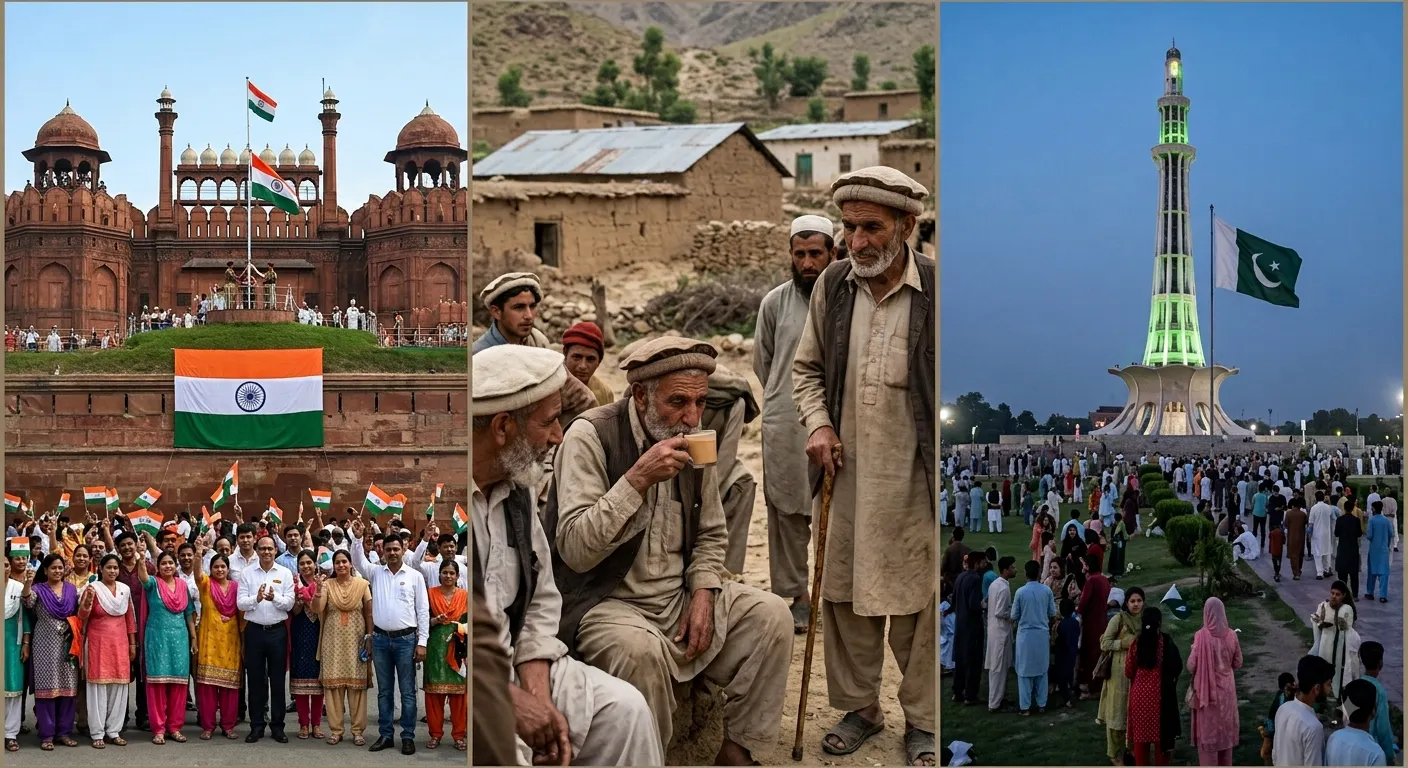
Pakistan absorbed the former tribal areas into Khyber-Pakhtunkhwa through the 25th Amendment, even though the question of their accession remains unsettled. Documentary weakness of the accession provides for suitable global vigilance and appropriate cartographic and diplomatic references against Pakistan’s forceful administration of these areas against the popular will.
Introduction
On the eve of our Independence Day — which also happens to be the Independence Day of Pakistan, both nations born in the twin throes of one Partition — international discourse on the subcontinent’s unfinished business has settled into a comfortable, three-cornered vocabulary: Pakistan-occupied Kashmir, so-called “Azad Kashmir,” and Indian-administered Kashmir. Three labels, one dispute, endlessly rehearsed at the United Nations and in Western op-eds — and one, in my submission, incomplete.
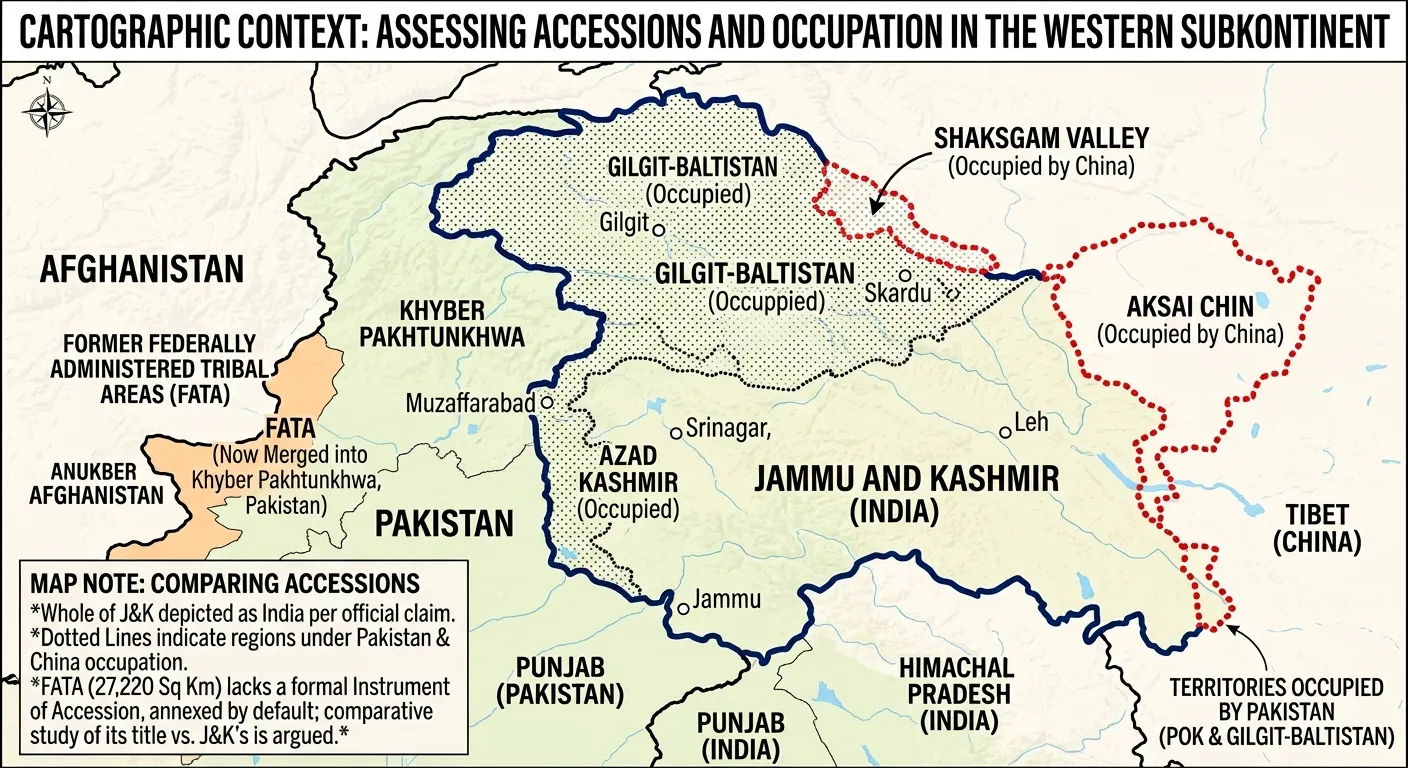
There is a fourth territory whose accession to Pakistan has never been subjected to the same rigorous documentary and legal scrutiny that Kashmir’s accession to India undergoes in every seminar room and select committee: the former Federally Administered Tribal Areas — 27,220 square kilometres, by Pakistan’s own 2017 census reckoning, an area larger than Haryana — merged since 2018 into Khyber Pakhtunkhwa, and claimed by Pakistan not through any instrument of accession, but by default.
I frame this argument carefully, and deliberately decline to join issue with a separate claim that circulates, from time to time, in less rigorously sourced accounts of Partition: that Sir Cyril Radcliffe awarded FATA to India. That is not a proposition this piece engages with, still less endorses — the Punjab Boundary Award’s jurisdiction never extended west of Punjab, and the point is better left to rest there than argued at length. What I am proposing instead is narrower, more defensible, and — I would argue — considerably more useful on the international stage: not a territorial claim, but a comparative one, about the quality of title.
Two mechanisms, deliberately kept separate.
The Indian Independence Act, 1947, does not treat all the territory Britain was vacating as a single, undifferentiated mass. Section 7(1) draws a careful distinction between two categories the Government of India Act, 1935 had already defined separately in Section 311 — Indian States on the one hand, and tribal areas on the other, the latter defined expressly by exclusion from the former.
For Indian States, Section 7(1)(b) provided that paramountcy would lapse, following which each state’s ruler — recognised as holding a form of sovereignty under individual Crown treaties — was free to accede to either Dominion. This is the mechanism that produced the documented Instrument of Accession: a formal instrument, executed by a recognised sovereign, in a process supervised by the departing Crown’s own machinery through V.P. Menon’s States Department, with a standstill agreement bridging the interim. Jammu and Kashmir’s accession in October 1947 followed exactly this route. It is a title India can produce, on paper, with a signature, a date, and a chain of custody.
For tribal areas, Section 7(1)(c) took a different form. It terminated the Crown’s treaties, agreements and “sufferances” with tribal authorities — but it prescribed no accession instrument, because the jirgas exercising customary authority in the frontier agencies were never recognised as treaty-holding sovereigns in the way princely rulers were. What followed, in November 1947, was not an accession under any statutory mechanism at all: it was a set of direct negotiations between Mr Jinnah and assembled tribal jirgas, conducted unilaterally, with no Crown supervision, no standstill arrangement, and — this is the point worth placing on record — no equivalent opportunity extended to India to negotiate in parallel, at a moment when the constitutional status of the tribal areas remained genuinely unsettled. It should be said, in fairness, that Partition produced any number of hurried and improvised arrangements on both sides of the new border, and the tribal negotiations were of a piece with the general urgency of that moment rather than a singular anomaly. What distinguishes this instance is simply that the informality has gone unexamined for seventy-eight years, while Kashmir’s far better documented accession has been examined and re-examined without pause.
Why the asymmetry matters
I do not propose, on the strength of this asymmetry alone, to delve into the wider debate over whether FATA is or is not Indian territory — that is a separate and considerably larger question, turning on facts of administrative history, treaty relationships and frontier geography that deserve examination by scholars with a deeper command of that record than I can offer in these pages. I would rather leave that door open to them than foreclose it here for the sake of a tidy argument. What I will say plainly is narrower: whatever the ultimate answer to that larger question, a defect in Pakistan’s title is not, as a matter of strict logical and legal corollary, an automatic accretion to India’s — the two questions remain analytically distinct. It is also fair to note that seventy-eight years of largely uncontested administration carry their own weight in international practice, whatever their documentary origin. But a defect of this kind is not without consequence either: it materially bears on the credibility of Pakistan’s own title and disclaimer over these areas, even where it does not by itself confer a competing title on India.
What the asymmetry does establish is this: when the international community is invited to weigh the comparative legitimacy of contested accessions in the subcontinent, it has for seventy-eight years applied one standard of scrutiny to Jammu and Kashmir — impugning the Maharaja’s authority, the timing, the alleged duress — while applying none whatsoever to the manner in which Pakistan absorbed the frontier tribal areas. That is not analytical neutrality. It is an inherited habit of attention, fixed on the dispute that generated the most conflict rather than the one whose founding instrument was, on the Act’s own terms, the more irregular of the two.
Placing it on the agenda
I would suggest four concrete uses for this argument, each standing on the comparative record alone, without requiring India to stake a formal territorial claim in advance of the fuller scholarly and legal examination this piece leaves open.
First, in bilateral and multilateral fora, India is entitled to ask that any discussion of “disputed accession” in the region apply a consistent evidentiary standard — and to note, when Pakistan invokes self-determination principles for Kashmir, that no comparable act of self-determination, formal accession, or plebiscite ever validated the incorporation of the tribal areas, whose people waited until Pakistan’s Twenty-Fifth Constitutional Amendment in 2018 — seventy-one years — for so much as ordinary constitutional and electoral rights.
Second, this comparative record deserves a place in India’s own documentary diplomacy. The same institutional memory that keeps twenty-four Assembly seats vacant under Section 14 of the Jammu and Kashmir Reorganisation Act and nominates displaced persons under Section 15B should also maintain and periodically publish a considered legal note on the asymmetry of accession between Kashmir and the former tribal areas. Not as a claim. As a record.
Third, and perhaps most usefully, the argument reframes the human question that both “Azad Kashmir” and the former FATA share: populations governed for decades through arrangements — political agencies, jirga settlements, Frontier Crimes Regulation — that fell well short of ordinary constitutional citizenship. Pakistan’s difficulty in defending its own frontier’s accession on the documentary standard it demands of Kashmir is, I would submit, the more persuasive international argument to press for now — leaving the larger territorial question to the scholars and specialists better placed to pursue it. It asks the world, at a minimum, to apply a single ruler evenly.
Fourth, there is a matter of cartographic and diplomatic consistency closer to home. India guards the boundaries of Jammu and Kashmir with a zealousness that admits no ambiguity. Every fresh act of Pakistani or Chinese encroachment is contested, mapped, and formally protested, whether in Gilgit-Baltistan, Aksai Chin, or the China-Pakistan Economic Corridor’s passage through territory India regards as its own. That same vigilance, I would submit, ought to extend to the manner in which the former tribal areas are now depicted. Having been absorbed into Khyber Pakhtunkhwa under the Twenty-Fifth Amendment, as though the question of their accession had always been settled, they are today shown on maps and in diplomatic usage as ordinary, undisputed Pakistani territory. Given the documentary weakness of that accession set out above, India would do well to treat these areas — at least in its own official cartography and diplomatic references — as contested or autonomous federally administered territory, rather than tacitly accepting their quiet absorption into an ordinary province as settled fact. The asymmetry of scrutiny that this piece has traced should not stop at argument; it should be visible on the map as well.
 A closing caution
A confident case does not need an invented title deed. It needs only to ask, evenly, of both sides of the Radcliffe line: where is your instrument, and who supervised its signing?
(The article first appeared on the blog of the author.)