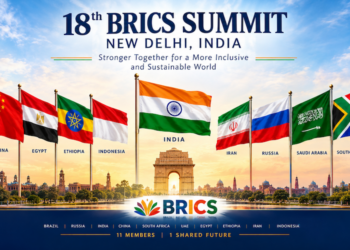

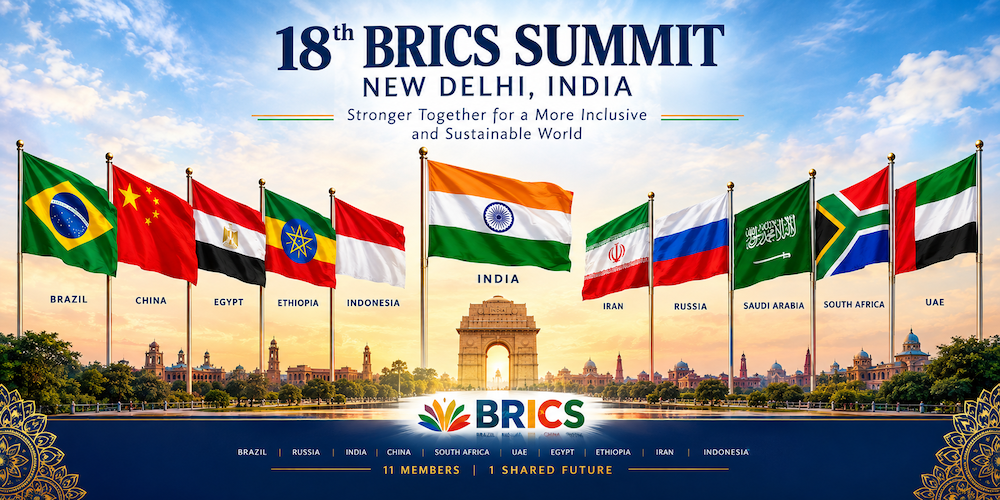
BRICS has evolved into an important platform for the Global South, bringing together 11 member countries and 10 partner countries representing nearly half of the world’s population and around 42% of global GDP. Its importance lies in strengthening economic cooperation, trade, development finance and technology while giving emerging economies a stronger voice in institutions such as the UN, IMF and World Bank. For India, BRICS also advances strategic autonomy, provides a platform for dialogue with China and Russia, and supports a more representative and multipolar global order. Its challenge is converting its enormous economic weight into effective collective action despite divergent national interests.
Introduction
As the countdown to the 18th BRICS+ summit begins in New Delhi, expectations for this uniquely non-Western collaborative organisation are expanding in depth and breadth, encompassing almost every dimension of socio-economic development amid geopolitical challenges and ongoing wars in Eurasia and the Middle East, in which several BRICS members are embroiled. This is a severe challenge that may cause rifts and reduce the impetus and impact of BRICS’ achievements. The expansion of BRICS from the original four to eleven partner countries, plus ten more waiting to join, has created its own heft and challenges in this consensus-driven organisation, which has become the flag bearer for the interests of the Global South and a harbinger of a possible future order embedded in multilateralism and multipolarity.
India is hosting the summit for the fourth time. The last one was in 2021, when several new areas were conceived and established the policy foundation: cooperation, sustainability, innovation, development, resilience, finance and multilateral reform. This year’s summit defined the acronym as a shift from a country-specific to a delivery-focused paradigm. Prime Minister Narendra Modi has attributed the BRICS acronym to mean ‘Building Resilience through Cooperation and Innovation for sustainable development’. These, inter alia, imply that Resilience provides the goal; Innovation provides the tools; Cooperation provides the scale; and Sustainability provides the direction. Hence, India’s 2026 presidency needs to build the next layer by connecting those priorities with institutions, technology, investment and practical partnerships.
A Busy Year
This is what has been done in the past year: 350+ meetings across 35 verticals and two dozen ministerial and high-level specialised agency meetings, from auditors to customs to the judiciary to standard-setting agencies to parliamentarians and think tanks. Whole idea is to avoid silo-centric approach to melt into an integrated mutually beneficial architecture for trade , investment, technology, tourism, health, education, skill development, climate change, counter -terrorism, finance and fintech and digital currencies and strengthening the relevant institutions , connectivity and above all the remit of culture, civilization, youth, sports,women led empowerment to blend with enhanced the P2P approach for which smooth visa free or easier travel for both tourists and professionals will have to be ensured and is a key irritant and bottleneck which has to be addressed.
India is quite adept at diplomatically wading through difficult terrain, and ironically most of her presidencies, from BRICS to the G20, have been mired in a very difficult international climate and black swan events. But it has always navigated the whirlwind successfully. This time round also, the US-Iran-Israel war, in which Gulf countries (UAE and Saudi Arabia are BRICS members too ) have become collateral damage as their sovereignty and territorial integrity have been violated by Iran, has caused a major trust deficit and rift, which was witnessed in the Foreign Ministers’ meeting when no joint communique could be issued despite the agreement of nearly all the sixty-plus parties. This will also play out on September 12-13, when the final Delhi Declaration will be worked out. But credit must go to the Indian presidency and leadership, which, in all the verticals, generated important initiatives and institutional arrangements through consensus.
Food and Energy Security Challenges
Food and energy security have been impacted by the Russia-Ukraine and Middle East wars; these, along with supply chain disruptions accentuated by continued unilateral tariffs and sanctions, have become a major challenge, especially for countries of the Global South, which tend to be disproportionately impacted. Happily, the BRICS can boast of some of the biggest producers of hydrocarbons, renewables and critical minerals, as well as the largest consumers; hence, the effort to calibrate the collaborative matrix through energy and food exchange immunised through trade in national currencies provides a powerful tool and potentially insulated mechanisms through Central Bank Digital Currencies (CBDCs) infused by innovative digital infrastructure could ensure sustained supply chains.
Slew of Initiatives
Some initiatives which have been agreed to during various ministerial and groupings to implement the past recommendations could include in Agriculture; BRICS Network of Centres of Excellence on Agro-Ecology and Regenerative Agriculture: A collaborative platform for joint research, knowledge sharing and capacity building; BRICS Network on Digital Agriculture: A network to strengthen cooperation in artificial intelligence, geospatial technologies, digital public infrastructure and data driven agricultural solutions, bridging innovation with practical applications for farmers; Global Forum on Farmers’ Rights in Seed Systems: A virtual collaborative platform-for member countries to exchange policy experiences, build local capacity, and document traditional agricultural knowledge. Initially, India will coordinate it through the Protection of Plant Varieties and Farmers’ Rights Authority.
And BRICS AGRIN (Agro-Inputs, Genetic Resources and Information Network): For an integrated health care system, a new BRICS Expert Group on Traditional, Complementary and Integrative Medicine has been established to strengthen collaboration and promote traditional systems of medicine. The BRICS Network of Centres of Excellence on Mental Wellness is expected to address a critical issue of our time. Likewise, the Expert Group on the BRICS Integrated Early Warning System for Prevention and Response to Mass Infectious Diseases was established. For energy security, the BRICS Guiding Principles on Energy Storage and Smart Grids were adopted.
The BRICS Digital Centre of Excellence for Smart Grids and Energy Storage was also launched. It will serve as a voluntary platform for knowledge sharing, capacity-building, exchanging policy and regulatory best practices, and promoting pilot initiatives among BRICS countries. The meeting also resulted in updating the Terms of Reference of the BRICS Energy Research Cooperation Platform (ERCP) aimed at strengthening the institutional framework for research, technical cooperation and knowledge exchange in the energy sector. Similarly, Beijing has developed and implemented specific innovative solutions for climate change and other areas. Delivery justifies deliberations.
BRICS Startup Innovation Fund: Recommendation for establishment of a dedicated institutional mechanism for governance, fund management and operations of the proposed Fund, with voluntary mobilisation of public and private financing for innovative and scalable start-up-led solutions across BRICS countries.
BRICS Incubator Network: Establishment of a digital interface/network to connect National Nodal Agencies, selected incubators and start-ups across BRICS countries, facilitate registration and linkages with participating incubators, and enable referral of qualified start-ups to incubators in other BRICS countries. The Framework for Cooperation in the SME Working Group was adopted, including establishing a BRICS MSME Cooperation Portal and a Dialogue on Finance to strengthen cooperation in MSME financing. In this regard, the BRICS MSME Forum Report 2026, “Advancing MSME Competitiveness in BRICS: Strengthening Access to Finance & Technology and Sustainable Growth” was adopted following the Inaugural BRICS MSME Forum held in Agra on 19 June 2026, a sustained platform for engagement to strengthen MSME cooperation.
A BRICS Photovoltaic Knowledge Portal for knowledge sharing and collaboration, and the joint development of a BRICS Solar PV Cooperation Roadmap have been instituted.
To promote and insulate trade from various shocks, Endorsement of the Statement on Preserving and Revitalising the Multilateral Trading System, reaffirming support for an inclusive, equitable, fair, transparent, open and rules-based multilateral trading system with the WTO at its core, while preserving the policy space of EMDEs, was adopted along with the Work plan on the Internationalisation of MSMEs comprising a Jaipur Consensus to study a BRICS Invoice Discounting Mechanism and adoption of the Guiding Principles for Credit Assessment Frameworks for Export-Oriented MSMEs. The group also adopted a work plan on the BRICS Shared Understanding on Global Value Chains, comprising the GVC Action Plan 2026-2030, including a Technical Council, BRICS Connect, and a GVC Joint Study to advance market access and economic diversification among members.
The BRICS Principles to Facilitate Digitally Delivered Services Across Borders, with the adoption of digital instruments to execute, will help enhance investment. Intra-regional trade and investment, along with relevant financial institutions, could provide the grouping with the requisite heft.
Reform in Global Governance
Global governance and multilateral institutions are under severe stress, and without reforms to the UN, UNSC, WTO, etc. Irrelevance looms as they become geriatric, courtesy of veto-wielding powers and a lack of respect for, or adherence to, institutional mechanisms and international rules and laws assiduously developed in the post-World War era. Hence, the BRICS, which by default has acquired much greater heft as several of the top ten economies and two of the permanent members are occupying a critical position in the BRICS, contributing to over 40% of the global GDP. A consensus among them beyond the rhetoric has to emerge to secure a shared future where India, Brazil and the African continent must be duly and rightfully represented as permanent members of the UNSC; for this, Russia and China must take the positive lead rather than indulging in innuendo so that the other three Western P5 countries are forced to align. So far, they support India, especially knowing too well that China will not support Indian candidature. But if Beijing is serious about a new equitable world order, it must adopt a clear, concise, and cooperative approach to reforming global institutions, first reflected in BRICS and SCO and then in other multilateral fora.