


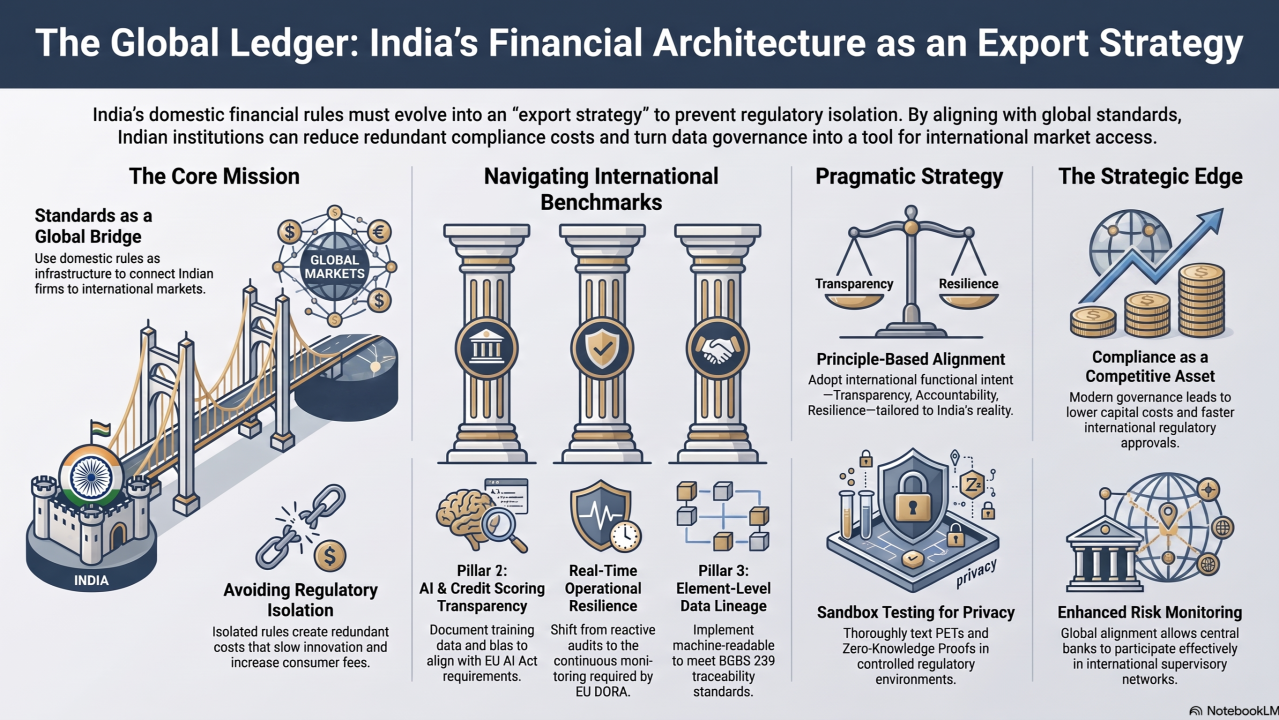
A sensible alignment strategy does not mean sacrificing national data sovereignty. International regulations are themselves in constant flux as several key frameworks in the EU and the US face ongoing legal challenges or legislative delays. Anchor domestic rules to rigid foreign text, and India risks chasing a moving target. Instead, policymakers should pursue principle-based alignment. We must adopt the functional intent of international standards like transparency, accountability, and resilience while tailoring the actual execution to India’s unique socioeconomic reality. Furthermore, emerging technologies such as Privacy-Enhancing Technologies (PETs) and Zero-Knowledge Proofs should be thoroughly tested in controlled regulatory sandboxes before being mandated across the sector.
Introduction
As India’s digital economy expands beyond domestic borders, the infrastructure powering it faces a quiet but critical challenge. The Reserve Bank of India (RBI) recently released its draft guidance on data governance, which is a welcome and necessary step toward structuring how financial institutions manage customer data, risk, and artificial intelligence. However, in an interconnected global market, domestic adequacy is only half the battle. If Indian financial institutions and fintech innovations are to operate seamlessly on the global stage, our regulatory standards must serve as bridges rather than barriers to foreign markets.
The Hidden Costs of Regulatory Isolation
For the average citizen, regulatory jargon like “data lineage” or “interoperability” might feel distant. Yet, their real-world impact is direct. When Indian regulatory frameworks diverge significantly from foreign benchmarks, institutions are forced to maintain costly, redundant compliance systems, one set of rules for domestic operations and another for international markets. These duplicated operational costs inevitably trickle down to consumers in the form of higher transaction fees and slower innovation cycles. For policymakers, the risk is equally stark. Rigid or isolated data rules can create blind spots in cross-border risk monitoring, limiting our central bank’s ability to participate effectively in global supervisory networks.
Navigating a Shifting International Landscape
To build a framework that endures, India must align its domestic rules with global benchmarks without falling into the trap of rigid, line-by-line copying:
● Artificial Intelligence and Credit Scoring: Western markets, notably through the European Union’s AI Act, are cracking down on “black box” automated decision-making. If an Indian fintech firm exports an AI-driven credit scoring model that lacks transparent training data and bias documentation, foreign regulators will block its entry. Building mandatory transparency and provenance requirements at home protects domestic consumers while preserving international market access.
● Operational Resilience: The EU’s Digital Operational Resilience Act (DORA) has set strict timelines for reporting major cyber incidents. Shifting domestic expectations from periodic, reactive audits to continuous, real-time resilience monitoring ensures Indian institutions remain trusted partners in global finance.
● Data Lineage and Traceability: Mandating element-level, machine-readable data tracking in line with established international benchmarks like BCBS 239 transforms compliance from a burdensome administrative task into a competitive asset. Institutions that are continuously audit-ready enjoy lower capital costs and faster regulatory approvals abroad.
Pragmatism Over Rigid Copying
A sensible alignment strategy does not mean sacrificing national data sovereignty. International regulations are themselves in constant flux as several key frameworks in the EU and the US face ongoing legal challenges or legislative delays. Anchor domestic rules to rigid foreign text, and India risks chasing a moving target. Instead, policymakers should pursue principle-based alignment. We must adopt the functional intent of international standards like transparency, accountability, and resilience while tailoring the actual execution to India’s unique socioeconomic reality. Furthermore, emerging technologies such as Privacy-Enhancing Technologies (PETs) and Zero-Knowledge Proofs should be thoroughly tested in controlled regulatory sandboxes before being mandated across the sector.
The Road Ahead
The RBI’s draft framework provides a strong, modern foundation for domestic data governance. The goal now must be to extend that foundation from local adequacy to international credibility. By adopting targeted, forward-looking enhancements today, India can ensure its financial ecosystem remains safe for its citizens, transparent for its policymakers, and undeniably competitive on the world stage.