


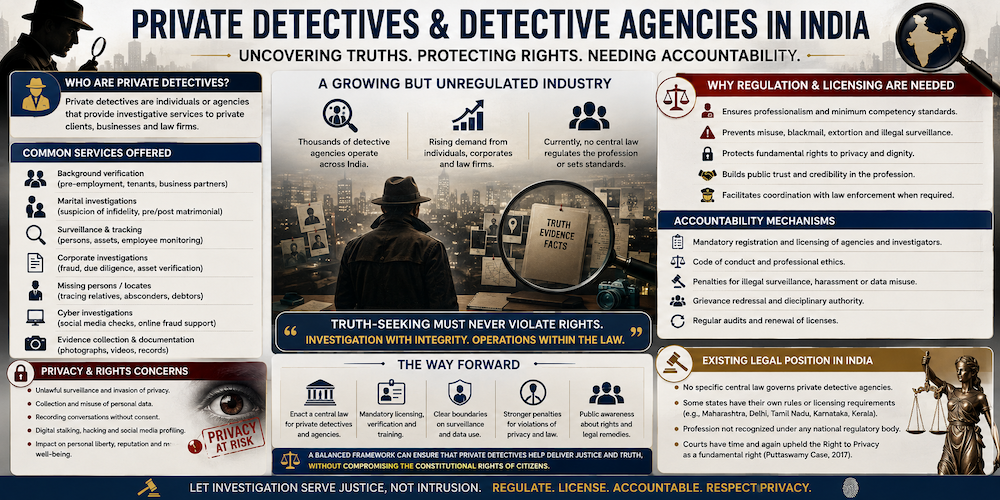
Recently, I learned that someone needed to hire a private detective agency to check the antecedents of the would-be groom. Both families were affluent. For a small background check like this, the detective agency they hired demanded several lakhs of rupees without any protection from information leak, accountability, or fair means. It raises several questions and a need for their regulation, accountability and reasonable fee structure.
Introduction
In India, if a crime is committed, then the investigation can be launched by the Police either on its own or on the report of anyone else. Courts can also direct the Police to investigate. One need not pay any fee to the Police as cost of investigation or as fee for investigation. However, the line of investigation, its pace, and the quality of the investigation may not be to the complainant’s satisfaction. In such cases, the interested parties might prefer that someone other than an enrolled Police person investigate the clues provided by the parties. This has led to a bustling private investigation business. Further, the dispute between the parties may sometimes be of a civil nature, in which the Police might not intervene. In such cases, private investigators are also hired to identify points that could be favourable to the party hiring them or the weak points of the opposing party.
Role of Private Detectives
Private Detectives also help locate missing persons or missing assets. Another area where such investigators are flourishing is marital disputes. A spouse wants to find out about the movement and conduct of the other spouse, especially where adultery is suspected. In fact, pre- and post-matrimony checks are important areas of engagement. There is another category of clients: NRIs (Non-Resident Indians). Many of them have criminal and civil disputes pending in India. They want someone to intervene on their behalf in India and carry out tasks to their satisfaction. Companies also hire such persons to uncover the rival company’s secrets. Demand for expert debugging is also there. In a nutshell, there is a big scope for private investigators in India. Private Detective Agents also perform employee antecedent verification. They will have a role to play in investigating Insurance Fraud, IPR violations, Corporate Fraud, Data Breaches, and Data Theft.
Prerequisites for an Investigator
Looking for evidence requires investigative expertise. The investigator should know the Constitutional provisions, Criminal Procedural law, law of evidence, and penal law. What all can be done while remaining within the legal bounds should be known. The Information Technology Act, 2000, read with Sections 61 to 63 of the Bharatiya Sakshya Adhiniyam, 2023, provides certain procedures for collecting electronic evidence. This has to be strictly adhered to. For some investigations, knowledge of Patent Law, the Copyright Act, the Companies Act, and Trademark Laws is necessary. Investigation is not the same as Security duty. Those experts in providing Security (to Buildings, Premises, Persons, Cargo, or Transportation) are not necessarily good investigators. Similarly, a good investigator may not be good at all for security duties. Undercover operators must be good at surveillance techniques. Therefore, to expect Private Security Agencies to conduct worthwhile investigations is asking for the moon. These skills are distinct and so should be the personnel carrying them out.
No Legal Framework for Private Detectives
As of today, no special protection under the law is available to such private investigators. Their rights are the same as are available to a common citizen. That includes the right to move freely in public spaces and the right to private defence, as provided in sections 34 to 44 of the Bharatiya Nyaya Sanhita 2023. There is no provision for them, as private investigators, to conduct any search, seizure, or arrest of any individual suspected of having committed any crime. Courts would normally not issue a warrant to arrest any individual. Legally, they cannot take samples from the scene of crime as it may tamper with evidence, and their act may be considered criminal trespass. They cannot testify in court as experts, irrespective of their experience as investigators. In short, there is no legitimacy for the profession of private investigation.
Demand creates Supply
As there is a need, so there are service providers. Presently, in India, there are about 20,000 Private Investigating Agencies, ranging from a single investigator to 50 or more investigators. Some Agencies operate in more than one state, and a few in more than one country. Before 2005, there was no platform for Private Detectives. Those working primarily as Private Security Agencies also masqueraded as Detectives. The Association (a private body) of Private Detectives & Investigators (APDI) was incorporated on 18 December 2006, while the Bill to regulate Private Detective Agencies was being formulated.
Deception used for Credibility
In place of the word ‘investigator’, the word ‘Detective’ is more fashionable because it connotes some expertise and stealth action. Since there is no law about them, most of them claiming to be ‘Government Registered’ are showing their registration under the Shops and Establishments Act or their Trademark Registration or some even a registration under the Private Security Agencies Regulation Act 2007. Some also display medals and trophies won by their owners in other fields, or certificates of participation from conferences. All the techniques of deception are employed to convince the client that they have come to the best Agency. Interestingly, many of these Agencies are owned by retired Army Officers and staffed by ex-servicemen or lower-rank personnel in the Police and CAPFs. None of them holds any expertise in investigation, much less any forensic investigation. They also have no special knowledge of Criminal Behaviour or Juvenile Delinquency.
Lack of Accountability
Another aspect of the present situation is the lack of accountability towards the client. The client approaches the Detective for work that must be done primarily through an undercover approach. If the task cannot be completed by the Detective, there is no system for refunding the fee paid or for imposing any penalty for deficiency in service. In fact, due to the confidential nature of the assigned task, the client would not even submit it for adjudication in any forum. The client’s helplessness is exploited to the hilt by Private Investigating Agencies. Some Agencies are known to blackmail the parties if they get hold of some sensitive evidence. Some Agencies boast of secret connections with Courts and Judges and charge Clients (mostly NRIs) huge sums, claiming the Judiciary demands it.
First Draft Bill to regulate Detectives
In the above scenario, in 2006, I, as Director of the National Institute of Criminology and Forensic Science, Delhi, prepared a Draft Bill to address the problem. To prepare it, large-scale consultations were held with all the stakeholders, including the Private Detective Agencies. The Bill was to bring in compulsory Licensing of Private Detective Agencies, terms of engagement of Private Detectives, their training, identification as Private Detectives, engagement with Clients, and action if the Agency is found to be in breach of conduct, including revocation of license. This Bill, after vetting by the Law Ministry, was moved in the Rajya Sabha by the MHA on 13 August 2007 as the Private Detective Agencies (Regulation) Bill 2007. The Bill was along the lines of the Private Security Agencies (Regulation) Act 2005, which was enacted earlier, and a suggestion to enact central legislation was made during its discussion. The Home Minister had given an assurance that an appropriate Bill would be brought to the House to regulate Private Detective Agencies. Rajya Sabha route was preferred because, being a permanent body, the Bills presented there do not lapse. The Bill before the Rajya Sabha provided for the establishment of a mandatory Licensing Framework and Regulatory Boards at the Central and State levels. It provided for the functioning of Private Investigators and, at the same time, for the protection of the individual’s privacy. It set standard training requirements for Agency Operators and Investigators. It prohibited Agencies operating without a license and prohibited foreign ownership of an Agency.
Vested Interest Stalls the Bill
But the Private Detective Agencies already functioning without any control or regulation did not like it. Their lobby ensured that the Bill was referred to the Parliamentary Standing Committee on Home Affairs. The Committee raised several questions, mostly objections, regarding the presentation of a Bill on this subject and submitted its Report to the Parliament on 13 Feb 2009. The Committee desired that the Ministry may have a fresh look at the provisions of the Bill in light of its Report. Ministry of Home Affairs constituted its own Committee and invited suggestions from States and UTs on it. But the matter remains pending. I pointed out the pendency to several successive Home Secretaries ( and concerned Joint Secretaries), but it did not move the file at all. As per the Rajya Sabha Records, it is still pending with the MHA.
The world has moved on. Will India?
By now, most countries have their own laws regulating the work of Private Detectives. In most countries, the law requires both Private Detectives and Private Detective Agencies to be licensed independently. The law also sets out the qualifications required to obtain such a license and the penalties for violations, including license cancellation. In Singapore, the governing law is the Private Security Industry Act, and the Singapore Police is the licensing authority for Private Detectives and Private Detective Agencies under this law. In the USA, private detective work is legal and regulated at the state and Local level rather than the federal level. In the United Kingdom, there is no specific regulatory law for Private Detectives. Still, their work is legal so long as they comply with the Human Rights Act 1998, the Data Protection Act 2018, and other laws on privacy and the prevention of harassment.
The Apex Court Intervention
Recently, the Supreme Court of India (Bench of Hon’ble Justices Sanjay Karol and Vipul M. Pancholi) on Friday, 31 July 2026 observed that, in the absence of statutory safeguards, there are concerns about privacy violations and the misuse of investigative powers by Private Detectives. The Supreme Court was hearing a matrimonial dispute case in which one party had engaged private detectives to film the other spouse’s movements. It urged the Union Government and the Law Commission of India to consider framing a legal framework for the functioning of Private Detective Agencies.
Conclusion
It is high time that India enacts a clear law on the subject. It will provide much-needed clarity to those who wish to invest in this business and provide quality service of international standards. It will instil professionalism and a sense of accountability among the owners and detectives of Agencies, and ensure adherence to ethical norms, especially regarding individual privacy. It will also raise the standing of Private Detectives to a respectable level. In the light of the Supreme Court’s order, the Ministry of Home Affairs may like to resurrect the Bill and resubmit it after taking steps as suggested by the Standing Committee on Home Affairs.
(The views expressed in the article are those of the author. They do not necessarily belong to the publication or the Editor.)