

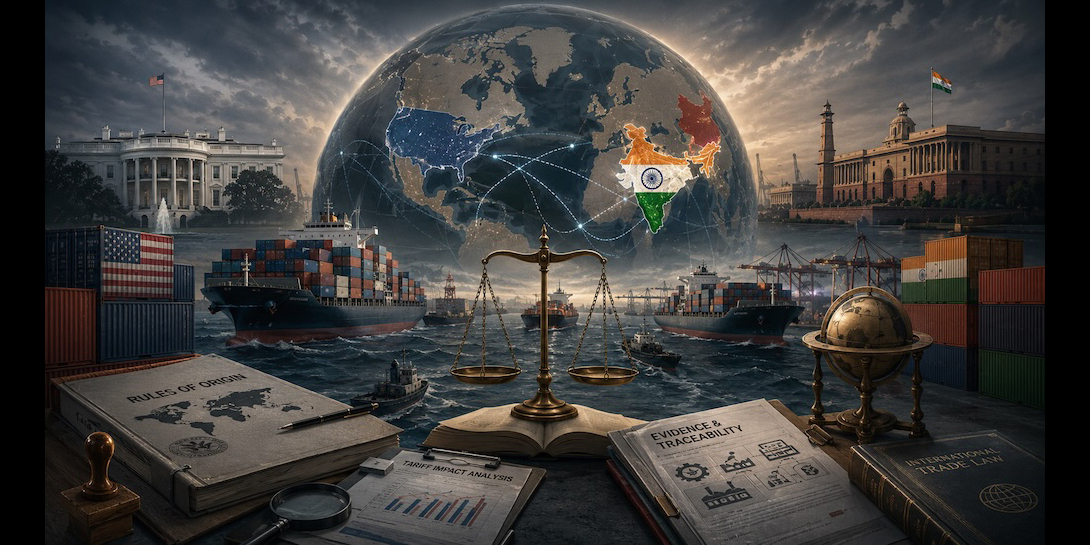
Startled by the Transhipment Report by the USA accusing India, among others, of helping China launder its exports, India has maintained a measured stance by promising to review the facts presented and follow the extant laws of the land. In an exclusive piece for the SAVIOURS, KBS Sidhu, a long-time observer of global affairs, discusses the imputations made and the evidence available to support them.
Introduction
On 13 August 2026, the White House’s Office of Trade and Manufacturing Policy, Peter Navarro’s fiefdom, released a 25-page report carrying no signed author page but a title fit for a pulp thriller: The Great Transhipment Scam: Rise, Scope, and Costs. “For years,” Navarro told reporters, “the great transhipment scam has let Communist China launder its exports through more than 40 countries.” India was placed in Tier 1, the report’s “Diversified Scale Leaders,” alongside Canada, the European Union, Israel, Japan, Mexico, South Korea and Taiwan. Within forty-eight hours, Navarro was on television saying India was “well on our radar.” This came a week after he had accused unnamed “Brahmins” of “profiteering at the expense of the Indian people” over New Delhi’s Russian oil purchases, a remark whose casteist crudity should have embarrassed its author on a second reading.
What does the report actually say, and what does it prove?
The report, stripped of its adjectives
Transhipment, in the ordinary commercial sense, is simply cargo moving through an intermediate point on its way to a final market. It becomes fraud only when a good’s declared country of origin is falsified to escape the tariff its true origin would attract. Washington’s Section 301 duties on China, first imposed in 2018, created the price differential that makes such falsification profitable, and the report is right that some exporters have exploited it. The Financial Times has documented origin-washing operations advertising their services out of Malaysia, and U.S. Customs and Border Protection brought a 2025 case recovering more than $400 million in evaded duty from a network routed through Indonesia, South Korea and Vietnam.
The report’s arithmetic is weaker than its rhetoric. Its headline figures span $40 billion to $303 billion a year, drawn from five different methodologies measuring five different things. Goldman Sachs’s roughly $40 billion is a top-down econometric inference. Commerce’s own $109 billion “trade-transfer benchmark” is, in the White House’s own words, “not a direct illicit-transhipment estimate.” Altana’s $303 billion is a facility-level supply-chain-exposure figure the report concedes “may include substantial transformation and legitimate logistics” — a meaningful share of it, in other words, may be honest manufacturing. A central range spanning nearly an order of magnitude is not a statistical finding. It is a policy scenario dressed in statistical language.
The $67 billion that has no India in it
India’s specific exposure rests on one figure. Commerce’s Office of Trade and Economic Analysis, using proprietary Panjiva shipment data, matched identical eight-digit HS codes entering a region from China and leaving the same region for the United States within the same quarter, and arrived at roughly $67 billion of alleged 2025 transhipment, combined across Mexico, India and Vietnam together. India’s individual share is not disclosed. No Indian company is named. No importer, exporter, freight forwarder, vessel, container number or bill of lading is produced. Instead, the report offers a phrase — “India’s Pune-Gujarat-Chennai production belt” — paired against Cincinnati, Dayton and Columbus as “ugly sister cities,” under HS 8413-8414: pumps and compressors.
The author’s long exposure to geostrategy, international politics and commerce is enough to spot the gap between a claim dressed in the vocabulary of evidence and a claim that has actually survived cross-examination. This is the latter’s opposite. Pune lies inland; Gujarat has several ports and a dozen industrial districts; Chennai is both a manufacturing hub and a port. Converting that geography into an actual shipping route, without a manifest, is an inference the White House’s own document declines to make.
The aggregate trade pattern does not settle much either. A Business Standard review found India exported roughly $750 million of pumps and compressors to the United States in FY2025-26 while importing nearly $2 billion of the same category from China — a genuine anomaly, worth India’s own reconciliation, and one its TradeStat database (which records commodity flows to the eight-digit level and explicitly captures re-exports) makes possible in principle. But an anomaly is a lead, not a verdict. The Chinese imports could be components entering genuine assembly, goods for India’s domestic market, carried-over inventory, or products unconnected to what later ships west. Caroline Freund’s own research, cited approvingly by the White House, found that Vietnam’s apparent 16.1 per cent “rerouting” share collapsed to 1.8 per cent once matching required the same firm, not merely the same tariff code in the same quarter. OTEA’s disclosed India methodology requires no such entity linkage. Until it is supplied, $67 billion remains an investigative hypothesis.
Not on the wrong side of any law
Nothing in the White House report alleges or establishes that India has violated any binding sanctions regime against China, Iran, or Russia, or any obligation India owes under the WTO framework. India buys Russian crude under no UN Security Council prohibition and no U.S. secondary-sanctions designation reaching Indian sovereign conduct. India’s trade with China proceeds under no bilateral or multilateral embargo to which either country is party. What is alleged, at most, is that some shipments passing through Indian territory may have been mis-declared as to origin under U.S. domestic customs law — a matter of individual importer liability under American statute, resolvable through American administrative and judicial process against the specific parties concerned, and nothing that implicates the Indian state or Indian industry as a whole.
A nation of 1.4 billion-plus citizens, a constitutional democracy older than most of the “Tier 1” jurisdictions named alongside it, owes no confession to a report that names no defendant. New Delhi has offered none. Asked about the report at his 14 August media briefing, MEA Spokesperson answered in two sentences: “We would like to study the findings and the methodology that has been adopted in detail,” he said, adding, “We have robust laws and procedures governing customs, rules of origin and exports, and any instances of violation that may be there are dealt with in accordance with law.”
That answer is sufficient on its own terms. Set beside the volume the occasion might have tempted — indignant rebuttal, point-by-point rejoinder, formal protest note — its brevity reads as confidence rather than evasion: a sovereign government declining to over-explain itself before an unnamed accuser has bothered to name a defendant. India ought not to dignify a report of this evidentiary quality with any lengthier engagement than the Spokesperson has already given it. A document that will not name a company, a shipment or a route does not merit a point-by-point government rebuttal. It merits the two sentences it received, followed by the quiet work of audits, reconciliations and cooperation where genuinely warranted, the kind of work a mature administration does regardless of who is speaking from a podium in Washington.
Whose scam, precisely?
Consider the sequence. On 20 February 2026, the U.S. Supreme Court, in Learning Resources v. Trump, held that the International Emergency Economic Powers Act does not authorise the president to impose tariffs — striking down the “reciprocal” and “drug-trafficking” tariff schedule whose price differentials had, by the administration’s own account, driven much of the fresh rerouting incentive it now decries. The nation’s highest court told the executive it reached for emergency powers Congress never granted it, doing by presidential whim what the Constitution reserves to the legislature. The administration’s response was improvisation: a pivot to Section 122 surcharges, accelerated Section 301 investigations, Section 232 remedies, a scramble across statutory authorities for one that would let the tariff regime survive judicial correction.
The Great Transhipment Scam, published nearly six months after that ruling, reads less like a sober customs-enforcement document than the aftershock of a tariff architecture the country’s judiciary had just declared unlawful. A policy whose legal foundation collapses should be met with a considered remedy through Congress, not with a report recasting the policy’s own failure as a “shadow network” spanning forty sovereign nations, several of them America’s closest allies and trading partners.
No U.S. bureaucrat as monitor
The deeper objection is constitutional, and it holds whether or not any individual Indian shipment eventually proves mis-declared. Peter Navarro is a political appointee in the Executive Office of the President. He is not a judge of any court, domestic or international; he holds no mandate under the WTO’s Dispute Settlement Understanding; he commands no jurisdiction over the sovereign conduct of the Republic of India. When he, or the unsigned report his office issues in his name, declares India an “enabler” of a “shadow transhipment network” without naming a single Indian defendant, disclosing a single shipment, or offering India any opportunity to test that evidence before a competent tribunal, what is being asserted is not a legal finding. It is an ex parte pronouncement by an official arrogating to himself the authority of a semi-sovereign monitor, judge and press secretary in one, over the trading conduct of the world’s most populous democracy.
India should say so without hedging. Where the United States believes specific Indian shipments have been mis-declared under its own customs law, the remedy lies in its own courts and administrative processes against the named importers, processes India does not quarrel with in principle, having offered exactly such cooperation. Where the dispute is systemic — rules of origin, tariff classification, the treatment of Chinese-origin inputs in third-country manufacturing — the appropriate venues are the bilateral origin-verification mechanism already contemplated in the February 2026 India-U.S. trade framework, and, failing that, the WTO’s dispute settlement architecture, battered as it presently is. A press-conference indictment dressed in statistics nobody outside one department’s proprietary database can verify is not one of those venues.
What India should say, and should not
India should concede nothing that has not been proven, because nothing has been. It should decline the theatre of contrition over an allegation naming no one, while offering what it has already offered: willingness to reconcile HS 8413-8414 trade flows at company level, to cooperate through the existing bilateral channel, and to prosecute, under its own law, any genuine instance of fraudulent mis-declaration a proper joint audit uncovers. That is the ordinary conduct of a trading nation confident enough in its own institutions to investigate rather than merely deny.
This is a bona fide difference of legal interpretation and evidentiary standard between two governments, the kind sovereign states resolve through negotiation or through the dispute-settlement mechanisms they have jointly built for that purpose, not through unilateral naming exercises issued from the West Wing. India’s trade with China, with Russia, with Iran within the bounds of applicable law, and with the United States itself, proceeds without violating any binding international obligation New Delhi has undertaken. A republic of this size and this age need not flinch at a report that cannot bring itself to name its own accused. It should continue its lawful commercial engagements without fear, and without the favour of Washington’s approval, which was never India’s to seek.
India’s conduct of its trade and commercial relationships, with the United States as with every other partner, rests on its own sovereign judgment, exercised with due regard to its bilateral treaties, its obligations under international law and the WTO framework, and, above all, the supreme interest of the country and its one-point-four billion people.