

Thank Heavens for Small Mercies
Let us begin with what the MEA’s statement actually protects, before we turn to what it exposes.
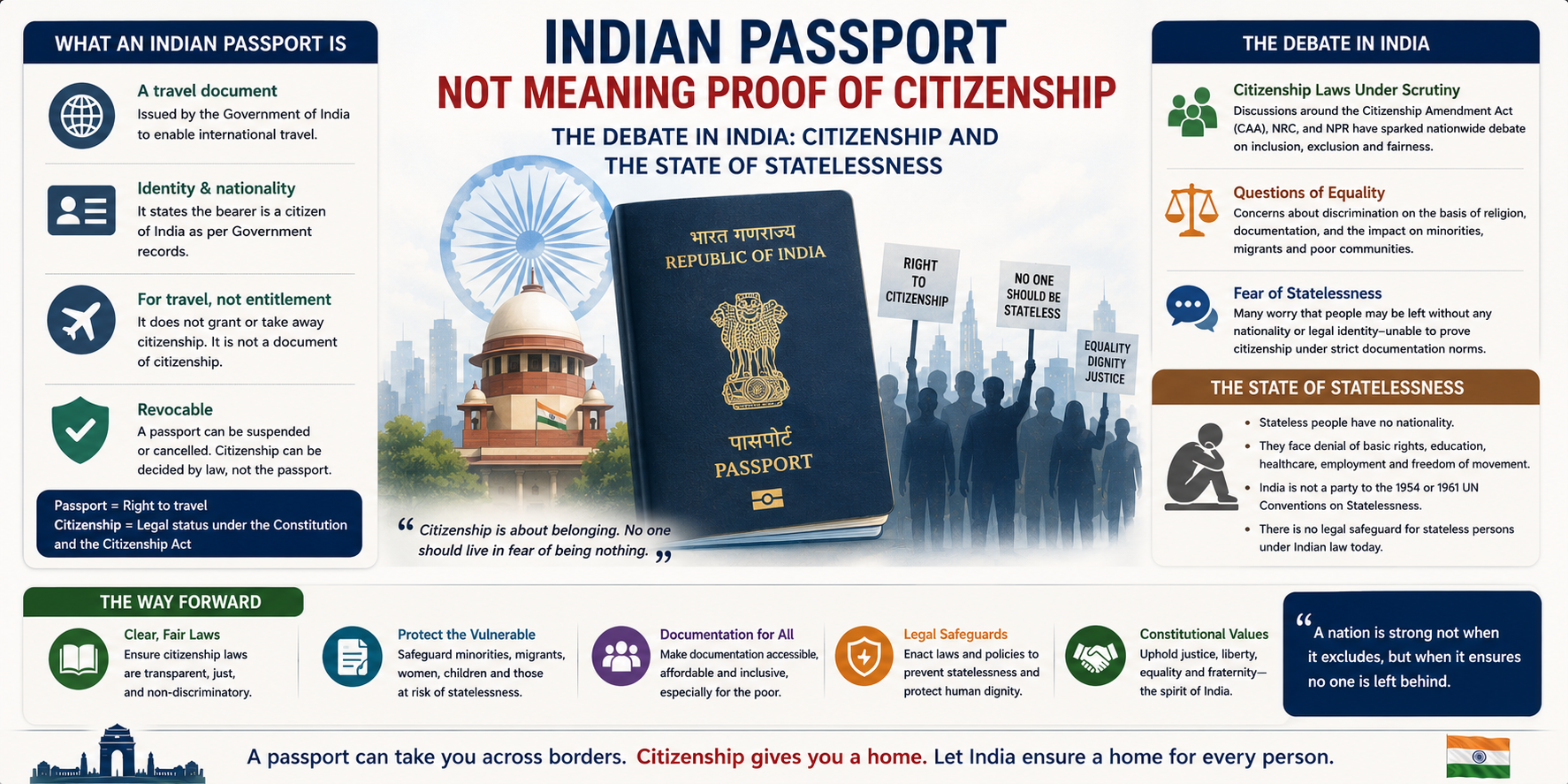
If your Indian passport is revoked — for any lawful reason whatsoever, whether non-renewal, impounding under Section 10 of the Passports Act, cancellation on security grounds, or any other exercise of executive authority — it does not ipso facto mean that you have been stripped of your Indian citizenship. The passport and the citizenship are legally distinct instruments. The cancellation of one does not extinguish the other. A government that revokes your passport has deprived you of your travel document. It has not, by that act alone, made you a non-citizen.
This is a constitutional protection hiding in plain sight, and the MEA has inadvertently illuminated it. The same legal logic that prevents the passport from serving as conclusive proof of citizenship also prevents the withdrawal of the passport from serving as conclusive proof of its absence. You remain an Indian citizen until citizenship is formally terminated through the specific processes prescribed under the Citizenship Act, 1955 — renunciation under Section 8, termination under Section 9 on acquisition of foreign citizenship, or deprivation under Section 10 by order of the Central Government after due inquiry. None of these is triggered automatically by a passport cancellation.
In a political environment where passports have been withheld from journalists, activists, and dissidents as an instrument of administrative pressure, this distinction matters enormously. Thank heavens for small mercies.
But the Statement Also Exposes a Deeper Problem
Having said that, the MEA’s statement of 24 June 2026 — issued on the 14th Passport Seva Divas and reported after it circulated on social media — does expose a gap that the government cannot now leave unaddressed. Javed Akhtar asked whether issuing a travel document to someone whose citizenship had not been formally verified was not, in itself, absurd. Aaditya Thackeray asked what exactly the Police verify before granting a passport if the result is not a citizenship document. Ordinary citizens asked the question that cut deepest: if not the passport, not the Aadhaar, not the voter ID — then what?
The honest answer is stark: for the overwhelming majority of India’s 1.4 billion citizens — those who are citizens by birth — there exists no document that conclusively, formally, and unambiguously certifies that citizenship. The MEA has told the country what does not constitute proof of citizenship. It has not told the country what it does. That is the question it now owes the country.
The Law Has Always Said This
The MEA official was not inventing a new legal doctrine. He was describing one that has existed for nearly six decades. Under Section 20 of the Passports Act, 1967, an Indian passport may, in specified circumstances, be issued by the Central Government to a person who is not a citizen. That single provision is legally sufficient to establish that holding a passport is not conclusive proof of citizenship.
The Aadhaar Act, 2016, is equally unambiguous. Section 9 states in terms: “The Aadhaar number or the authentication thereof shall not, by itself, confer any right of, or be proof of, citizenship or domicile in respect of an Aadhaar number holder.” Parliament wrote that into the statute in 2016. UIDAI reiterated it through a formal notification in August 2023. The Supreme Court, in its judgment of 27 May 2026, upholding the constitutional validity of the Election Commission’s Special Intensive Revision of electoral rolls, confirmed it again: the voter ID establishes prior enrolment, not citizenship; the ECI can verify electoral eligibility but cannot adjudicate citizenship status. None of this is new law. What is new is that the government has publicly said it — and, in doing so, made it impossible to pretend the gap does not exist.
The Certificate That Exists — And Who Gets It
There is, in Indian law, a document that does conclusively establish citizenship. It is the Certificate of Naturalisation, issued by the Ministry of Home Affairs under Section 6 of the Citizenship Act, 1955, to foreign nationals who have completed eleven years of aggregate lawful residence over the preceding fourteen years — plus twelve unbroken months immediately before applying — and who satisfy the MHA’s Empowered Committee of their suitability. A parallel Certificate of Registration is issued under Section 5 to persons of Indian origin resident here for seven years, to spouses of Indian citizens who have similarly resided for seven years, and to certain other specified categories.
Both involve a formal process: District Level Committee verification of documents, an Oath of Allegiance administered by a Designated Officer, security agency clearance, and final approval by the Empowered Committee. Both are now issued as digital certificates, with physical ink-signed copies available on request.
These certificates are issued only to those who acquire citizenship through naturalisation or registration. They are not issued to citizens by birth. I was born in Bathinda on 31 July 1961. Under the law as it stood that day, I became an Indian citizen at the moment of birth, by operation of statute. No certificate was issued. No document was generated. The law simply applied, and citizenship accrued silently. The overwhelming majority of India’s 1.4 billion citizens are in exactly this position: citizens by birth, holding no certificate, and now being told that the documents they carry — passport, Aadhaar, voter ID — do not conclusively establish citizenship.
How We Got Here: The Quiet Dismantling of Birthright Citizenship
Before 1 July 1987, birth on Indian soil conferred citizenship automatically and without condition, regardless of parental status — classical jus soli. After the Citizenship (Amendment) Act, 1986, came into force, at least one parent was required to be an Indian citizen. After the Citizenship (Amendment) Act, 2003, came into force on 3 December 2004, the conditions tightened further: either both parents must be Indian citizens, or one must be a citizen, and the other must not be an illegal migrant. If either parent is an illegal migrant, the child born in India acquires no citizenship at birth — regardless of any other circumstance.
India has, in effect, moved from jus soli to jus sanguinis — from citizenship by territory to citizenship by descent — while retaining the administrative infrastructure and public understanding of the earlier territorial model. A person born before 1987 carries the old assumption: birth here made me Indian. The law that supported that assumption has been repealed. The assumption persists. The SIR exercise in Bihar and Punjab has forced this collision into the open.
The Pathway: What Must Now Be Done
First, the Ministry of Home Affairs must publish clear, nationally standardised guidance on which documents, or combinations of documents, a citizen born in India can use to establish citizenship — for electoral rolls, NRC-type exercises, welfare entitlements, and any future citizenship verification. The Assam NRC accepted legacy documents, including pre-1971 electoral rolls, land records, school-leaving certificates, and refugee registration certificates. The Bihar SIR accepted eleven specified categories. There is no principled reason these frameworks should differ by state or by exercise. A uniform national standard is both legally achievable and administratively necessary.
Second, Parliament must examine whether India needs a National Citizenship Register — distinct from the National Population Register, Aadhaar, and the electoral roll — underpinned by a Certificate of Citizenship accessible to all citizens, including and especially those who are citizens by birth. This register has been contemplated since the 2003 amendment to the Citizenship Act. More than two decades later, it no longer exists outside Assam. The MHA already issues certificates of naturalisation and registration to those who acquire citizenship through a formal process. That institutional architecture should now be extended to issue a Certificate of Citizenship to those born here — proactively, as a matter of administrative routine, not on demand during a verification drive.
Third and most urgently, Parliament must confront the statelessness risk the 2003 amendment has created but never acknowledged. A child born in India to one citizen parent and one illegal migrant parent acquires no citizenship at birth. If the other parent’s home country also declines to recognise the child, the child is stateless, through no act of their own. India is party to neither the 1954 UN Convention on the Status of Stateless Persons nor the 1961 Convention on the Reduction of Statelessness. A domestic provision preventing statelessness for children born on Indian soil — preserving the deterrent against illegal migration while protecting the innocent child — is the minimum that justice requires.
An Honest Statement Deserves an Honest Answer
The MEA’s statement was legally accurate. The public reaction — bewildered, anxious, angry — was entirely rational. But those who heard only the anxiety missed the protection embedded in the same legal logic. If the passport is not proof of citizenship, neither is its cancellation proof of the loss of citizenship. That is a shield the law extends to every Indian whose passport a government might wish to revoke. In a constitutional democracy, that matters.
What also matters is the gap the statement has exposed. The Certificate of Naturalisation exists. The Certificate of Registration exists. What does not exist is a Certificate of Citizenship for the 1.4 billion who were born here and need no naturalisation because India was already theirs at birth. That document — and the National Citizenship Register that would underpin it — is not a bureaucratic luxury. After 24 June 2026, it is a democratic and constitutional necessity.
The government has told us what does not prove citizenship. It now owes us the architecture that does.