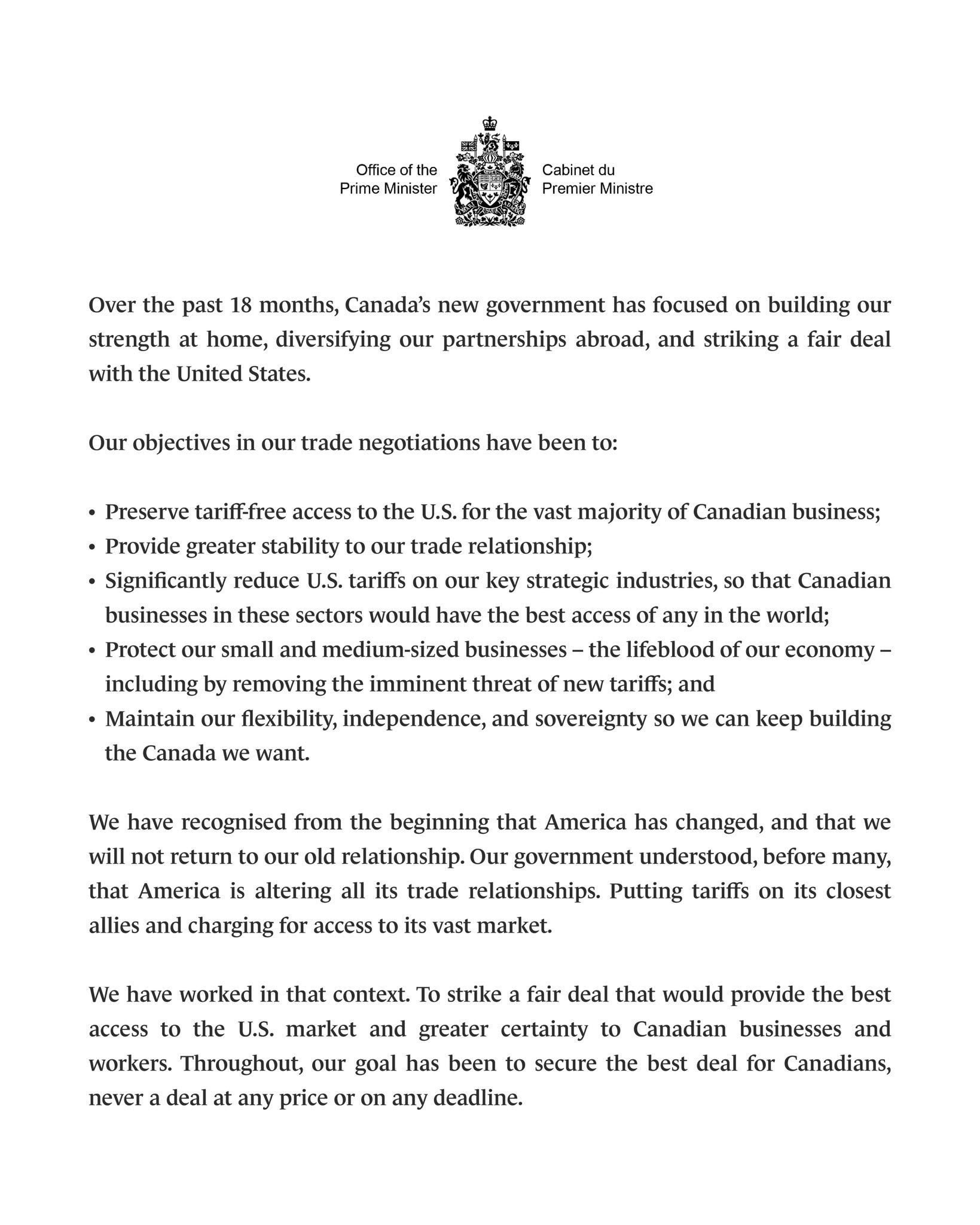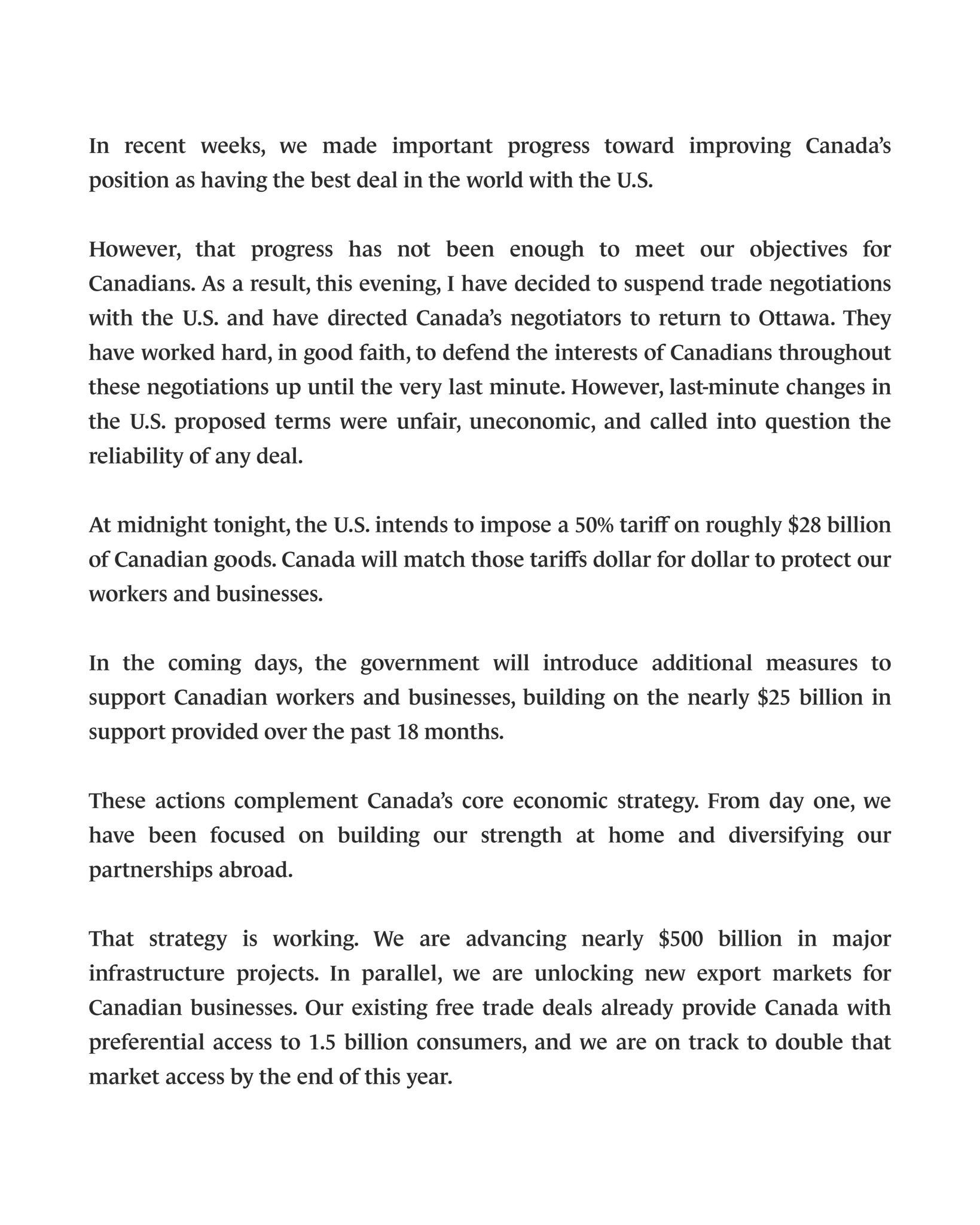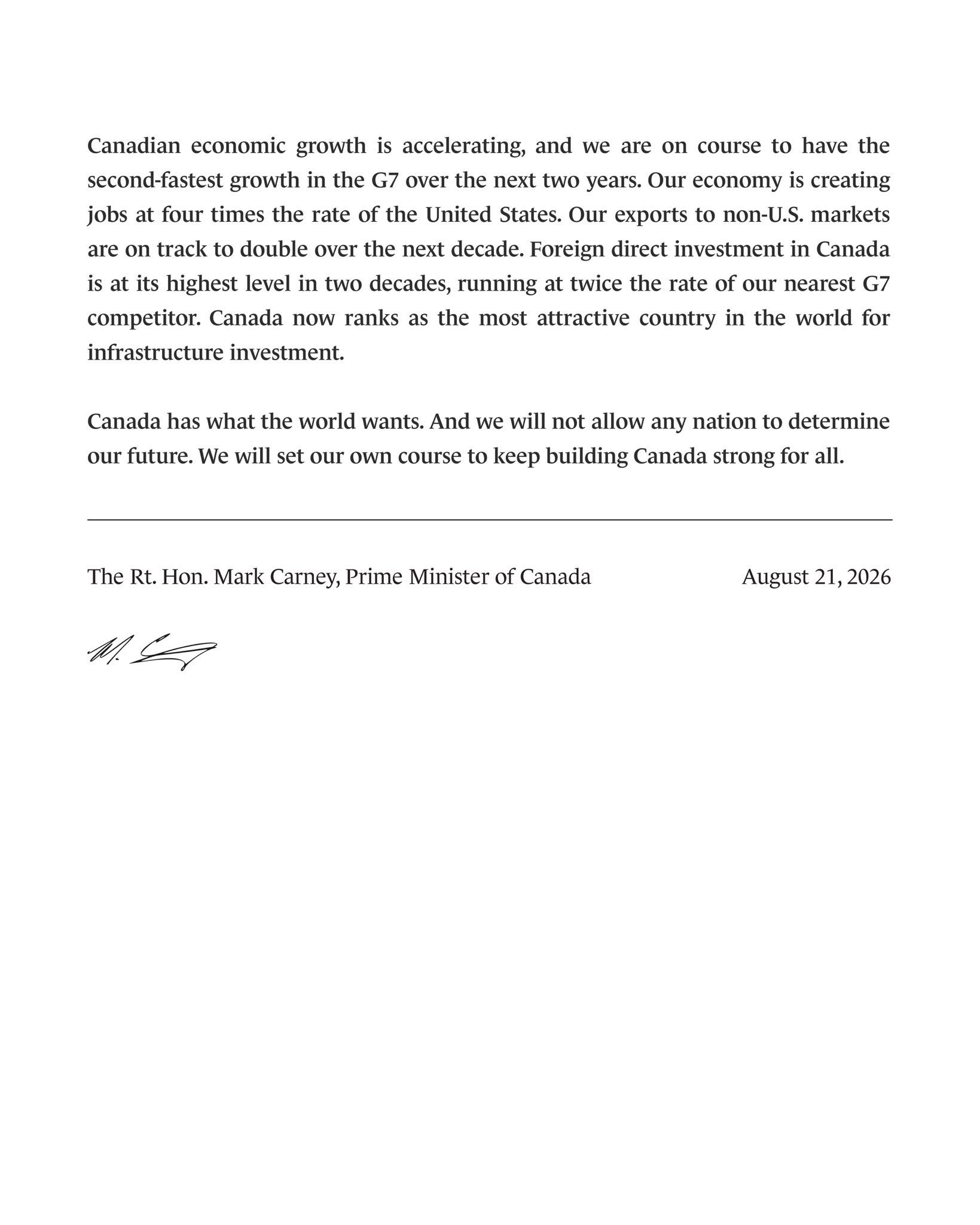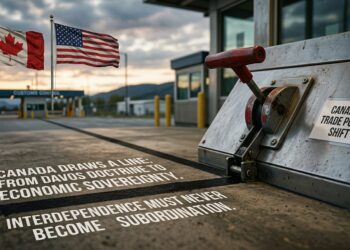


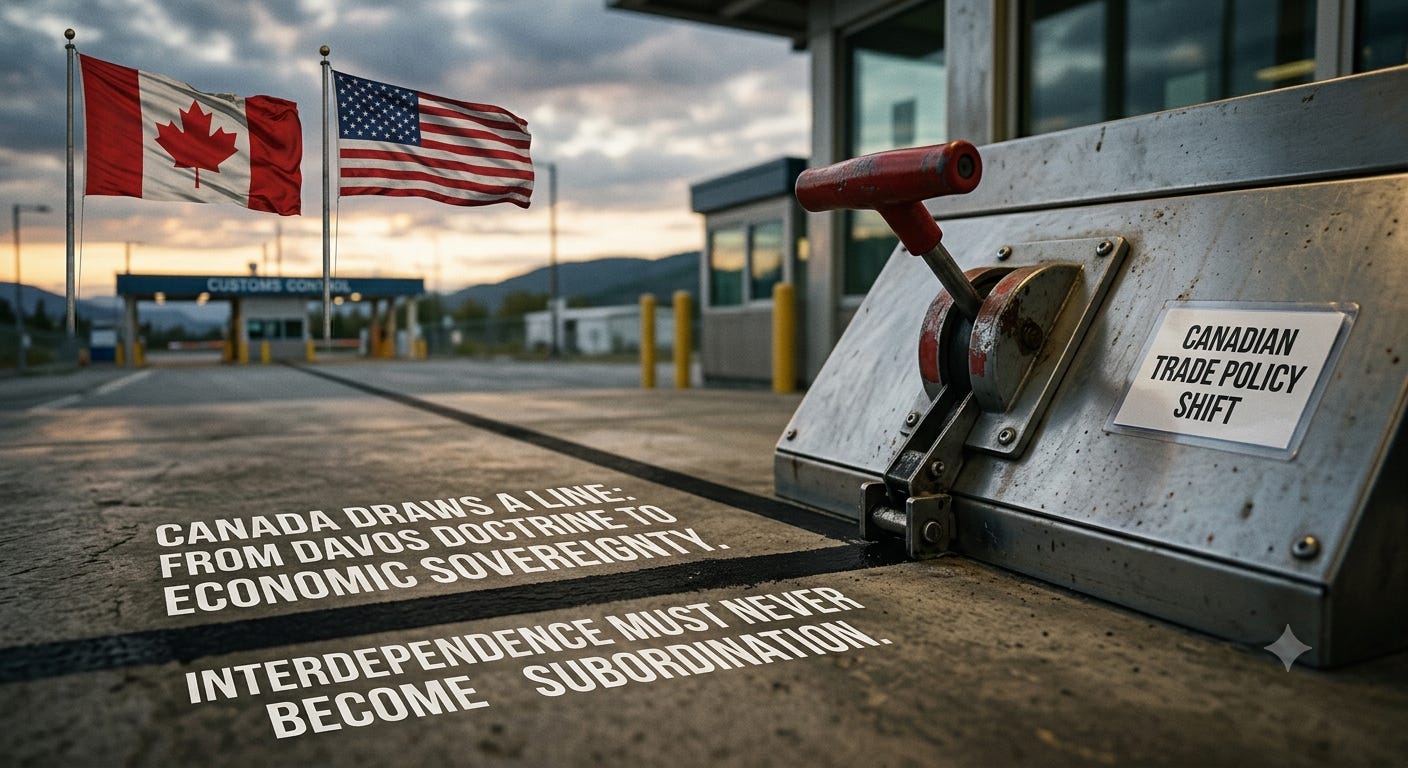
Carney’s suspension of trade talks with Washington is the first real test of the doctrine he set out at Davos: interdependence must never become subordination.
A rupture, not a transition
What makes this week’s episode more significant than a routine tariff escalation is that it follows directly from Mark Carney’s much-discussed address to the World Economic Forum at Davos in January. There, Carney went beyond warning of a difficult phase in global trade; he announced a change in Canada’s strategic premises. The world, he argued, was living through a rupture, not a transition — the end of the comforting belief that rules, alliances and economic interdependence would automatically restrain the powerful.
Carney’s central proposition at Davos was stark. The post-Cold War order had rested on a degree of American hegemony, institutionalised through multilateral rules and reinforced by expanding economic integration. That arrangement, he suggested, no longer functioned as advertised. Great powers were increasingly turning economic integration into coercion: tariffs as leverage, financial infrastructure as pressure, supply chains as vulnerabilities to exploit.
Canada’s current confrontation with the United States gives that diagnosis an immediate, concrete form. At Davos, it was analysis. This week, it became policy.
From Ottawa’s Davos to Ottawa’s deadline
Trump had already extended the original deadline once by three days, buying both sides a narrow window to find a landing zone. Two days before it lapsed, officials on both sides sounded as though they were headed toward a compromise. They were not. The window closed at midnight without an agreement, and the United States imposed 50 per cent tariffs on some $20 billion worth of Canadian products — hockey sticks and tongue depressors among the more improbable casualties — early Saturday morning. Canada announced it would retaliate dollar for dollar beginning September 8, targeting steel, dairy, appliances, agricultural equipment, pulp and paper, and electronics.
Carney’s account of why the talks collapsed is precise rather than rhetorical. Canada, he said, had been prepared to drop its remaining retaliatory tariffs on steel, aluminium and autos if Washington substantially lowered its own, and to encourage the provinces to restore American alcohol sales on their shelves. Washington’s final terms, however, went further: reduced tariff relief for Canadian-made vehicles, restrictions on Canada’s freedom to strike trade deals with other countries, and weakened protections for language, culture and sovereignty. “They asked too much and offered too little,” Carney said — and called the sovereignty-adjacent demands simply “unacceptable.” On the American side, Trade Representative Jamieson Greer took a starker line still: Washington had offered relief on steel, autos and lumber, “and they still would have an even better deal, but they didn’t want that.” No further talks, he said, are currently planned.
There is also a telling detail in how Trump reached for these tariffs. Rather than his usual recourse to emergency economic powers — struck down by the Supreme Court in February — he invoked Section 338 of the Tariff Act of 1930, a Depression-era provision aimed at countries found to discriminate against American commerce. It has never before been used to impose a tariff, requires no investigation to trigger, and carries no statutory limit on how long it may remain in force. A nine-decade-old statute drafted in the shadow of Smoot-Hawley is now the instrument of choice against a treaty ally — a measure of how far this relationship has travelled.
At Davos, Carney had warned that the old international vocabulary could become a form of evasion. The appropriate response, he said, was not fatalism, nor retreat into isolation, but a willingness to “name reality.” That reality, in his telling, is a world in which the powerful act through economic pressure as readily as through military force. A country’s dependence on a large market, a payments network, or a cross-border supply chain can become political leverage whenever it suits the stronger party. Statecraft’s task, on this reading, is to keep interdependence from curdling into subordination — not to sever every connection.
This is the logic behind Ottawa’s refusal to accept last-minute terms under duress. The question before Carney’s government was never whether access to the American market mattered — it does, profoundly. The question was whether Canada should accept an understanding whose terms could be rewritten under pressure each time a deadline approached. Carney’s own words, delivered as the talks fell apart, made the underlying diagnosis explicit: Canada had recognised “that America has changed,” and that the two countries would “not return to our old relationship.” The line from January’s Davos podium to August’s breakdown is, in that sense, unbroken.
The doctrine of middle powers
Carney’s Davos speech mattered because it supplied a political vocabulary for countries that are neither superpowers nor passive spectators. Its subject was the predicament of the middle power: too economically exposed to ignore the great powers, yet too substantial to accept permanent dependency as the natural order of things.
The line that travelled furthest from that speech was blunt: if a country is not at the table, it is on the menu. Its force lay not in rhetoric but in the strategy behind it. Middle powers, Carney argued, possess more agency than they habitually acknowledge. They can diversify economic relationships, strengthen domestic productive capacity, build coalitions with like-minded states, and defend common rules through joint action rather than solitary appeal.
This week’s breakdown matters beyond the immediate tariff schedule because Ottawa attempts to make its economic policy consistent with its own stated reading of the world. Canada is not claiming it can replace the American market overnight — geography alone forecloses that fantasy. Its aim is narrower and more durable: reducing, deliberately and over time, the extent to which the threat of exclusion from that market can dictate its national choices.
How Washington plays this hand
President Trump’s approach to this standoff follows a pattern now familiar from a year and a half of similar episodes with multiple trading partners: deadlines are set, then extended when convenient, then enforced abruptly when patience — or leverage — runs out. The three-day extension he granted Canada was not a softening of position; it was room created to test whether Ottawa would fold before the clock ran out a second time. When it did not, the tariff followed within hours, calibrated at a level — 50 per cent, reached via a statute unused since before the Second World War — designed to be felt rather than merely noticed.
This is less a considered trade strategy than a negotiating style transplanted onto a sovereign relationship: pressure, pause, reassessment, pressure again. It has worked, to varying degrees, with partners willing to treat each deadline as a fresh negotiation. Greer’s own framing of the breakdown — that Washington offered Canada “an even better deal” and was refused — suggests the administration still expects eventual capitulation, dismissing the possibility that Ottawa’s public commitment to retaliate is more than a bargaining posture. Whether a partner prepared to absorb real retaliatory costs changes that calculus, or whether the September 8 countermeasures are dismissed as a marker of resolve without consequence, will be the more revealing test of the next few weeks than anything said this weekend.
A test of the thesis
Turning diagnosis into doctrine carries risk. Retaliation carries costs. American tariffs hurt Canadian exporters; Canadian counter-tariffs raise costs for Canadian consumers and businesses. Diversification is a strategic necessity, not an instant remedy — geography cannot be wished away, and the United States will remain Canada’s indispensable commercial partner for the foreseeable future, whatever the current temperature of the relationship.
But this is also why Carney’s position is more serious than simple defiance. He is not after a rupture in Canada–US trade; he wants trade that rests on reciprocity and some minimum of predictability — freedom from a relationship in which economic integration can be converted, whenever convenient to the other side, into unilateral political leverage, rather than separation from the United States itself. Carney’s credibility will now depend on execution — on whether the promised support for exposed workers and firms, and the wider programme of infrastructure and market diversification, produce results measured in years rather than press releases.
A word for India
For India, watching this drama from a considerable distance, Carney’s doctrine offers a lesson worth noting rather than a template worth copying outright. India’s own negotiation with Washington has followed a different rhythm altogether: patient attrition rather than rupture, with successive near-completions, an interim tariff reduction from 25 to 18 per cent in February, a Supreme Court detour on the American side, and periodic Indian pullbacks whenever the terms on offer fell short of what New Delhi judged acceptable on agriculture and dairy. There has been no suspension, no recalled delegation, no matching retaliatory package — only a quieter insistence, sustained over eighteen months, that a deal will be signed when it is fair and not a day before. Whether that patience achieves what Carney’s public confrontation aims at remains, for now, an open question; but the underlying instinct, that interdependence must not be allowed to become subordination, is one New Delhi appears to share, even while choosing a very different register to express it.
How this might end
The talks did not merely stall; they broke down in public, on the record, with both sides naming their conditions and both declining to meet them. A trade-law scholar’s observation on the breakdown captures why that matters more than the tariff figure itself: Canada had signalled in advance that it would stop negotiating and retaliate if the tariffs landed, Washington had said publicly it would not tolerate retaliation, and both governments have now committed themselves in public — which is precisely how escalation stops being a choice and starts being a script both sides feel bound to follow. With Canada’s countermeasures set for September 8 and no further talks currently scheduled, the question now is what happens once the retaliation actually lands.
Three broad paths seem plausible from here.
- The first is a face-saving thaw before or shortly after the September 8 deadline: back-channel contacts resume, a narrower sectoral arrangement is stitched together, and both leaders declare progress while shelving the harder questions — vehicle content, third-country trade freedom, cultural sovereignty — for a later round. This is the pattern Washington has followed with several other partners over the past year, and it remains the path of least domestic cost for both governments, even after a public breakdown like this.
- The second is a prolonged stalemate, in which neither side blinks through the autumn, Canadian exporters and American consumers alike absorb real costs, and the dispute becomes a fixture of the relationship rather than an episode within it — resolved only when a change in political weather, on either side of the border, alters the incentives.
- The third, and now the least avoidable given Section 338 carries no expiry date, is that this becomes semi-permanent: a tariff regime with no legal off-switch, met by a retaliation regime with no political off-switch either, each side waiting for the other to move first.
Carney’s own instinct, if his Davos doctrine is taken at its word, favours patience over panic even now. President John F. Kennedy’s line from an earlier era of hard bargaining fits the moment: “Let us never negotiate out of fear. But let us never fear to negotiate.” That is close to the posture Ottawa has tried to hold through this breakdown — declining to accept terms extracted under pressure, while insisting, even as retaliation is announced, that the door to genuine negotiation remains open on Canada’s terms. Whether Washington eventually reads that posture as principle rather than bluff, and whether a statute with no sunset clause tests that patience past its limit, will likely decide which of the three paths this dispute actually takes.