


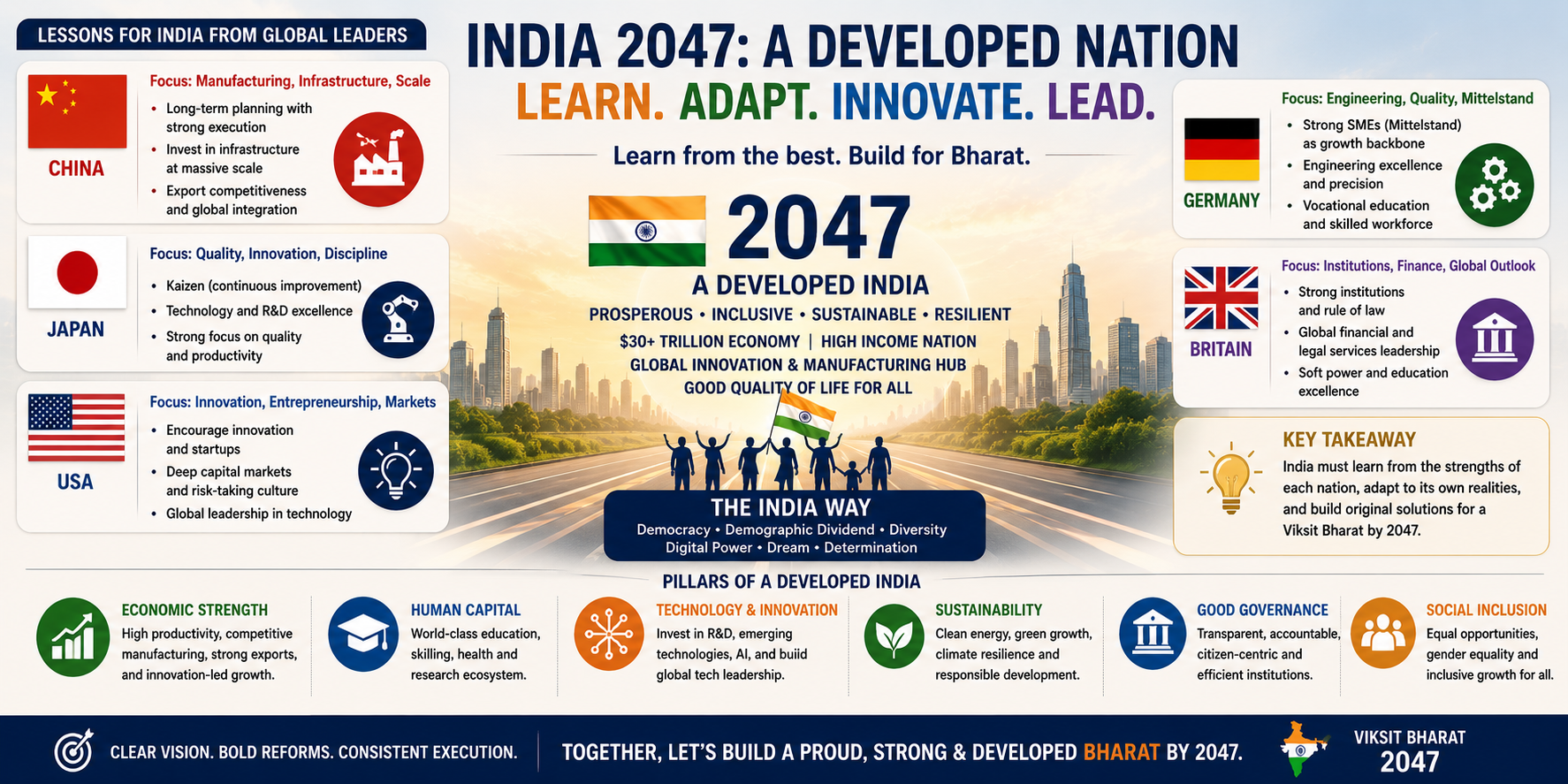
The goal of becoming Viksit by 2047 is a stiff one. All sections of society, government, academia, industry, and business have to work in tandem, shedding their turf fixation in favour of a larger common objective. Institutional reform may become imperative through innovation and emulation, even if it makes some uncomfortable. The following piece, written exclusively for the Saviours, dwells on this theme
From Theory to Capability
The debate on national development often revolves around a deceptively simple question: what comes first—education or industry? Do universities create economic growth, or does economic growth create universities? The question may seem academic, but history shows that the answer has shaped the destiny of nations. The rise of Germany, Japan, the United States, South Korea, Taiwan and China suggests that successful nations do not treat education, technology, industry and governance as separate domains. Rather, they create a mutually reinforcing ecosystem in which knowledge generates capability, capability creates productivity, productivity drives prosperity, and prosperity finances further knowledge creation.
This question is particularly relevant for India as it pursues the ambitious vision of becoming a developed nation by 2047. The challenge before India is not merely to increase GDP, expand higher education, build infrastructure or create jobs. The real challenge is to build a national capability system that can continuously generate innovation, productivity, entrepreneurship, social mobility, and institutional excellence. History offers valuable lessons in this regard.
Britain: First Mover
Britain, the birthplace of the Industrial Revolution, followed a path that is often misunderstood. Much of its early industrial success emerged not from universities but from workshops, factories and entrepreneurial experimentation. The pioneers of industrialisation were craftsmen, mechanics and practical innovators rather than university-trained scientists. Steam engines, textile machinery, and iron production technologies evolved through trial and error, practical experience, and incremental improvements. Universities such as Oxford and Cambridge played only a limited role during the early decades of industrialisation. Britain succeeded because it was the first mover. It had no competitors to catch up with and could afford to learn through experimentation. In today’s highly complex technological environment, where success depends upon artificial intelligence, biotechnology, semiconductors and advanced materials, such a path would be far too slow.
Germany: Knowledge-Based
Germany took a fundamentally different route. Entering the industrial race nearly a century after Britain, Germany recognised that it could not catch up merely by copying British factories. Instead, it created a new model centred on knowledge. The establishment of the Humboldtian university system in the nineteenth century transformed higher education from a mechanism for transmitting existing knowledge into a system for generating new knowledge. Research became inseparable from teaching. Universities evolved into laboratories of innovation. Professors became inventors, scientists and industrial problem-solvers. German industry, particularly in chemicals, engineering and pharmaceuticals, grew directly from this scientific foundation. Companies such as BASF, Bayer and Hoechst built their competitive advantage on research and scientific talent rather than on cheap labour or natural resources. By the beginning of the twentieth century, Germany had become the world’s leading scientific and industrial power despite starting much later than Britain.
Japan: From Feudal to Industrial Giant
Japan’s experience offers a third model. Following the Meiji Restoration of 1868, Japanese leaders understood that national survival depended upon rapid modernisation. Unlike Germany, Japan did not attempt to create an entirely indigenous knowledge system from scratch. Instead, it became one of history’s most effective learners. Japanese policymakers studied British naval systems, German universities, French administration and American industrial methods. Thousands of students were sent abroad. Foreign experts were invited to Japan. Modern universities, railways, factories and military institutions were established simultaneously. Within less than half a century, Japan transformed itself from a feudal society into a major industrial and military power. Its success lay not merely in importing knowledge but in adapting global knowledge to local realities.
USA: Learning to its Advantage
The United States combined elements of both the British and German approaches. During the nineteenth century, it created a unique partnership between universities, industry and government. The Morrill Act democratised higher education by establishing land-grant universities focused on agriculture, engineering and practical sciences. Research universities such as Johns Hopkins adopted the German model of knowledge creation. At the same time, private entrepreneurs built industries while the federal government financed strategic research. This triangular relationship eventually produced Bell Labs, Silicon Valley, the aerospace industry, the internet and numerous technological breakthroughs that shaped the modern world. The American experience demonstrates that the greatest innovations emerge when universities, industry and government operate as partners rather than as isolated institutions.
Other Successes
The experiences of South Korea, Taiwan and Singapore further enrich these lessons. These nations achieved remarkable transformations despite limited natural resources. Their success rested on strategic focus, disciplined governance and extraordinary investments in human capital. Education was not treated as a social sector alone; it was viewed as a national competitiveness strategy. Universities were aligned with industrial priorities. Skills development was linked directly to economic opportunities. Government policies consistently encouraged export competitiveness, technological upgrading and workforce productivity. The result was a virtuous cycle of rising capabilities and rising prosperity.
China: Gamechanger
China represents perhaps the largest-scale development experiment in human history. Over the last four decades, it has combined infrastructure development, manufacturing ecosystems, technology acquisition and large-scale human capital formation to become a global economic powerhouse. While India’s democratic system differs fundamentally from China’s political model, the importance of long-term planning, manufacturing depth and technological capability remains highly relevant.
The common thread connecting all these national experiences is not the superiority of one institutional model over another. Rather, it is the creation of capability. Successful nations systematically build the ability of individuals, institutions and enterprises to solve increasingly complex problems. Development, therefore, is fundamentally a process of capability expansion.
What India Should Do
This insight is particularly important for India. Since Independence, India has invested heavily in scientific and technical institutions. The establishment of the IITs, IISc, agricultural universities, AIIMS, research laboratories and public sector enterprises created a strong intellectual foundation. These institutions have produced world-class talent and contributed significantly to national development. However, the connections among education, research, industry, and employment have often remained weaker than they should be. India has excelled at producing talent but has not always fully harnessed it for domestic transformation.
Today, India stands at a historic inflexion point. The coming decades will be shaped by artificial intelligence, automation, robotics, biotechnology, climate technologies, advanced manufacturing and digital public infrastructure. Traditional development models based solely on cheap labour or natural resource advantages will become increasingly inadequate. Economic success will depend upon a nation’s ability to generate, absorb and apply knowledge continuously.
This reality requires a broader understanding of development itself. GDP growth, while important, is ultimately an outcome rather than a cause. The true drivers of development are capabilities embedded within people, institutions and systems. Nations become prosperous when they cultivate knowledge, skills, innovation, entrepreneurship, governance effectiveness and social trust. These capabilities reinforce one another, creating a self-sustaining cycle of progress.
The challenge before India is therefore not merely to expand universities, establish more skill centres or create additional industrial parks. The challenge is to integrate these components into a coherent national capability ecosystem. Schools must prepare learners for lifelong learning. Universities must become centres of innovation rather than examination factories. Research institutions must work closely with industry. Industries must become active partners in workforce development and technology creation. The government must act as an enabler, coordinator, and strategic investor. Citizens must be empowered to participate in continuous learning and economic transformation throughout their lives.
The National Education Policy 2020 and the National Credit Framework provide an important foundation for such a transformation. By enabling mobility across academic, vocational and experiential learning pathways, these reforms recognise that capability development cannot remain confined within traditional institutional boundaries. In many ways, they represent India’s attempt to build an integrated learning ecosystem suitable for the twenty-first century.
The journey towards Viksit Bharat 2047 can therefore be understood through six interconnected pillars.
Pillar |
Strategic Purpose |
Human Capital |
Creation of skilled, adaptable and innovative citizens |
Research & Knowledge |
Generation of new ideas, technologies and solutions |
Industry & Enterprise |
Conversion of knowledge into productivity and wealth |
Innovation & Technology |
Sustaining long-term competitiveness |
Governance & Institutions |
Enabling effective execution and coordination |
Inclusion & Sustainability |
Ensuring equitable and enduring development |
These pillars should not be viewed as separate policy domains. They function as parts of a single national system. Weakness in any one pillar reduces the effectiveness of all others. Conversely, improvements in one area generate positive spillovers across the entire ecosystem.
Uphill or Doable?
Looking towards 2047, India’s development challenge is unprecedented in scale. No nation in history has attempted to transform a society of more than 1.4 billion people into a developed economy while simultaneously preserving democracy, diversity, federalism and social inclusion. Yet India’s size can also become its greatest advantage. If effectively mobilised, India’s demographic strength, entrepreneurial energy, technological capabilities and civilisational wisdom can create a development model unlike any seen before.
The lessons of history are clear. Germany built scientific capability. Japan built a learning capability. America built an innovation capability. South Korea built educational capability. Singapore has built governance capability. China built a manufacturing capability. India’s task is more ambitious. It must build all of these capabilities simultaneously while remaining anchored in its democratic and civilisational values.
Conclusion
The ultimate lesson is that prosperity is not created by resources, geography or demographics alone. It is created by organised human capability. Nations rise when they transform knowledge into competence, competence into productivity, productivity into prosperity and prosperity into collective confidence. The real objective of Viksit Bharat 2047 is therefore not merely economic growth. It is the creation of the world’s largest, most inclusive and most dynamic capability ecosystem. If India succeeds in this endeavour, the achievement will extend far beyond economics. It will represent one of the most significant civilisational transformations of the twenty-first century.