

Introduction
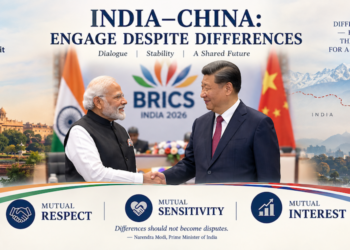
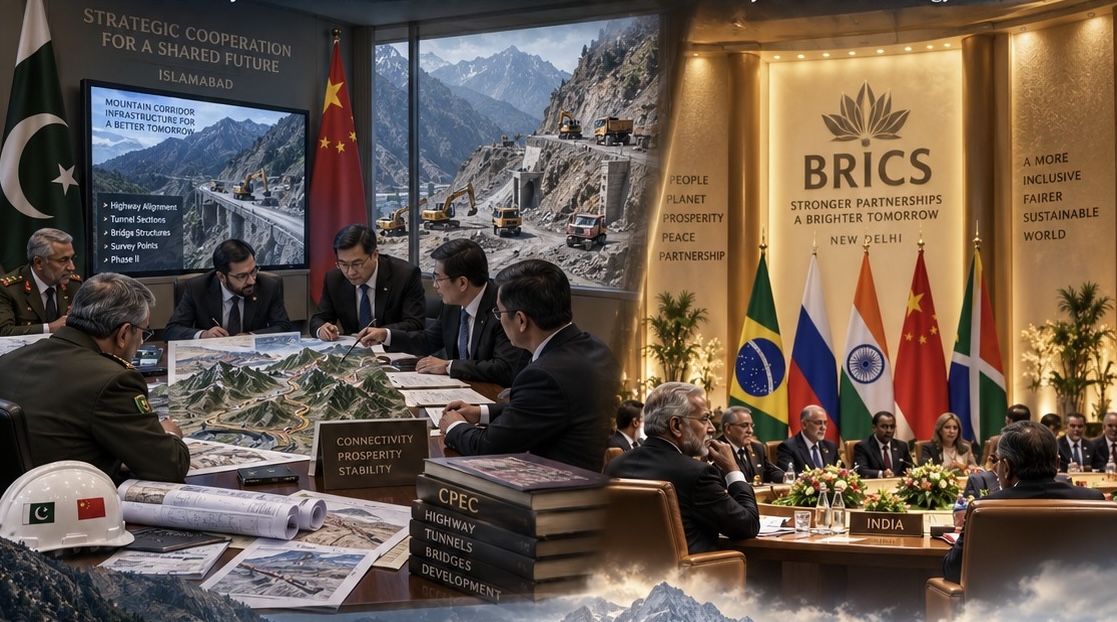
On Saturday, 12 September 2026, Prime Minister Narendra Modi met President Xi Jinping on the sidelines of the 18th BRICS Summit in New Delhi, Xi’s first visit to India in seven years. The readout spoke of the “three mutuals” (mutual respect, mutual sensitivity and mutual interest). In a line that must have taken some drafting, it also acknowledged a “structural trade imbalance”.
On Wednesday, 16 September, the Pakistan–China Boundary Joint Commission held its inaugural meeting at the Foreign Office in Islamabad. A Chinese deputy director-general for boundary affairs and Pakistan’s director-general for China co-led it; they discussed joint surveys of a frontier that runs through Indian territory.
Four days separated the bonhomie from the nishandehi.
New Delhi’s reply was swift and correct: There is no boundary between Pakistan and China, the 1963 agreement is illegal and invalid, and Pakistan should give up the theatrics and vacate. I would go one step further, because the documents permit it.
A Nishandehi on a Void Deed
Read the 1963 instrument itself, signed in Peking on 2 March 1963 by Chen Yi and Zulfikar Ali Bhutto. Its formal title describes a boundary between Xinjiang and “the contiguous areas the defence of which is under the actual control of Pakistan”. It speaks of defence and of actual control, and nowhere of sovereignty.
Article 6 then provides that, once the Kashmir dispute is settled, “the sovereign authority concerned” will reopen negotiations with China to sign a formal treaty replacing the agreement. Pakistan conceded, in its own hand, that it was not that authority.
India’s title rests on the plain position that the whole of Jammu and Kashmir, PoK, Gilgit-Baltistan and the Shaksgam tract included, has been India’s from the day of accession. Pakistan’s concession adds nothing to that title, but an admission against interest deserves to be read into the record.
Any Financial Commissioner who has heard a revision petition in Punjab knows the sequence. A man in possession without title executes a deed. The buyer then applies for a nishandehi (the demarcation of a field by the kanungo and patwari, chain in hand, against the shajra, the village field map), so that pillars can be fixed and possession made to look settled. The demarcation may be accurate to the inch. The deed stays void.
Islamabad and Beijing have done exactly that. The new body is distinct from the 1963 demarcation commission, whose one-time mandate ended with the 1965 protocol and maps. It flows from Article 45 of the 2013 Agreement on the Boundary Management System, and handles inspection, joint surveys, markers and cross-border facilities. It is a standing Nishandehi on a void deed.
New Delhi’s same-day protest is the true owner interrupting the record before continuous, unchallenged administration passes itself off as title.
Settled on the Flanks, Stalled at the Centre
The method is sixty-six years old. On 28 January 1960 China reached a boundary settlement with Burma that generally followed the McMahon Line, while Beijing refused in principle to accept that line’s legitimacy. On 21 March 1960 it signed one with Nepal, eventually running the line across the summit of Everest.
Only in April 1960 did Zhou Enlai arrive in Delhi to tell Pandit Nehru that the same McMahon Line, in the eastern sector, was an imperialist imposition China had never accepted. From Delhi he went on to Kathmandu, where the Sino-Nepalese Treaty of Peace and Friendship was signed on 28 April 1960. Settle the flanks; isolate the centre. Pandit Nehru was left defending a line Beijing had just accepted, without naming it, a few hundred kilometres to the east.
China’s unilateral ceasefire came on 21 November 1962. Its agreement with Pakistan came a hundred and one days later, and the China–Pakistan axis was born in the rubble of Panchsheel. In July 2025, the Deputy Chief of Army Staff, Lt Gen Rahul R. Singh, said Pakistan had received live inputs from China on Indian deployments during Operation Sindoor.
Today China has settled boundaries with 12 of its 14 land neighbours; only India and Bhutan remain. In Bhutan, one Chinese proposal would swap the Doklam areas under Bhutanese control for the Jakarlung and Pasamlung valleys it claims. Doklam, readers will recall, was the scene of the 73-day standoff of 2017.
The Field and the File
China contests India twice over, in the field and on the file. The field has Doklam and Galwan, where twenty Indian soldiers fell on the night of 15 June 2020. The file is quieter, and those of us who spent our working lives in government should read it closely.
In May 2007, China denied a visa to Ganesh Koyu, an IAS officer from Arunachal Pradesh, to join a 107-member study team to Beijing and Shanghai, on the ground that he was a Chinese citizen needing no visa; the entire visit was cancelled at the Prime Minister’s intervention. In January 2012, a visa was refused to Group Captain M. Panging of the IAF, and a 30-member tri-Service delegation’s visit was called off. In 2023, three Arunachal wushu players were denied accreditation for the Hangzhou Asian Games, and the Sports Minister cancelled his own trip. On 21 November 2025, Pema Wangjom Thongdok, an Arunachal-born Indian living in Britain, was held for some eighteen hours in transit at Shanghai after officials declared her Indian passport invalid.
By March 2012, China had signalled that it had stopped stapling visas for Jammu and Kashmir residents; for Arunachal, the policy did not change. Beijing treats Kashmir as a dispute. It treats Arunachal as its own.
A Hundred and Twelve Billion Reasons
The strategic rival is also, uncomfortably, our largest trading partner. In 2025–26 China overtook the United States in that position; India imported $131.63 billion from China against exports of $19.47 billion, a record deficit of some $112 billion. The gap for June 2026 alone was $15.3 billion.
Composition matters more than size. Nearly four-fifths of imports sit in electronics, machinery, organic chemicals, and plastics, with active pharmaceutical ingredients close behind; without these inputs, Indian factories fall silent. When Beijing put rare-earth magnets under export licensing in 2025, Indian automobile lines scrambled for supply. A deficit in consumer goods is a nuisance. A deficit in intermediates is a lever, and the lever sits in Beijing.
Cheap Barrels, Deep Tanks
China’s independent Shandong refiners, the “teapots”, have long been the buyers of last resort for sanctioned Russian and Iranian crude. A US House select committee reported on 31 March 2026 that from such barrels China had assembled a strategic reserve of roughly 1.2 billion barrels, about 109 days of seaborne import cover, at well below market cost.
India stopped buying Iranian oil in 2019 in deference to American sanctions. From 27 August 2025, Indian exports bore an extra 25 per cent tariff over Russian crude; China, the largest buyer, bore none.
On 16 September 2026, the very day of the Islamabad meeting, the US House passed the Sanctioning Russia and Iran Act by 262 votes to 159, authorising tariffs of up to 100 per cent on the top five importers of Russian oil and gas. The vote came three months after Indian refiners, offsetting the Hormuz disruption, had pushed Russian crude past half of India’s imports.
Even as the American blockade of Iran, reinstated in mid-July, cuts China’s Iranian intake, Beijing can draw down tanks it filled at a discount. India’s strategic caverns at Visakhapatnam, Mangaluru and Padur hold 5.33 million tonnes at full capacity, about nine and a half days of crude requirement, and in March 2026 they held less than two-thirds of that.
Self-Reliance as a Standing Order
The remedy is housekeeping, in four standing orders.
First, codify the 2007 precedent as all-or-nothing. No official, military or sporting delegation travels to China if any member is refused a regular stamped visa. Pair the rule with a standing advisory for Arunachal-born Indians transiting Chinese airports.
Second, place Article 6 on the table at every Special Representatives round. Beijing itself told New Delhi in 2017 that the line was open to renegotiation. Hold China to that, before a provisional line is settled by habit.
Third, prepare a jamabandi of dependencies (the revenue record of rights, periodically revised) listing every critical input for which China supplies more than half. Tie production-linked incentives to components rather than assembly.
Fourth, treat the petroleum reserve as defence infrastructure: Fill the existing caverns and fund the approved Chandikhol and Padur expansions.
India should accept the courtesies with grace and never mistake them for a title deed.
(Views expressed are personal.)