



In the wake of the NEET-related protests and their aftermath, the Saviours invited a Gen Z to understand how they think about the State and its response to Gen Z’s aspirations. In this detailed piece, the author discusses how she perceives the governance issue involving the young who form the largest section of our population.
Introduction
Gen Z, referring to those born between 1997 and 2012, is often described as the generation of “digital natives.” In India, this generation occupies a unique place in the country’s rapidly transforming social fabric. It is perhaps the last generation to remember a largely analogue childhood and the first to enter adulthood in a fully digital world. Many grew up with handwritten schoolwork, limited television, neighbourhood friendships and institutions that operated through formal, hierarchical channels. They later encountered smartphones, social media, instant communication and digital public services. This experience of two distinct worlds has shaped both their adaptability and their impatience. They understand the value of continuity and stability, but also expect institutions to be accessible, responsive and transparent. Their aspirations are therefore not merely products of the internet; they reflect a generation that constantly measures older systems against the speed, participation, and openness made possible by today’s technology.
Evolving Discourse
The Indian Gen Z is coming of age during a period of significant national transformation. It is entering higher educational institutions, workplaces and electorates at a time when the country is rapidly expanding its digital infrastructure, strengthening public service delivery, encouraging entrepreneurship and pursuing the goal of Viksit Bharat 2047. Young Indians are more connected, informed, and confident about the opportunities available to them than any previous generation.
India is estimated to have 700 million smartphone users and is the world’s second-largest smartphone market after China. Over the past decade, the Government of India has demonstrated that institutions can evolve rapidly when technology, administrative capabilities, and public commitment work in tandem. Digital payments, Direct Benefit Transfers, online public service delivery systems and technology-enabled welfare have made the state accessible to millions. These initiatives have not only improved governance but significantly raised public expectations about how efficient and responsive institutions must be.
Aspirations of Gen Z must be understood in this evolving national context. A generation encouraged to innovate, become self-reliant and contribute to Viksit Bharat is bound to have a stronger voice in national life and nation-building. Their expectations are not detached from India’s development trajectory; rather, they are products of the possibilities this journey has created.
Government Response & Institutional Action
The challenge, therefore, lies in the fact that India’s institutions are still adapting to a generation raised in a digital, participatory and instantaneous world. Prime Minister Narendra Modi’s recent decision to address Gen Z directly through Instagram is an example of leadership recognising this shift and adapting accordingly. By reaching young Indians on the platforms they use and communicating more directly and informally, the leadership demonstrated a strong willingness to meet this generation where it is and engage with it in its own language. This engagement should not be viewed as an isolated communication exercise. It reflects a broader evolution in the relationship between policymakers and the youth of our country. The Prime Minister has consistently emphasised the role of young people as principal drivers of India’s development journey. Initiatives such as Pariksha Pe Charcha, Viksit Bharat Young Leaders Dialogue, MY Bharat and continuous interactions with students, sportspersons, startup founders and young innovators have created channels through which the country’s leadership communicates with the next generation. The use of Instagram instead of conventional platforms represented a natural extension of this approach into a space where young Indians express themselves, exchange ideas and shape public discourse.
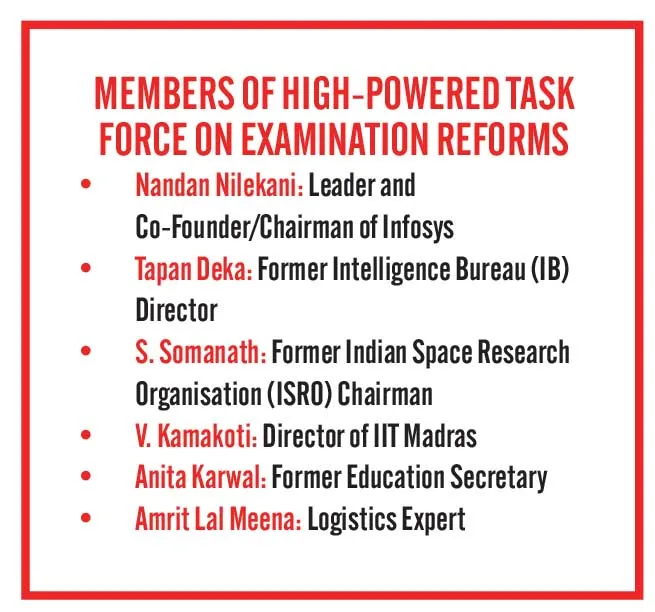 What is more important is that this communication is increasingly accompanied by strong institutional action to meet the requirements of Gen Z. Recent decisions concerning the public examination system demonstrate that the Government is listening to young people and responding with structural reforms. Competitive examinations occupy a particularly important place in Indian society. They are pathways to education, employment, social mobility and economic security. The Government’s decision to constitute a high-poweredtask force on examination reforms, headed by Nandan Nilekani, is significant in this context. Nilekani’s association with Aadhaar reforms and India’s wider digital public infrastructure brings valuable technological and administrative experience to the reform process. The task force is expected to examine how technology can be used more effectively to make the examination process more secure, transparent and credible. The Prime Minister has placed examination reforms within the Government’s larger approach of using technology to solve complex governance challenges.
The significance of the task force lies in its forward-looking character. Examination security cannot depend entirely upon action taken after an irregularity has occurred. It requires stronger safeguards across the entire examination cycle—from the preparation of question papers and their printing to transportation, storage, allocation of examination centres, candidate verification, evaluation and declaration of results. Secure digital systems, encrypted transmission, real-time monitoring, data analytics and stronger accreditation of examination centres can substantially reduce opportunities for malpractice. India’s experience in building digital systems at population scale places it in a strong position to create a more secure and dependable examination architecture.
Strong Legislation
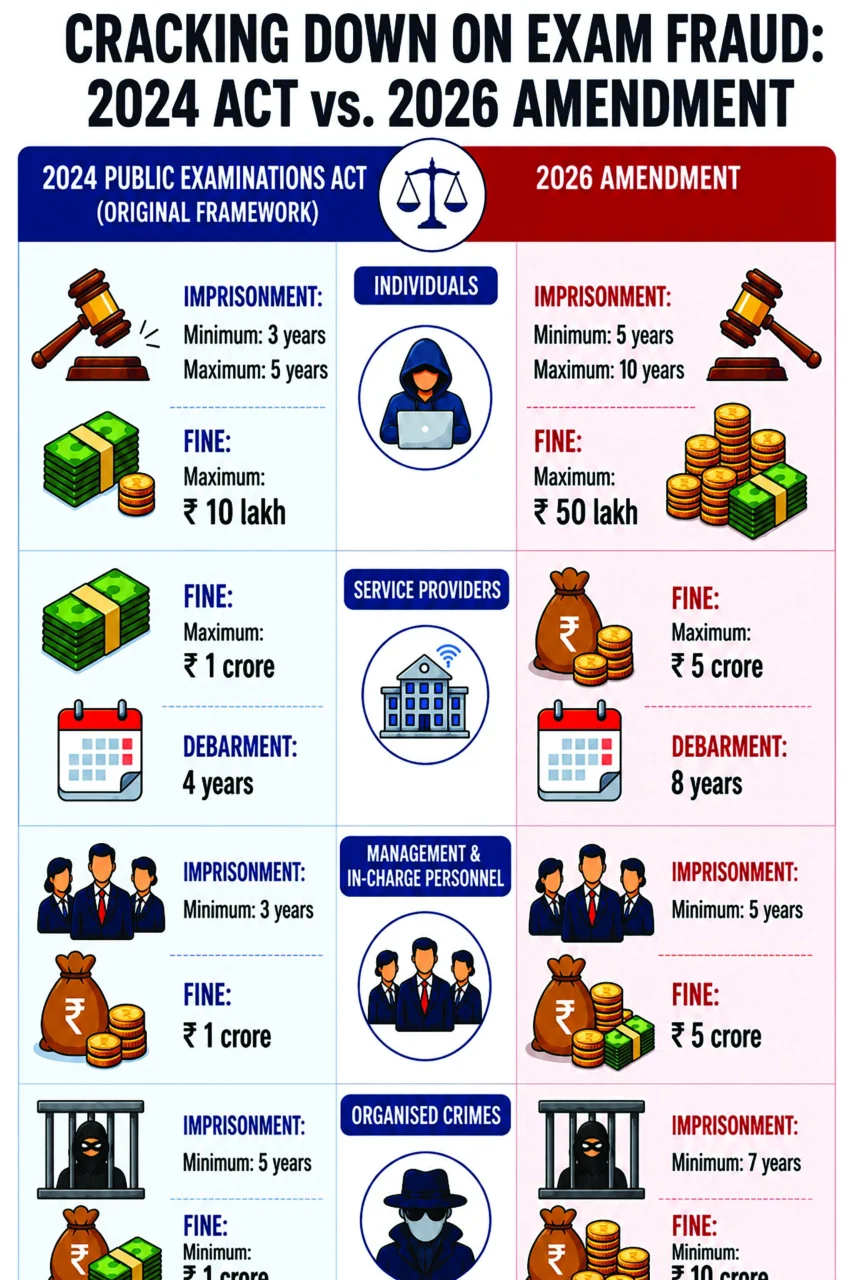
The Public Examinations (Prevention of Unfair Means) Amendment Bill, 2026 reinforces this commitment through legislative action. Building upon the 2024 Act, the Bill strengthens penalties for those who compromise the integrity of public examinations. It prescribes imprisonment of 5 to 10 years and a fine of up to ₹50 lakh for individuals found to have used unfair means. Those involved in organised examination fraud may face imprisonment of seven to ten years and a fine of at least ₹10 crore. Service providers may be fined up to ₹5 crore and debarred from conducting public examinations for 8 years, while directors and senior management personnel found responsible may face imprisonment of 5 to 10 years and a fine of ₹5 crore. Passed by both Houses of Parliament in July 2026, the Bill represents more than a tightening of criminal penalties. It reflects the Government’s recognition that examination malpractice is often organised, technologically sophisticated and capable of undermining public confidence in merit-based recruitment. Alongside stronger punishments, the Bill provides for specialised investigations through dedicated task forces, a two-month timeline for completing investigations and the establishment of Special Fast Track Courts to expedite trials. Considered together with the high-powered examination reform task force, these measures indicate a comprehensive approach that combines legislative deterrence, technological innovation, and institutional reform to safeguard the integrity of India’s examination system.
These developments also offer a broader lesson for governing Gen Z. Young citizens are more likely to appreciate the complexity of policymaking when they can see that their concerns are recognised and translated into measurable action. Trust in institutions is strengthened when communication is followed by reform. The Government’s response demonstrates that responsiveness need not weaken institutions; rather, it can make them stronger by enhancing both credibility and accountability.
Larger Aspirations beyond NEET Reform
Yet the aspirations of Gen Z extend well beyond the examination system. Young Indians seek quality education, meaningful employment, opportunities for entrepreneurship, access to technology and the freedom to pursue unconventional careers. They are entering a labour market increasingly shaped by artificial intelligence, automation, the platform economy and emerging technologies. Governance must therefore prepare them not only for the jobs that exist today but also for the opportunities that will define tomorrow.
What has already been done
The Government has already created a broad policy architecture for this transition. Skill India seeks to improve employability by connecting education with industry requirements. Startup India has encouraged entrepreneurship and innovation, while Digital India has expanded access to technology and online opportunities. The Pradhan Mantri Mudra Yojana has enabled aspiring entrepreneurs to access formal credit, and the Atal Innovation Mission and the creation of Atal Tinkering Labs have fostered innovation and problem-solving among students. Collectively, these initiatives have helped change the language of aspiration. Entrepreneurship and innovation are increasingly viewed as credible pathways alongside conventional employment.
The National Education Policy, 2020 similarly reflects an understanding of the changing needs of younger generations. Its emphasis on multidisciplinary learning, flexibility, vocational education, critical thinking and technology integration represents an attempt to move beyond rigid educational structures. For a generation that values adaptability, the policy recognises that lifelong learning and continuous skill development are becoming as important as formal qualifications.
This long-term vision has been reinforced by the proposal in the Union Budget 2026–27 to establish a high-powered Education-to-Employment and Enterprise Standing Committee. By studying employment trends, the services sector, exports and the impact of emerging technologies such as artificial intelligence on jobs and skills, the Committee seeks to better align India’s education and training ecosystem with future economic requirements. Such planning is essential if India’s demographic dividend is to become a lasting developmental advantage.
The Government has also increasingly sought to transform young Indians from passive beneficiaries of policy into active participants in nation-building. Initiatives such as MY Bharat, youth parliaments, innovation challenges, hackathons and volunteering programmes provide structured opportunities for young citizens to contribute ideas, engage with policymakers and participate in public life. These initiatives recognise that the creativity and energy of India’s youth constitute one of the country’s greatest national assets.
India’s digital public infrastructure further strengthens this participatory model of governance. Through UPI, Aadhaar-enabled services, DigiLocker, Direct Benefit Transfers and online government platforms, technology has transformed the relationship between citizens and the state by making governance more transparent, accessible and efficient. The same capabilities can strengthen grievance-redressal mechanisms for students and young professionals by ensuring that applications, complaints and requests are trackable, time-bound and transparent.
Way Forward
At the same time, India’s Gen Z is far from homogeneous. A young professional in a metropolitan city, a first-generation university student in a small town and a young person in a remote tribal district face very different opportunities and challenges. The way forward must therefore involve adapting both institutions and social expectations to the realities of a generation coming of age in a digital economy.
Digital learning should become an active part of conventional school curricula rather than an occasional supplement, equipping students not only to consume technology but also to use artificial intelligence, create digital content, understand online entrepreneurship, manage personal finances and navigate cyber risks responsibly. A broader transformation within families must accompany this change. Parents should no longer restrict their children to conventional white-collar expectations but recognise emerging professions—including content creation, digital marketing, gaming, design and other forms of online entrepreneurship—as legitimate career options when pursued with skill, discipline and a sustainable plan.
At the same time, schools and universities must strengthen the transition from education to employment through internships, apprenticeships, vocational training and career counselling that reflects the changing labour market. Mental-health support should similarly become part of educational and workplace infrastructure, given the pressures created by academic competition, employment uncertainty and constant social comparison. The state can deepen its engagement with young citizens by establishing permanent youth advisory councils within ministries, state governments and local bodies, while also creating opportunities for students to participate in community projects, social audits and district-level development initiatives. Public institutions, particularly universities, recruitment bodies and grievance-redressal authorities, must become more transparent by providing clear timelines, digital status tracking and regular communication. Government outreach should also move beyond one-way messaging towards campus dialogues, interactive consultations and accessible policy communication through short videos, infographics and regional-language content.
As more young people enter the creator and platform economy, they must be educated about contracts, taxation, intellectual property rights, financial planning, online harassment, and the uncertainties of platform-based income. Ultimately, the objective should not be to push every young person towards a digital career or to discard the stability offered by traditional professions, but to expand the range of futures that young Indians are permitted to imagine while equipping them with the skills, institutional support, and civic platforms necessary to pursue those futures responsibly.
Conclusion
Ultimately, the relationship between Gen Z and the Indian state should not be viewed through the language of generational conflict. Rather, it reflects a partnership evolving alongside India’s rapid social, technological and economic transformation. The Government has demonstrated its willingness to modernise institutions, embrace technology and engage directly with young citizens. Recent examination reforms illustrate that this responsiveness is increasingly being translated into structural and legislative action. The aspirations of Gen Z are not a challenge to India’s development journey; they are evidence of its success. Young Indians expect more because the country’s progress has shown them that transformation is possible. The responsibility of governance is to channel these aspirations into constructive participation, innovation and nation-building. If institutional stability can continue to be combined with technological innovation, responsive policymaking and meaningful youth engagement, India will possess one of its greatest strengths in its journey towards Viksit Bharat 2047.