

Introduction
The continuing turmoil in Manipur over the last few years has given a lifeline to many inimical international and national forces in India and abroad, enabling them to accelerate efforts to destabilise this part of the country, thereby weakening India and preventing it from becoming a superpower. Since internal enemies are broadly known, let’s focus here on the international dangers.
Parting Gift of the British!
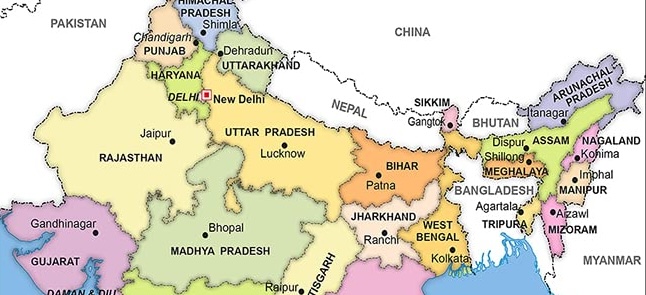
The seed of this problem lies in the partition of India at the time of Independence in 1947, when Punjab and Bengal were divided to create West and East Pakistan. While partitioning Bengal geographically, the British played a trick, leaving just a small corridor connecting mainland India to the northeast, and our leaders fell into the trap. Then Calcutta (now Kolkata) was the hub of economic activity, encompassing all of north-eastern India and extending to south-east Asia. The partition in one stroke dismantled all that. Not only that, it put India’s security in great danger by leaving just a 22-kilometre-wide land corridor, the Siliguri Corridor, located in northern West Bengal between the mainland and north-eastern India. Also commonly known as the “Chicken’s Neck”, it is approximately 60 Kms long and varies in width from 17 to 22 Kms at its narrowest point in West Bengal. Defending this corridor has become one of India’s top defence priorities since then because it is too small a piece of territory to defend. As warfare strategies change rapidly with new technologies, it is more challenging by the day. This way of geographical partitioning India was a British gift to us!
China, Pakistan and Bangladesh Chemistry
This has made India vulnerable to neighbouring countries like China and Pakistan, East Pakistan then and now Bangladesh, with whom our relations keep on changing. And then there are big superpowers which don’t want India to prosper. Three factors help these forces.
- The isolated northeast with mostly hilly terrain, poor connectivity and infrastructure, long-running insurgencies due to the aspirations of many local ethnic tribal groups leaning on their history, economic underdevelopment, ethnic and tribal conflicts, Border Management challenges and so on. Many insurgent groups accept international help in various forms.
- The second factor has been its remoteness from mainland India and its relative neglect by the Central Government until recently. This also emboldens foreign powers to fish in those areas.
- And thirdly, the narrow Siliguri Corridor connecting mainland India to the northeast, which could be a good target for enemies, though India is taking care of the defence of this corridor.
North-eastern India shares international borders with five countries – China, Bhutan, Bangladesh, Myanmar and Nepal- and, in a way, doesn’t share a border directly, but rather with West Bengal, which lies west of the Siliguri Corridor connecting mainland India to the northeast. China’s Chumbi Valley sits roughly 130 Kms only north-northeast of this corridor. Protruding southwards from Tibet like a dagger between Sikkim and Bhutan, this narrow tongue of Chinese territory places Beijing’s military logistics dangerously close to this Chicken’s Neck.
But even otherwise, China has been supporting the insurgent groups of that region. In the late 1970s and early 80s, it was providing physical training and weapons to Manipuri insurgent groups like PLA (whose then-leader, Biseswor Singh, had told me personally after he had gone to China with a group for training and weapons), PREPAK, etc., and to NSCN from Nagaland. And now, its increasing economic cooperation with Myanmar and, more recently, with Bangladesh, is not a good sign for India in the northeast. The visit of the current Prime Minister of Bangladesh to China some time back is a pointer to this, as an agreement regarding the Teesta Project was finalised.
Support to Insurgency
About Pakistan then and now Bangladesh, right from the start of the idea of Pakistan, its supporters were of the view that the entire northeast India should be part of East Pakistan, as northeast India is a natural landline extension of the new entity. Later, Sheikh Mujibar Rehman, who led the movement for the formation of Bangladesh, also reiterated the same view. That apart, the then East Pakistan and later Bangladesh started their nefarious activities by actively supporting the insurgent groups from the northeast, like NSCN from Nagaland, ULFA from Assam, PLA etc. from Manipur, MNF from Mizoram, NLFT and ATTF from Tripura and quite a few others, by providing them shelters, weapons and training, etc. Once the visit of training of NSCN cadre in West Pakistan and international support for it by Pakistan had. Only during Sheikh Hasina’s regime in Bangladesh did this activity stop, and now we’re keeping our fingers crossed again. Also, illegal migration from Bangladesh and Rohingyas originally from Mizoram to the north-eastern states and the rest of India is continuing unabated with some local Indian help by unscrupulous people, some of whom do it for petty gains and are thus inimical to India.
The Burma Angle
As far as Myanmar is concerned among the neighbours, it’s helping in destabilising India by default as the Military Government there has no control over the regions bordering India, thereby giving a free hand to Indian insurgent groups to operate from bases from there. Also, one of the NSCN groups, NSCN-K (Khaplang), is essentially from Myanmar, as Khaplang is a native of Myanmar. As we all know, most of the tribes living in the Indian states of the northeast and bordering Myanmar have kith and kin on both sides, and this creates other problems in Indian states as noticed often.
Drugs and the North-East
An additional factor is the region, and particularly Manipur, being at the tip of the Golden Triangle for smuggling of drugs, weapons, teak wood, and precious stones into India, and from here some portion of drugs going to other countries. This has been going on for a long time, and drug lords, whose budget is far more than any state of the northeast, have a vested interest in weak governance there and in back insurgencies and other nefarious activities. This can be seen in the recent turmoil in Manipur where drug lords seem to have played a major role in fomenting trouble from the Kuki side. Manning the long, almost porous border with Myanmar has been a big challenge for India.
Suspicious Foreigners’ Movement
Having discussed neighbours, let’s now turn our attention to other superpowers that create trouble in that region of India. Recently, in March of this year, India’s National Investigating Agency arrested one American and six Ukrainians from separate airports in Delhi, Lucknow, and Kolkata over allegations of illegally entering Mizoram without permits and crossing into Myanmar. It is alleged that even drones were smuggled by them there to help and train the local groups fighting against the Myanmar government. Some are even linking this to the use of drones sometime back by some Kuki groups in Manipur in the recent conflict. This cannot be ruled out.
Also, some other foreign powers are taking deep interest in fomenting trouble in India, about which less is known in the public domain, but our intelligence would know more about these for sure.
Strengthen DONER
The solution to all this lies in strong, dedicated efforts on all fronts. A fully centralised setup is needed to address its internal problems and difficulties, including defence and diplomatic requirements. The present small Ministry of Development of the North Eastern Region, created in September 2001, is responsible for planning and monitoring economic growth, infrastructure, and welfare projects across the eight north-eastern states of Arunachal Pradesh, Assam, Manipur, Meghalaya, Mizoram, Nagaland, Sikkim, and Tripura. But it is not sufficient. Its charter and consequently budget should also increase significantly. For 2026-27, its annual budget is just Rs. 6810.30 crores, out of the Government of India’s total budget of Rs. 53.5 lakh crores! There should be a setup akin to a mini-Central Government for the northeast region, encompassing many more departments, including defence and diplomacy, and with sufficient funds. We have been talking about the Act East Policy, but the efforts are not good enough.
The North-East is a big and important part of our country. So efforts need to be stepped up to make it more secure and prosperous and make it a real gateway to South-East Asia. It has a lot of potential, in various forms, to become an economic powerhouse for the country.