


“Bahujana Hitaya, Bahujana Sukhaya”—For the welfare and happiness of the many. This timeless Buddhist ideal, drawn from the teachings of Lord Buddha, has guided All India Radio (Akashvani) ever since it became India’s public broadcaster. More than a motto, it became a national mission—to inform, educate, inspire and unite.
As India observes 23 July, National Broadcasting Day, we commemorate not merely the beginning of radio broadcasting in 1927 but the birth of an institution that quietly shaped the consciousness of modern India. If 15 August 1947 gave India political freedom, I often believe that 23 July 1927 began the long process of integrating the minds and hearts of Indians. Radio became the invisible thread that stitched together a civilisation of extraordinary diversity into one national family.
For me, however, this day carries a far deeper and more personal meaning. My association with All India Radio is not merely professional—it is the story of three generations of my family whose lives were intertwined with Akashvani.
My late father, Shri N. D. Raina, joined the Hindi Division of the External Services in 1956 as a scriptwriter. His pen gave life to nearly sixty-eight radio plays, including programmes such as Hawa Mahal and numerous stories for children. Through his writing, I witnessed how radio entered millions of homes, carrying imagination where television had yet to reach.
My father-in-law, Shri H. K. Ramakrishna, was among the pioneers of the Kannada News Unit at All India Radio, New Delhi. Later, he served as a Kannada news broadcaster with Radio Moscow from 1985 until his retirement in 1991. His distinguished career reflected the international reach of Indian broadcasting and its commitment to linguistic diversity. My wife’s family too remained closely associated with Akashvani through her father and his brother, Dr H K Ranganath, who held several important positions in the organisation and contributed significantly to public broadcasting.
Destiny brought me to All India Radio in 1982 after my father’s untimely demise. Before joining the Indian Foreign Service in 1986, I worked in the Hindi Division of the External Services. Those four years became one of the richest learning experiences of my life.
I had the privilege of working with legendary broadcaster Devki Nandan Pandey, producer Dr S S S Thakur, and several distinguished colleagues, including Nirmala Joshi, Y. K. Sharma, Savitri Thakur, Prem Joshi and many accomplished announcers from Urdu, Nepali, Swahili, Arabic and across different divisions. I also participated in Dr Thakur’s radio adaptation of the Mahabharata. Among my most treasured memories remains the opportunity to interview the great poet Harivansh Rai Bachchan at his residence, where he spoke with remarkable warmth about his literary journey and family. Also got the chance to interact with many top artists and film personalities.
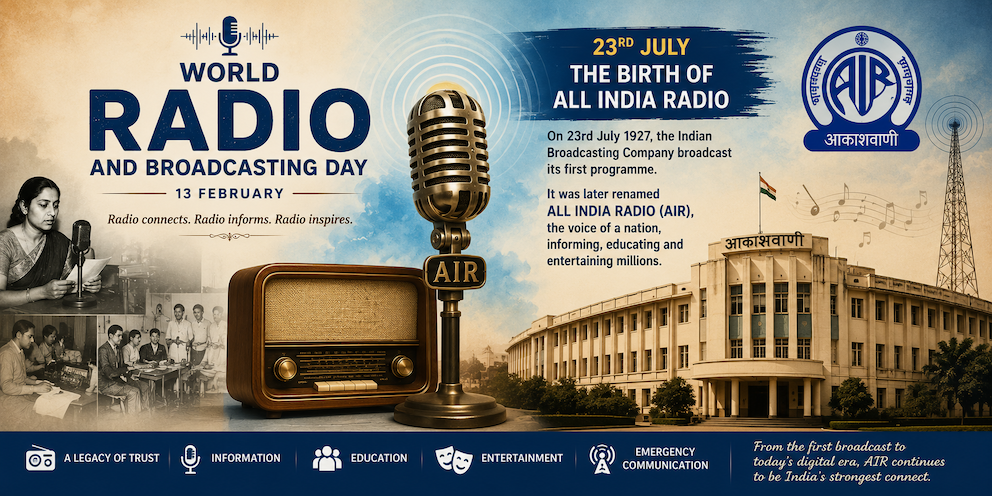
The history of All India Radio mirrors the evolution of modern India. Radio broadcasting began on 23 July 1927 when the Indian Broadcasting Company inaugurated its Bombay station. Following financial difficulties, the Government assumed responsibility in 1930 under the Indian State Broadcasting Service. On 8 June 1936, it became All India Radio, and in 1956 officially adopted the beautiful name Akashvani—“Voice from the Sky.” The launch of Vividh Bharati in 1957 transformed popular broadcasting, while the establishment of Prasar Bharati in 1997 gave public broadcasting greater autonomy.
Yet its greatest contribution cannot be measured merely through institutional milestones.
At Independence, India possessed only six radio stations. Today, Akashvani reaches almost the entire population and over ninety-two per cent of the country’s geographical area. But its real achievement lies elsewhere. It made India hear itself.
Before highways, satellites and the internet connected us, radio carried the voices of every region into every home. It introduced Indians to one another’s languages, music, folklore, literature, festivals and aspirations. It brought classical musicians and folk artists national recognition. It guided farmers, educated families, informed citizens during wars, elections and national emergencies, and became the trusted companion that greeted millions every morning and bade them good night.
As someone who grew up inside the world of Akashvani, I can confidently say that radio did not merely broadcast India—it helped create the idea of India. It nurtured an Indian mind while respecting every regional identity. It transformed diversity into shared belonging.
Even today, despite television, digital media and social networking platforms, I begin my mornings with radio. It reminds me of history, introduces me to forgotten personalities, informs me of national events, enriches me with music and literature, and continues to offer a depth and credibility rarely matched by other media. Radio remains intimate, dependable and profoundly human.
On this National Broadcasting Day, therefore, we should celebrate not merely an institution but a civilisational force. The story of All India Radio deserves to be taught to our younger generations, for it is through Akashvani that millions first learnt what it meant to belong to India.
For my family, Akashvani has been a lifelong companion. For the nation, it has been its enduring voice.
And for me, All India Radio will always remain the soul of India.
Long Live India and AIR!