


Introduction
The global shift towards clean energy is no longer confined to large power stations and utility-scale renewable projects. Across the world, citizens, housing societies, farmers, businesses, and local institutions are increasingly becoming active participants in producing their own electricity. This transformation is giving rise to a new concept known as “solar communities”—a model that democratises energy generation and empowers people to become both producers and consumers of clean power.
The Rise of Solar Communities
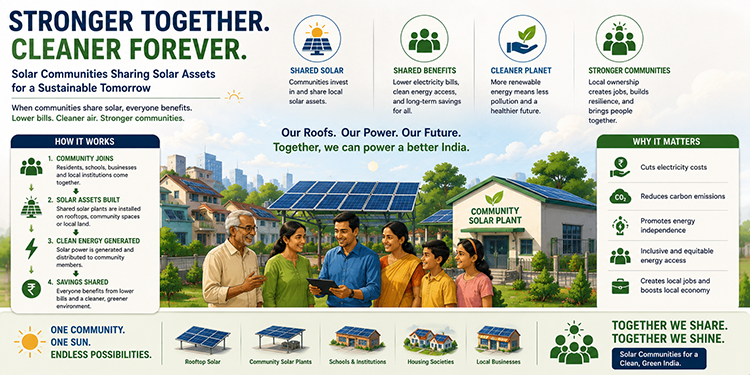
Solar communities are collaborative arrangements in which multiple individuals or organisations share the benefits of electricity generated from a common solar installation. These installations may be located on residential rooftops, community buildings, agricultural land, industrial estates, or public institutions.
Unlike conventional power systems that rely on centralised generation and long-distance transmission, solar communities bring electricity production closer to consumers. This localised approach reduces transmission losses, improves energy security, encourages community participation, and creates both economic and environmental benefits.
The fundamental principles of solar communities include collective ownership, shared benefits, community participation, and long-term sustainability.
A solar cooperative society typically consists of housing society residents, farmers, small businesses, and local institutions pooling their financial resources or land to establish shared solar power systems. Such collective arrangements substantially reduce installation costs while allowing members to share electricity savings and earn income from surplus power supplied to the grid.
Government-supported financing through institutions such as the Small Industries Development Bank of India (SIDBI), the State Bank of India (SBI), and other financial institutions can further strengthen these initiatives through concessional loans and renewable energy financing schemes. Members may also serve as mutual guarantors, making financing more accessible and affordable.
How Solar Communities Function
Electricity generated from community solar installations can be consumed directly by members, supplied to the grid through net-metering mechanisms, or stored in community battery systems for later use.
Key features include:
* Shared ownership and collective benefits
* Reduced installation costs through economies of scale
* Improved energy security
* Lower carbon emissions
* Greater public participation in the clean-energy transition
Typically, solar panels are installed on residential buildings, schools, industrial facilities, agricultural structures, and community spaces. Energy generated is allocated among participants based on their investment or subscription share. Excess electricity can be exported to the grid, generating credits or additional revenue.
Global Momentum Behind Community Solar
Several countries have demonstrated the enormous potential of community-based solar energy.
Vietnam stunned the world by adding nearly 6 gigawatts of rooftop solar capacity within a single month when supportive policies and incentives were introduced. Germany, the United States, Japan, and Australia have also become global leaders in promoting solar cooperatives and community-owned renewable energy systems.
Studies indicate that if rooftops worldwide were effectively utilised, they could generate nearly 27 petawatt-hours of electricity annually—enough to transform global energy systems. This transition is also creating thousands of green jobs in manufacturing, installation, maintenance, and energy management.
Building Energy Resilience
One of the most significant advantages of solar communities is resilience. Neighbourhoods equipped with rooftop solar systems and battery storage can continue to function during grid failures, natural disasters, and extreme weather events.
As climate-related disruptions become more frequent, decentralised energy systems offer greater reliability and energy independence for households and communities.
Existing Models in India
India already has several examples of community-based solar initiatives.
Cooperative Group Housing Societies
Many residential societies are installing rooftop solar systems on apartment buildings, parking structures, and common facilities. The electricity generated powers lifts, water pumps, lighting systems, and security infrastructure, reducing maintenance costs and lowering residents’ electricity bills.
Solar-Powered Farmer Cooperatives
Farmer groups are jointly developing solar installations to operate irrigation pumps, cold storage facilities, and rural enterprises. Surplus electricity is sold to distribution companies, creating an additional source of income for farming communities.
Community Participation in Solar Parks
Large solar parks increasingly involve local communities through land-leasing arrangements, revenue-sharing mechanisms, and employment opportunities. Such participation ensures that renewable energy development also contributes to local economic growth.
Village Solar Microgrids
Remote villages are establishing solar microgrids to provide reliable electricity for homes, street lighting, water supply systems, schools, healthcare facilities, and digital connectivity. These systems reduce dependence on diesel generators and unreliable grid supply.
Educational and Institutional Campuses
Universities, schools, hospitals, and public institutions are increasingly adopting shared solar systems to reduce operational costs while demonstrating environmental responsibility.
Solar Cooperative Societies: A Future Model
India has immense potential to develop dedicated Solar Cooperative Societies.
Membership could include:
* Households
* Farmers
* Small businesses
* Educational institutions
* Municipal bodies
These cooperatives could undertake collective procurement, shared financing, battery storage management, energy trading, and system maintenance. Such an approach would make solar power accessible even to low-income communities that may otherwise struggle to invest individually.
India’s Big Opportunity: A National Right to Solar
India has one of the world’s largest rooftop solar potentials, yet only a small fraction has been utilised.
A national “Right to Solar” policy could become a game-changing reform by guaranteeing every eligible building owner the ability to install solar systems without unnecessary bureaucratic hurdles.
Such a policy would:
* Enable citizens and businesses to adopt rooftop solar more easily.
* Encourage private investment in distributed renewable energy.
* Reduce pressure on electricity distribution companies during peak demand.
* Deliver affordable and reliable electricity to households and MSMEs.
* Generate employment in installation, maintenance, and related services.
* Accelerate India’s renewable energy and climate commitments.
Countries such as Spain, Vietnam, and Brazil have already demonstrated how supportive regulatory frameworks can rapidly expand rooftop solar adoption. India can achieve similar success through clear and predictable policies.
What Makes Solar Communities Successful?
Three factors are particularly important:
Right to Install: Citizens should have a legally protected right to install rooftop solar systems without unnecessary restrictions.
Fair Compensation: A transparent and stable tariff for surplus electricity exported to the grid encourages investment and improves financial viability.
Neighbourhood Solar Networks: Local governments can facilitate community solar projects combined with battery storage systems, enabling residents to access affordable electricity and share financial benefits through a “solar dividend.”
Economic Benefits
Solar communities reduce electricity costs through collective investment and bulk procurement. They also create employment opportunities in manufacturing, installation, maintenance, operations, and energy management.
In many Indian states, the growth of solar power is encouraging the establishment of small-scale industries in suburban and rural areas. Access to affordable green electricity attracts enterprises such as flour mills, agro-processing units, grinding mills, and other micro-industries. Panchayats and local bodies can play an important role in facilitating these connections, thereby creating additional employment and strengthening rural economies.
Green Jobs and Skill Development
India’s solar expansion is creating a new generation of green jobs. The sector requires trained technicians, installers, electricians, maintenance specialists, battery management experts, and energy auditors.
As solar cooperatives expand across urban and rural areas, demand for specialised skills will continue to grow, creating sustainable employment opportunities for young professionals and technical workers.
Environmental and Social Benefits
By replacing fossil-fuel-based electricity with renewable solar energy, communities can significantly reduce greenhouse gas emissions and air pollution. Solar communities contribute directly to national climate goals while improving local environmental quality.
Equally important are the social benefits. Community-owned energy systems encourage citizen participation, strengthen social cooperation, and improve access to clean and affordable energy for low-income and underserved populations.
The Road Ahead
Solar communities represent far more than an energy solution. They offer a pathway to economic development, environmental sustainability, community empowerment, and energy independence.
Rooftop solar is already among the most affordable sources of electricity available today. A national Right to Solar, combined with supportive financing and community participation, can help India reduce energy costs, strengthen energy security, create millions of green jobs, and build resilient, future-ready communities.
The clean-energy revolution is no longer a distant vision. Through solar communities, it can begin on every rooftop, in every village and neighbourhood across India.