

“ Peace is always beautiful.” – Walt Whitman
A hundred days of war near the Strait of Hormuz appears set to end in Switzerland on the coming Friday — and India stands to gain, if it asks the right question about Russian oil.
Geneva Beckons: From Ceasefire to Settlement
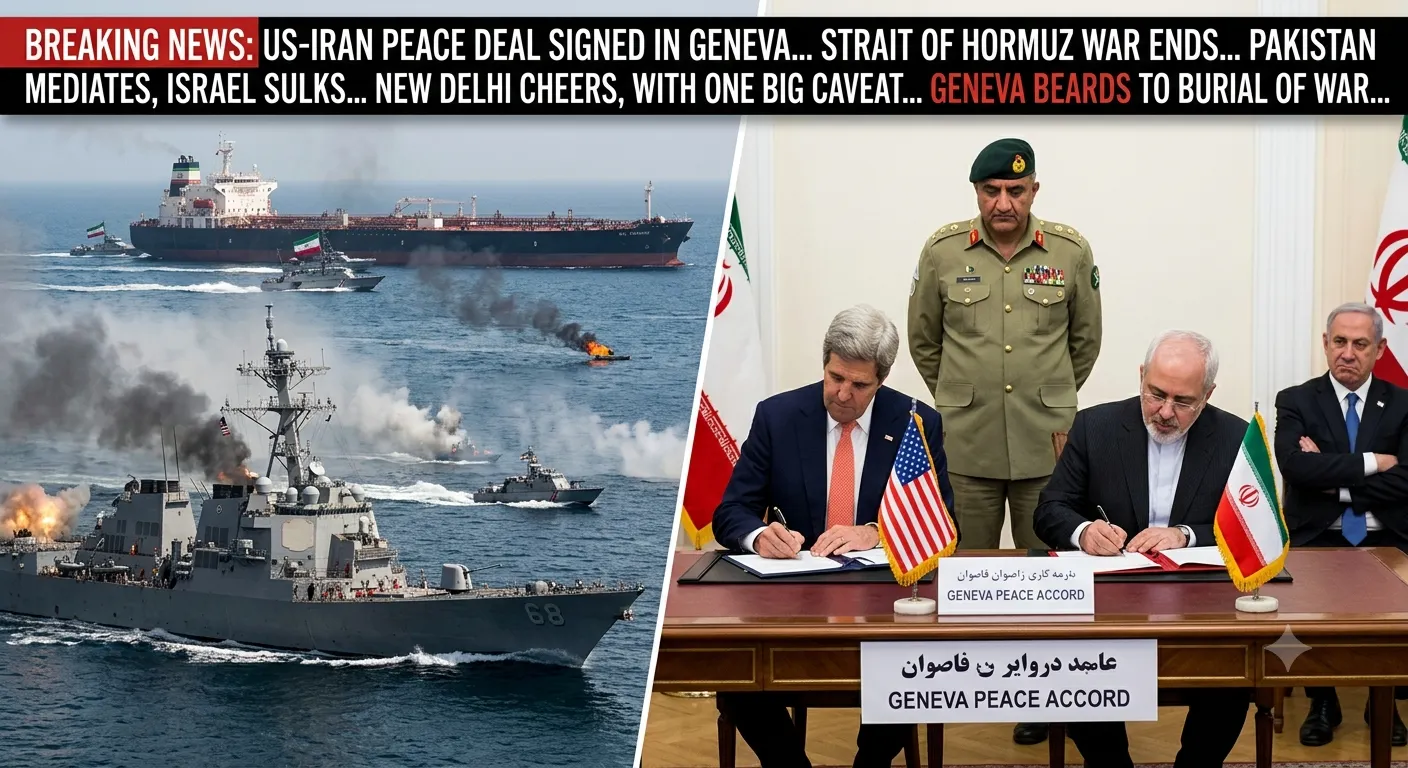
History, as is its habit, has chosen Geneva — that grey, unglamorous city of treaties and tribunals — to host the formal burial of the latest US–Iran war. On the coming Friday, after more than a hundred days of fighting that periodically threatened to choke off a fifth of the world’s seaborne oil, Washington and Tehran are expected to put their signatures to a peace pact whose broad contours have been agreed in principle, even if the fine print remains, tantalisingly, unpublished.
It has been a long road to this signing table. In early April, an exhausted six-week war produced a fragile two-week ceasefire, conditioned on Iran reopening the Strait of Hormuz to commercial shipping. Tehran, almost simultaneously, tabled a sweeping ten-point proposal — sanctions relief, troop withdrawal, security guarantees, the works — as the opening bid for a permanent settlement. That ceasefire was never meant to last beyond a fortnight, but it laid the groundwork for the negotiating track on which the present deal has been built. By mid-June, with Pakistan playing an unusually visible mediating role, both capitals signalled they had a text they could live with. On Friday, Geneva is where ink meets paper.
The Core of the Bargain
What does the emerging deal actually contain? Strip away the diplomatic fog, and a reasonably stable core emerges across the April ceasefire, Iran’s ten points, and the June framework.
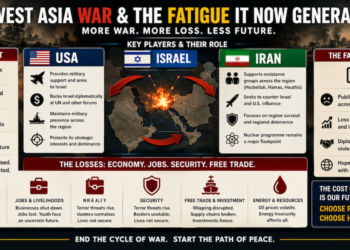
First, and most consequentially for the world economy: the Strait of Hormuz. Iran is to clear mines and cease harassment of shipping; the United States, in turn, is to lift its naval blockade in a synchronised fashion, restoring “toll-free” passage through the channel that carries roughly a fifth of global oil. Some versions of Iran’s position insist on retaining a degree of sovereign control over the Strait even while permitting unhindered navigation — a face-saving formula that both sides can sell domestically.
Second, sanctions and oil exports. Iran’s opening demand was the wholesale lifting of US primary and secondary sanctions, release of frozen assets, and reconstruction compensation for war damage — a maximalist wish-list. What appears to have been negotiated, at least for the initial 60-day window, is more modest: sanctions waivers that permit Iran to sell oil with fewer restrictions, alongside talks on the unfreezing of assets and the easing of humanitarian and commercial channels. Whether Iran’s greater demands for compensation survive into the final Geneva text is, as of this writing, unknown.
Third, the nuclear question. Here, the language being reported — Iran “committing not to pursue nuclear weapons,” with early talks on disposing of highly enriched uranium and managing enrichment activity under some monitoring regime — has an unmistakably JCPOA-era ring to it, though dressed in new clothes. This is less a restoration of the 2015 deal than a fresh “nuclear-for-sanctions-plus-security” bargain, with the verification architecture, sunset clauses and UN anchoring all still to be worked out.
Fourth, the regional dimension — proxies, troop presence, and guarantees. Iran wants a US drawdown from the region, an end to strikes on its allied militias, and crucially, a UN Security Council resolution that would give any settlement the force of international law, alongside a formal non-aggression guarantee. The American side wants curbs on Iran’s support to its regional proxy network and a broader de-escalation understanding. Some reporting suggests the package may even touch the Israel–Hezbollah front in Lebanon, though this looks like the loosest thread in an already complex weave.
Pakistan’s Moment — and Why New Delhi Should Not Grudge It
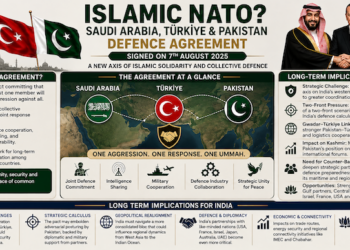
Step back from the clauses, and a larger geopolitical fact stares us in the face: Pakistan has emerged — whether India likes it or not — as the indispensable broker of this peace. Prime Minister Shehbaz Sharif’s social media announcements have, in effect, been treated by global wire services as semi-official confirmation of the deal’s terms and timing. Behind him stands Field Marshal Asim Munir, the Army Chief whom President Trump has taken to naming approvingly in public remarks — an unusual American courtesy towards a Pakistani military chief, and one that itself signals how central Rawalpindi’s institutional weight has been to this mediation. Islamabad’s positioning as mediator between Washington and Tehran, leveraging its historic ties with both, represents a diplomatic coup that New Delhi should not dismiss with reflexive sourness.
I say this as someone who has spent a career watching Pakistan through the lens of Punjab’s security establishment, and who harbours no illusions about Rawalpindi’s instincts. But statecraft demands we separate the messenger from the message. If Pakistan’s mediation produces a durable de-escalation in the Gulf — and with it, calmer and cheaper oil — India is among the principal beneficiaries, full stop. Grudging Islamabad its moment in the Geneva sun may not be appropriate when the dividend flows straight into our refineries and our current account.
The Indian Dividend
And the win, for India, could be substantial — provided the deal holds. Three benefits flow more or less directly.
One, price stability. A reopened, demilitarised Hormuz removes the single largest geopolitical risk premium baked into Brent and Dubai crude over the past hundred-odd days. For an economy that imports roughly four-fifths of its crude, even a sustained ten-to-fifteen-dollar reduction in the risk premium translates into real relief on the current account, on inflation, and on the rupee.
Two, assured supply. With the US naval blockade lifted and Iranian exports potentially flowing more freely under sanctions waivers, the global crude market gains a supplier that has been functionally off the table for Indian refiners since the renewed sanctions regime of the past decade. India’s refiners — who once, in calmer years, settled Iranian oil payments substantially in rupees through a basket of Iranian banks — could, in time, find that channel reopening, however cautiously.
Three, a calmer neighbourhood for energy logistics more broadly. A de-escalating Gulf reduces insurance premiums on tankers, shipping delays, and the broader anxiety that has periodically rattled Indian fuel retailers and refiners through this conflict.
The 64-Million-Dollar Question: What About Russia?
But — and this is the caveat that should worry our policy establishment far more than it currently seems to — none of this addresses the question that actually keeps Indian oil planners awake at night: Russia.
Over the past year, Russian crude has become the single largest component of India’s import basket — at one point this spring accounting for nearly two-fifths of import value, worth several billion dollars a month. That dependence exists despite, not because of, Washington’s preferences. The Trump administration imposed a punishing twenty-five per cent additional tariff on Indian goods explicitly tied to our continued purchase of discounted Russian crude, stacking atop an earlier twenty-five per cent tariff for other trade reasons — a combined fifty per cent duty wall that has strained the bilateral relationship as much as any issue in two decades. A temporary sanctions waiver issued earlier this year has since lapsed, with no clarity from Washington on renewal. Much of this rupee-denominated trade has, in practice, been settled through Dubai — UAE banks and intermediaries acting as conduits for converting rupee payments into forms that Russian counterparties would accept, a workaround that has itself come under periodic scrutiny from Western regulators. Meanwhile, reports suggest Russia and its Indian counterparts have also resorted to cryptocurrency settlements — Tether, Bitcoin, and Ether — as a further workaround, alongside the long-discussed but never fully operationalised direct rupee-rouble mechanism.
Here, then, is the five-million-dollar question — or, given the stakes, perhaps the fifty-billion-dollar one. If Washington and Tehran can shake hands in Geneva, does that herald any softening of Washington’s stance on India’s rupee-denominated, discounted Russian oil purchases? Or does a US–Iran rapprochement, by easing one source of global crude tightness, actually give Washington more room — not less — to squeeze India on the Russian question, on the theory that alternative supply is now more plentiful and India’s discount-driven dependence on Moscow becomes that much harder to justify on energy-security grounds?
Our Ministry of External Affairs spokespersons will be asked precisely this in the days ahead, by journalists both domestic and foreign. They had better have an answer more convincing than the customary formulations about India’s “time-tested” energy diversification strategy and its sovereign right to source crude “based on market factors.” Those lines have served their purpose during the war years. They will not survive contact with a press corps asking a sharper question: now that the Gulf is calming down, what exactly is India’s plan for Russian oil — and for the rupee-rouble, or rupee-crypto, or whatever-currency mechanisms that have kept it flowing?
A Note of Cautious Optimism
None of this should curdle the broader mood. A war that has rattled energy markets for over three months appears, however imperfectly, headed towards its formal end. The fine print — on sequencing, on snap-back clauses, on whether Iran’s hardliners accept what their negotiators have signed, on whether Israel and the Gulf states quietly acquiesce — remains genuinely uncertain. The New York Times is right to flag Iranian domestic politics as “very complicated” even after a Swiss signature. Peace deals in this region have a well-documented habit of fraying at the edges.
But cautious optimism, for India, seems the right register. Lower, steadier oil prices are an unambiguous good for an import-dependent economy heading into an election cycle in which fuel prices are never far from the political conversation. A reopened Hormuz and a potentially reopened Iranian supply line give our refiners options they have lacked for years. And if Pakistan’s diplomatic stock rises a notch in Washington and Tehran as a consequence — well, India has navigated less comfortable truths before.
What India cannot do is treat Friday’s Geneva ceremony as background noise. It is, instead, the moment to sharpen our own diversification strategy — towards the Gulf, towards a reopening Iran, towards West Africa and the Americas — while quietly, firmly, and without theatrics, working with Washington to determine exactly where the Russian oil question stands once the guns in the Gulf fall silent. The peace in Geneva may turn out to be the easy part. The conversation in South Block about Moscow, the rupee, and the next sanctions waiver is the one that genuinely matters for New Delhi.
(The article first appeared on the author’s blog. The views expressed are personal.)