


Introduction
The term “Digital Arrests” is not mentioned in any statute book of our country. A term carrying no legal meaning but concealing within it two offences as old as organised society – impersonation and extortion. This non-existent phenomenon has become one of India’s most devastating cybercrimes. What the fraudster has done is not invent a new crime. He has solved a logistics problem that has always constrained him in the past — physical proximity to the victim. The dacoit who blocked the highway needed to be there, in person, to instil fear. The impostor who impersonated a government officer needed to appear at the door. The limitation of physical access to the victim served as the natural boundary for these crimes. Cyberspace has dissolved that boundary entirely. Through a phone call, a WhatsApp video, or a deepfake of the official or judge rendered on a mobile screen, the criminal now occupies the victim’s living room without ever leaving any compound.
Incorporating Sophistication
The first phase of the fraud was relatively crude. Callers impersonating TRAI or Police officers read from standardised scripts and use basic voice calls. The frauds were often inconsistent in detail, easily exposed by anyone who asked a technical question. The number of reported instances nearly tripled between 2022 and 2024. The second phase saw the introduction of video calls and staged environments. Fraudsters invested in Police uniforms, government office backdrops, and fake ID cards. The psychological impact of seeing a uniformed officer on a video screen dramatically increased compliance rates. The I4C reported a loss of Rs. 120.30 crore in the January-April 2024 period alone. The third phase introduced artificial intelligence as a force multiplier. The deployment of deepfakes — specifically, AI-generated video impersonations of real judicial and law enforcement figures — represents the most dangerous evolution. A victim who would rationally question a voice on a phone call will comply with a judicial order delivered by someone who looks and sounds exactly like the Chief Justice of India. In January 2025, a Russian national was arrested in India for his role in a digital arrest scam operating under a Chinese syndicate. Digital arrest fraud networks now function like corporate structures, with separate units managing SIM card procurement, mule account recruitment, technical infrastructure, and cryptocurrency conversion. Under the aegis of Operation Chakra V, the CBI found that more than 700 branches of various banks had opened approximately 8.5 lakh mule accounts, which were later used in cybercrimes.
Definition Problem
What these criminals exploit is not the absence of law but the absence of definition. Indian law does not require a new statute to prosecute the age-old crime in a new form – it already has the tools under the Bharatiya Nyaya Sanhita 2023 (BNS) and the Information Technology Act, 2000, to punish crimes such as extortion, cheating by personation, and identity theft. The challenge is the speed and cross-border nature of the crime, which has so far outpaced the institutional capacity to respond to it.
Game of Nerves
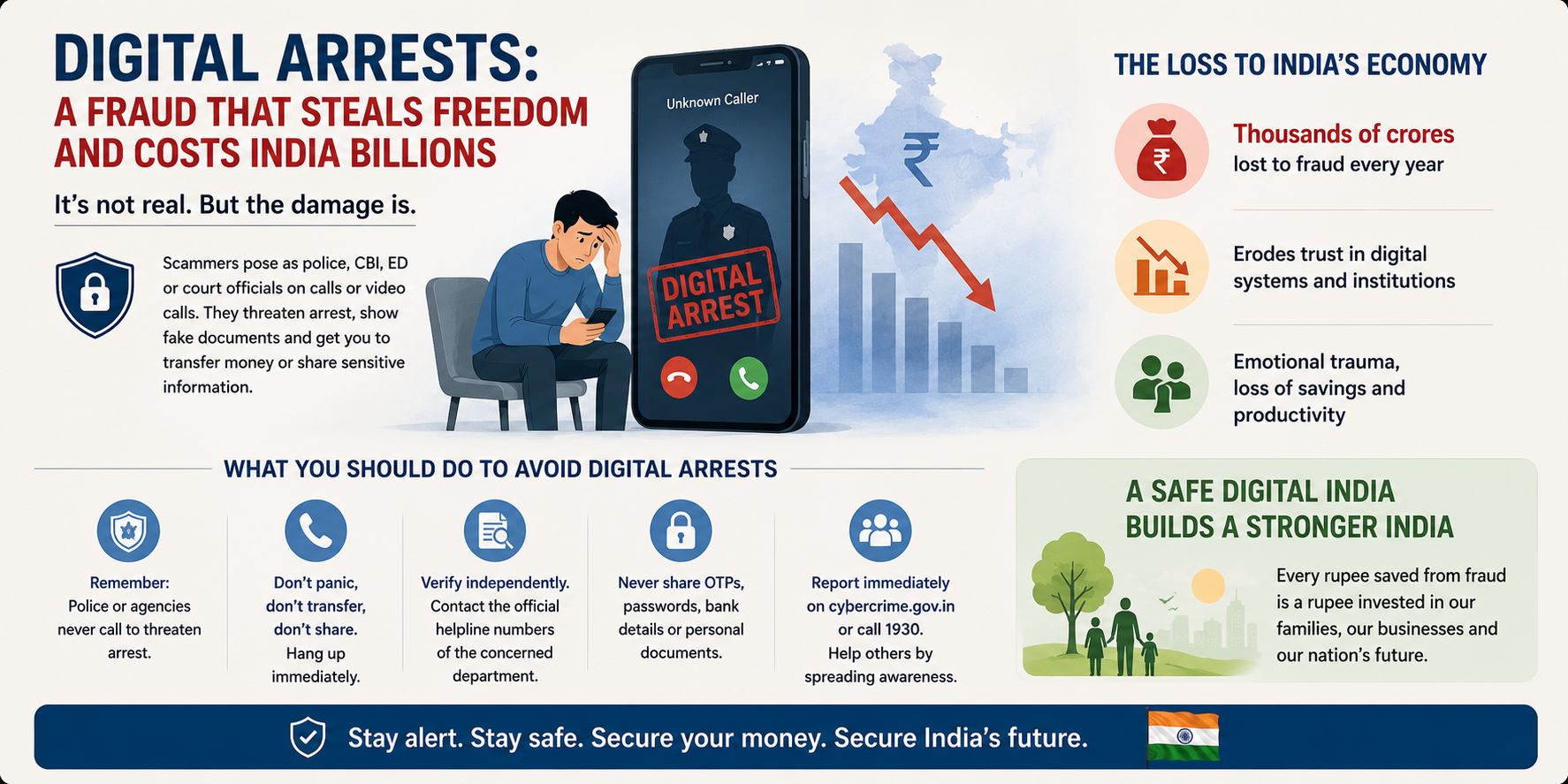
What makes the digital arrest scam uniquely effective is not the technology but the psychology. Indians have both fear and trust in the government institutions, which is exactly what the scammers exploit. Accusations of serious crimes trigger fight-or-flight responses, which cloud judgment. By keeping victims on continuous calls, fraudsters prevent them from seeking advice or verification. Analysis of NCRP data reveals that impersonation of law enforcement — Police, CBI, ED, TRAI, and the income tax department — appears in nearly 90% of all complaints. WhatsApp is the video call platform of choice. Threats of arrest are explicit, and in nearly one-third of complaints, family members are either threatened, placed on the call, or leveraged as psychological pressure points. A 93-year-old retired Chief Engineer of Indian Railways, living alone in Karnataka, lost all his life savings from Fixed Deposits via WhatsApp video calls. His complaint records a loss of over Rs. 60 lakh. The data shows that Fixed Deposit and Mutual Funds liquidation — the most irreversible financial commitment a victim can make — was recorded in a significant number of complaints. When a victim breaks a fixed deposit or sells jewellery — assets that are deliberately illiquid, stored over years or decades, culturally significant — it speaks to a level of psychological subjugation that goes far beyond a UPI transfer. The scale of the problem came to light in 2025 when the National Cybercrime Reporting Portal (NCRP) received more than 30,000 complaints categorised as Digital Arrests – an average of nearly 90 complaints every day. In the same year, the Supreme Court of India, surveying losses across all reporting channels, estimated nationwide digital arrest fraud losses at nearly Rs 3,000 crore.
Awareness & More Awareness
No genuine agency can ever arrest a person virtually. In his “Mann Ki Baat” program, Prime Minister Narendra Modi described digital arrests as a major cybercrime and gave citizens a three-step mantra: Stop, Think, and Take Action. (रुको, सोचो, एक्शन लो). Far from a passive bystander, the government has built a layered and increasingly sophisticated response. Its institutional backbone is the I4C — the Indian Cyber Crime Coordination Centre — which brings banks, payment aggregators, telecom providers, IT intermediaries, and law enforcement onto a single platform, recognising that these scams can only be defeated by dismantling the entire ecosystem of mule accounts, spoofed numbers, and messaging platforms that sustains them. The National Cyber Crime Reporting Portal (cybercrime.gov.in) routes complaints to the relevant State or UT Police. The toll-free helpline 1930, launched under the Citizen Financial Cyber Fraud Reporting and Management System in 2021, operates on the “golden hour” principle: report a fraudulent transfer quickly, and the money can be frozen before it vanishes into mule accounts. By early 2025, the system had saved over Rs. 4,386 crore across more than 13 lakh complaints. Several SIM cards and IMEI numbers linked to cyber fraud had been blocked. I4C identified and shut down WhatsApp accounts and Skype IDs used in digital arrest operations. The Department of Telecommunications directed telecom providers to block all incoming international calls displaying Indian numbers. Aadhaar-based biometric verification for new SIM cards aims to curb the supply of anonymous SIMs that fraudsters rely on.
Build Resilience
The foundations are in place. The next phase must focus on consolidation, acceleration, and internationalisation across six fronts. Parliament should create a specific statutory offence for impersonation-based cyber extortion. A clear legal definition would remove ambiguity in investigations, prosecutions, and sentencing and signal the seriousness with which the state regards these crimes. The financial response system must compress the “golden hour” into minutes: banks should act on fraud alerts in near real time, while AI systems proactively flag suspicious transactions before funds can be dissipated. The Supreme Court’s mandated standard operating procedure must be uniformly implemented — a victim in Guwahati deserves the same speed of response as one in Bengaluru. Internationally, India must deepen extradition arrangements, intelligence-sharing, and joint enforcement with Cambodia, Myanmar, Laos, and Thailand, building on existing CBI-Interpol channels. On victim restitution, frozen proceeds of crime should be returned through fast-track, court-monitored mechanisms, with a national compensation framework providing particular support to senior citizens. Finally, awareness must reach the last mile: cyber hygiene in school curricula, panchayat-level campaigns in regional languages, dedicated outreach for the elderly, and stronger accountability for SIM vendors and financial institutions that enable mule accounts.
Conclusion
The digital arrest scam thrives on two things: fear of the state’s coercive power and ignorance of the simple truth that no such arrest exists in law. India’s response — institutional coordination through I4C, the life-saving 1930 helpline, mass dismantling of fraudulent infrastructure, anti-spoofing controls, and an awareness blitz led from the top, now reinforced by the Supreme Court’s mandate to the CBI — has already saved thousands of crores and protected countless citizens. If the momentum of 2025–26 is sustained, India can turn one of its most painful chapters in cybercrime into a template for how a digitising democracy protects its most vulnerable. For many victims, digital arrest is not merely a cybercrime but the destruction of a lifetime’s savings in a matter of hours. The challenge before India is not only to punish those behind these scams, but to ensure that fear can no longer be weaponised against ordinary citizens.