

The exposition of the sacred relics of the Buddha is far more than a religious ceremony or cultural event. It is a profound civilisational act that reconnects humanity with one of the greatest spiritual traditions born on Indian soil. For millions of Buddhists worldwide, the relics are not merely archaeological remains preserved in museums or monasteries. They are living embodiments of the Buddha’s presence, compassion and teachings. Their exposition evokes deep devotion, inspires spiritual reflection and revives the timeless message of peace, wisdom and compassion.
In contemporary times, Prime Minister Narendra Modi has made an extraordinary contribution to reviving global awareness of Buddha Dhamma and reaffirming India’s role as the land of the Buddha. Through sustained engagement with Buddhist nations, support for international Buddhist conferences, development of Buddhist pilgrimage circuits, and the exposition of sacred Buddha relics in countries across Asia, his government has brought renewed focus to India’s Buddhist civilisational heritage. His widely noted statement at the United Nations that “India has given Buddha to the world, not yudh (war)” has come to symbolise India’s commitment to peace, dialogue and coexistence rooted in the teachings of the Buddha. These initiatives have strengthened spiritual bonds with Buddhist communities worldwide and reinforced India’s position as the authentic custodian and promoter of the Buddha Dharma.
At a time when the world is grappling with war, social fragmentation, ecological degradation, rising extremism and unprecedented mental stress, the message associated with the Buddha’s relics acquires renewed relevance. The relics silently communicate values that transcend geography, politics and generations—non-violence, moderation, mindfulness, ethical conduct and harmonious coexistence.
As the birthplace of Buddhism and custodian of some of the most sacred relics associated with the Buddha, India carries a unique civilisational responsibility. It is a responsibility not merely to preserve these treasures but also to share them with humanity in a manner that upholds their sanctity while strengthening the spiritual bonds that unite Buddhist communities worldwide.
The Piprahwa Relics as a Bridge for India-Myanmar Ties
Myanmar occupies a special place in this narrative.
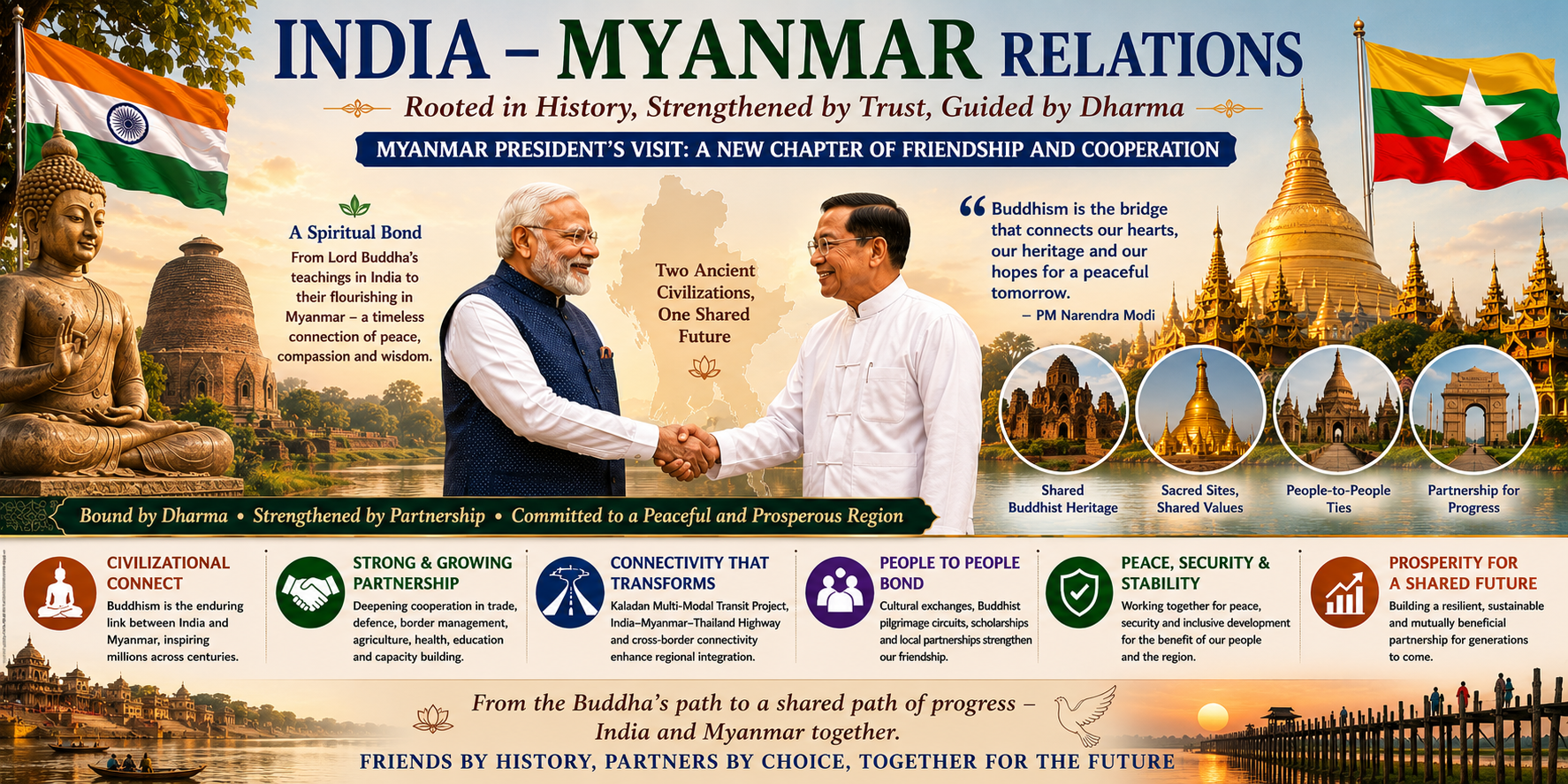
For a newly elected Myanmar head of state, paying homage to the absolute earliest primary remains of the Buddha is an act of profound personal and national merit-making. This spiritual intent was mirrored earlier in his trip, where he began his Indian tour by offering prayers, meditating under the sacred Bodhi Tree at the Mahabodhi Temple in Bodh Gaya, and visiting the Burmese Monastery in Bihar.
For centuries, the people of Myanmar have shown extraordinary devotion to relics associated with the Buddha. Portions of the relics from the Piprahwa discovery were historically distributed for veneration in Buddhist countries, including Burma (now Myanmar). These relics became objects of national reverence and a source of spiritual identity. Even today, Myanmar remains one of the strongest custodians of Theravada Buddhist traditions that originated in India.
This explains why every exposition of the Piprahwa relics evokes deep interest in Myanmar. For the Buddhist people of Myanmar, these relics are not simply archaeological objects. They are a living link to the Buddha himself and to the sacred geography of India. For India, Myanmar represents a civilizational partner connected through more than two millennia of Buddhist exchanges, pilgrimages, monastic scholarship and cultural interaction.
The larger message emerging from the Piprahwa relics is profound. The relics demonstrate that while Buddhism spread across Asia and became part of the heritage of many nations, its roots remain firmly embedded in India. The Buddha walked on Indian soil. His teachings emerged from Indian civilisation. The earliest relics were enshrined by his own clan in India. The great universities that carried Buddhism to Asia flourished in India. The sacred sites that continue to attract millions of pilgrims are located in India.
Origins of the Relic Tradition
The origins of relic veneration can be traced directly to the Mahāparinibbāna Sutta. Following the Mahāparinirvāṇa of the Buddha at Kushinagar, his relics were divided among eight clans and kingdoms and enshrined in stupas. This was not intended to create ownership over the Buddha’s memory but to ensure that future generations could remain connected to his teachings.
The relics became focal points for cultivating faith, mindfulness and ethical reflection. The Buddha himself recognised that stupas and relics would inspire devotion and spiritual growth among future generations. Thus, the preservation and respectful exposition of relics became integral to sustaining the living memory of the Buddha and keeping the Dhamma accessible to humanity.
The stupa tradition that emerged from this distribution was among the earliest forms of spiritual and cultural integration in Asia. Through relics, the Buddha’s message travelled beyond regional boundaries and became a shared civilisational heritage.
Ashoka and the Expansion of the Buddha Dharma
The next great chapter in the history of the relics unfolded under Emperor Ashoka in the third century BCE. Following the devastating Kalinga War, Ashoka embraced Buddhism and transformed it from a regional spiritual movement into a civilisational force.
According to Buddhist traditions, Ashoka redistributed relics from existing stupas and established thousands of new stupas across his empire. Whether symbolic or literal, the tradition of eighty-four thousand stupas reflects the scale of his commitment to spreading the Buddha’s message.
Under Ashoka, relics became instruments of moral governance, cultural integration and international outreach. Buddhism moved beyond monasteries into governance, diplomacy, education, architecture and public life. The Buddha Dharma became a foundation for ethical statecraft and peaceful engagement with neighbouring societies.
It was through this vision that India first emerged as a spiritual and cultural centre whose influence extended across Asia.
The Piprahwa Relics: A Direct Link to the Buddha
Among all discoveries in Buddhist archaeology, few hold greater significance than the relics found at Piprahwa in present-day Uttar Pradesh, near the Nepal border.
In 1898, British estate manager William Claxton Peppé excavated a large stupa at Piprahwa. Deep inside the mound, he discovered a massive stone coffer containing reliquary caskets, bone fragments, ashes, precious stones, crystals, pearls and gold ornaments. An inscription in early Brahmi script linked the deposit to the Shakyas and the Buddha’s relics. The discovery immediately became one of the most important archaeological finds in the history of Buddhism.
Yet the story did not end there.
Several decades later, Archaeological Survey of India archaeologist K. M. Srivastava undertook fresh excavations at Piprahwa between 1971 and 1973. Going beyond the Peppé excavation, Srivastava discovered additional relic chambers containing soapstone caskets with bone fragments and associated material, datable to the period immediately following the Buddha’s passing. These findings significantly strengthened the argument that Piprahwa preserved one of the earliest relic deposits associated with the historical Buddha. His work transformed Piprahwa from a remarkable discovery into one of the most important archaeological sites in the Buddhist world.
The importance of Srivastava’s excavations lies in their demonstration of multiple phases of relic enshrinement. The original Shakyas’ relic deposit appears to have been expanded and protected over the centuries, including during the Mauryan period, when Emperor Ashoka redistributed Buddhist relics across his empire. This provided archaeological evidence of the site’s continued Buddhist veneration.
Over the years, relics and associated treasures from Piprahwa became dispersed among museums and institutions. Some relics entered collections in India while others travelled abroad during the colonial period. In 2025, a significant chapter closed when the Piprahwa relic jewels, which had remained outside India for 127 years, were returned, enabling a historic reunification of the collection.
This led to the landmark exposition inaugurated by Prime Minister Narendra Modi in New Delhi on 3 January 2026 titled The Light and the Lotus: Relics of the Awakened One. For the first time, the repatriated relics were brought together with authentic relics and archaeological material preserved in Indian institutions. The exhibition presented not only sacred relics but also the complete historical narrative of the Buddha, the Shakyas, Piprahwa and the spread of Buddhism from India.
The significance of the New Delhi exposition extends beyond archaeology. It reaffirmed India’s position as the cradle of Buddhism. Every major event in the life of the Buddha occurred on the soil of the Indian subcontinent. The Buddha was born in the Shakya realm, attained enlightenment at Bodh Gaya, delivered his first sermon at Sarnath and attained Mahaparinirvana at Kushinagar. The earliest Buddhist councils, monastic institutions and centres of learning emerged in India before Buddhism spread to Sri Lanka, Myanmar, Thailand, China, Korea, Japan, Mongolia and beyond.
India as Custodian of a Sacred Legacy
The rediscovery of Buddhist sites such as Piprahwa, Sanchi, Satdhara, Amaravati and Nalanda restored an important dimension of India’s civilisational memory. The responsibility that accompanies such discoveries is immense.
India’s stewardship of Buddha relics extends far beyond museum preservation. These relics are treated as sacred objects deserving the highest levels of reverence, care and protection. Their transportation, conservation, and exhibition involve extensive security arrangements, scientific preservation measures, and close consultation with Buddhist monastic traditions.
This approach reflects a deeper understanding that relics cannot be reduced to cultural artefacts or diplomatic instruments alone. Their spiritual significance remains paramount.
India’s handling of these relics demonstrates a rare balance between modern conservation standards and traditional Buddhist reverence. This distinction becomes particularly important in an era when cultural heritage is often employed as an instrument of geopolitical influence.
Carrying the Buddha Dharma to Asia and Beyond
For over two millennia, Indian monks, scholars, and pilgrims have carried the Buddha Dharma across mountains, deserts, and oceans. They travelled through Central Asia into China and onward to Korea and Japan. Others crossed maritime routes to Sri Lanka and Southeast Asia.
These emissaries did not carry religion alone. They carried Indian philosophy, ethics, language, art, architecture and systems of knowledge. Centres of learning such as Nalanda, Vikramashila and Takshashila attracted students from across Asia and helped shape the intellectual foundations of entire civilisations.
The Buddhist traditions that flourished in Sri Lanka, Myanmar, Thailand, Cambodia, Laos, Vietnam, Mongolia, China, Korea and Japan retained a deep civilisational connection with India. Even today, millions regard Bodh Gaya, Sarnath, Kushinagar, Rajgir and Nalanda as sacred destinations that form part of their spiritual identity.
The exposition of relics, therefore, revives memories of these ancient bonds and reinforces India’s enduring role as the fountainhead of Buddhist civilisation.
Relics, Soft Power, and Strategic Relevance
The strategic importance of Buddhist relics should not be underestimated. Across Asia, Buddhist heritage continues to influence public consciousness, cultural identity, and perceptions of history.
In recent years, several countries have invested heavily in promoting Buddhist cultural narratives, organising heritage exhibitions and constructing institutions associated with Buddhism. In this environment, authenticity becomes critically important.
The Piprahwa relics possess a moral and spiritual authority that cannot be replicated. Their significance derives from their direct association with the Buddha and from India’s status as the land of Buddhism’s origin.
The exposition of such relics reinforces India’s standing as:
This soft power asset is especially relevant across the Himalayan region, Southeast Asia and the wider Indo-Pacific, where Buddhist cultural networks continue to shape societal attitudes and long-term relationships.
A Civilisational Responsibility for the Future
India must approach the preservation and exposition of Buddha relics not as isolated ceremonial events but as part of a comprehensive civilisational mission.
This requires a long-term strategy that combines spirituality, scholarship, diplomacy and cultural outreach. Every exposition should be accompanied by educational programmes, scholarly exchanges, exhibitions, publications and digital initiatives that deepen understanding of the Buddha’s teachings.
Equally important is the preservation of sanctity. The relics must remain symbols of compassion and spiritual awakening rather than instruments of political competition.
The ultimate objective should be to carry forward the Buddha Dharma in a manner that benefits humanity and contributes to global harmony.
Conclusion
The Piprahwa relics are both a sacred inheritance and a reminder of India’s enduring civilisational role as the birthplace and principal custodian of the Buddha Dharma. Their respectful exposition strengthens living bonds with Buddhist communities across Asia and the wider world while reaffirming India’s unique cultural and spiritual leadership.
As a matter of policy, India should move beyond episodic relic expositions and adopt a sustained strategy of Buddhist engagement as an integral component of its foreign policy. This should include systematic efforts by Indian ambassadors and diplomatic missions in Buddhist-majority countries to raise awareness of India’s sacred Buddhist relics, pilgrimage circuits, and civilisational heritage at the highest political, cultural, and religious levels. Buddha Dhamma talks, scholarly dialogues, monastic exchanges and cultural programmes should be organised throughout the year rather than only during relic expositions, ensuring continuous engagement with Buddhist communities and institutions.
Every Indian embassy in Buddhist countries should review its role and recognise India’s Buddhist heritage as a principal instrument of connectivity and goodwill. By placing Buddhist civilisational diplomacy at the centre of its outreach, India can deepen people-to-people ties, strengthen long-term strategic relationships and reinforce its position as the authentic source of the Buddha Dharma. In doing so, India not only safeguards a priceless legacy but also advances a message of peace, compassion and coexistence that remains profoundly relevant to the contemporary world.