


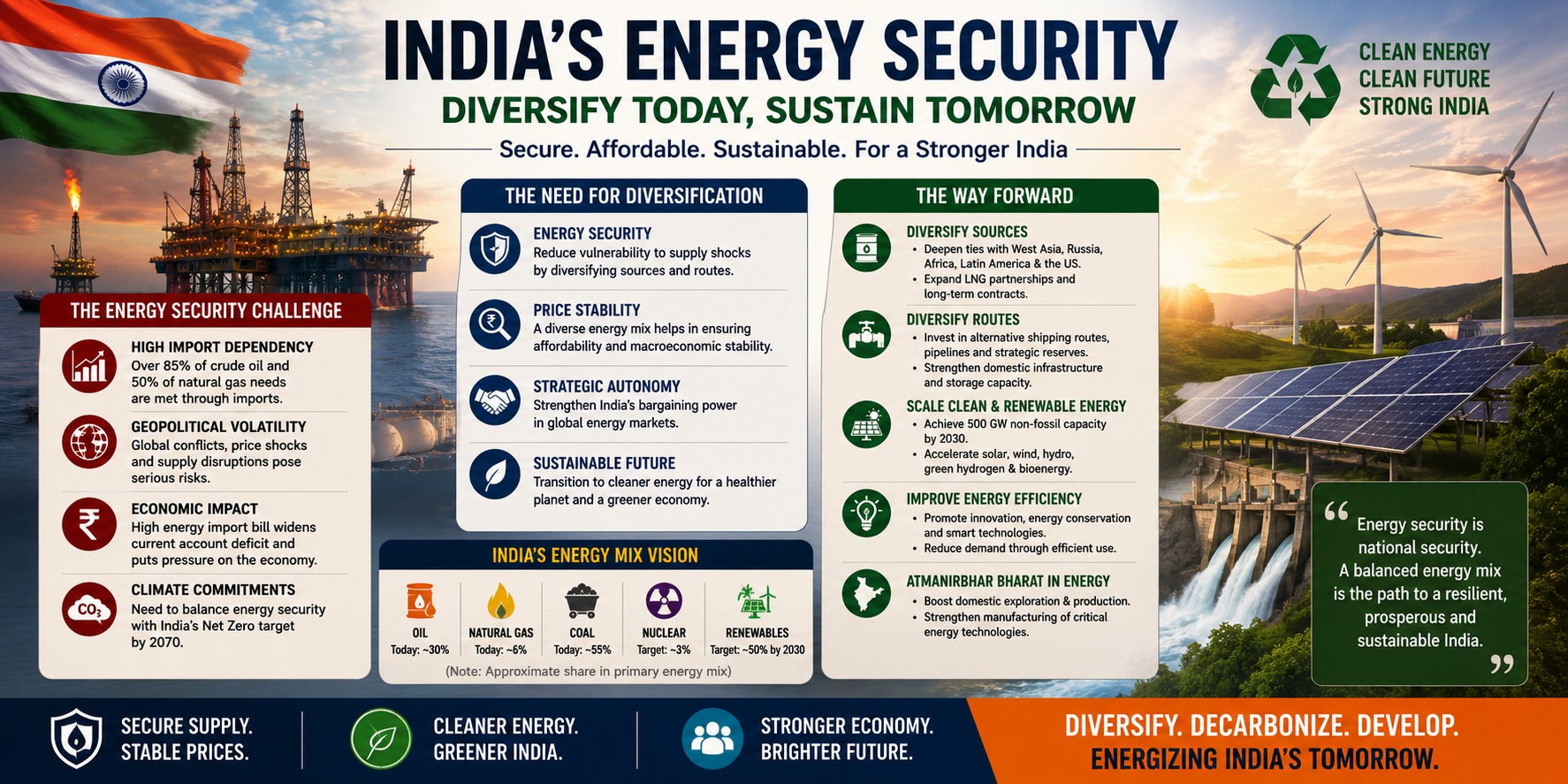
The global turmoil, particularly the American and Israeli war on Iran, has compromised energy security globally. India, one of the largest importers of fossil fuels, is now feeling the pressure and taking several steps to curb their use. A former Indian Oil Chairman, in an exclusive piece for the Saviours, discusses several aspects of the issue in a very insightful piece.
Introduction
Coal and Coal Gasification: Key to Energy Security
India possesses abundant coal reserves of nearly 400 billion tonnes, and annual coal production has already crossed one billion tonnes. Coal remains the country’s primary source of energy, particularly for power generation, where it accounts for more than 70 per cent of electricity production. At the same time, India has committed to ambitious climate goals, including creating 500 GW of non-fossil-fuel power generation capacity by 2030 and achieving net-zero emissions by 2070.
These commitments are driving the rapid expansion of renewable energy sources, including solar, wind, hydro, and nuclear power. However, India cannot afford to abandon coal entirely, as it remains its largest indigenous energy resource.
One practical approach to balancing energy security with environmental responsibility is large-scale coal gasification. India should establish several coal gasification projects at coal pit-head locations, thereby reducing the need to transport coal across the country. Such projects can facilitate the production of liquid fuels, petrochemicals, synthetic gas, and fertilisers, helping reduce dependence on imported crude oil and petroleum products.
The Government of India (GoI) approved a ₹8,500 crore financial incentive scheme in January 2024 to promote coal/lignite gasification projects, aiming to achieve 100 million tonnes (MT) of gasification by 2030 to reduce imports. This incentive targets public and private sectors, covering up to 15% of capital expenditure (capex) for selected projects.
The Union Cabinet, chaired by the Prime Minister Shri Narendra Modi, has recently approved a Scheme for Promotion of Surface Coal/Lignite Gasification Projects with a financial outlay of Rs. 37,500 crore.
The Scheme marks a major step towards accelerating India’s coal/lignite gasification programme, advancing the national target of gasifying 100 Million Tonnes (MT) of coal by 2030, strengthening energy security, and reducing dependence on imports of key products such as LNG (more than 50% imported), urea (~20% imported), ammonia (~100% imported), and methanol (~80–90% imported).
Renewables renew Hope
India has also recently inaugurated its first geothermal energy project by retrofitting unused oil and gas wells in Gujarat. This marks an important step in diversifying renewable energy deployment, with the project expected to generate nearly 450 KW of continuous power.
Nuclear energy is another important clean energy source. However, India’s nuclear power capacity currently stands at only around 9 GW. Expansion has been relatively slow due to high capital costs, long construction periods, and regulatory complexities. Small modular nuclear reactors could prove highly useful in the future, especially when integrated with electrolyser facilities to produce green hydrogen for industrial clusters such as refineries, steel plants, and fertiliser units.
Oil is the Achilles heel
Indian oil and gas output has not improved despite several initiatives, due to limited proven reserves.
The traditional model of relying on global markets for cheap energy resources is becoming increasingly uncertain amid West Asian tensions, sanctions risks, shipping disruptions, and great-power rivalries.
Important Initiatives
One important step taken by the Indian government has been the blending of ethanol with petrol. Ethanol is being produced from sugarcane, molasses, agricultural residue, and domestic waste. Ethanol blending has already increased from about 2 per cent to nearly 20 per cent, reportedly saving around ₹1.5 lakh crore in foreign exchange. In addition to reducing import dependence, it also helps lower vehicular emissions.
India is also focusing on reducing the cost of green hydrogen, which could play a major role in decarbonising industries such as refineries, steel, and fertilisers. However, unless the cost of green hydrogen falls to around 1–2 USD per kilogram, its economic viability and large-scale affordability will remain uncertain.
Domestic manufacturing of solar modules, battery storage systems, power electronics, and electrolysers requires critical minerals such as lithium, platinum, iridium, and tungsten. Therefore, sourcing and processing these minerals will become increasingly important because energy self-reliance is not only about generating energy but also about securing control over supply chains.
Energy efficiency-the “New Resource”!
Dual Resilience & Self-Reliance
Over the coming decade, India is likely to pursue a “dual resilience” strategy: maintaining diversified and affordable fossil fuel supplies in the short term while simultaneously accelerating domestic clean-energy capacity and supply-chain ownership. This strategy would include larger strategic petroleum reserves, diversified crude sourcing, stronger maritime security for trade routes, and selective use of natural gas as a balancing fuel.
On the clean-energy side, India is expected to accelerate solar and wind deployment, expand energy storage, modernise transmission grids, strengthen domestic manufacturing, and promote green hydrogen for heavy industries rather than indiscriminate mass usage.
India should treat energy self-reliance as a portfolio strategy rather than an ideological choice. The most practical approach is to maintain coal’s reliability in the short term, expand solar and wind energy as rapidly as grid infrastructure and storage capacity permit, improve transmission systems, strengthen gas flexibility, scale biofuels carefully, and expand nuclear energy where technically and economically feasible.
At the same time, energy efficiency must be treated as a first-class energy resource rather than a secondary policy objective.
Conclusion
Therefore, the most realistic strategy for India is not ideological purity but resilience. The country should maintain coal availability to ensure energy security, accelerate renewable energy expansion, aggressively improve efficiency, and develop domestic manufacturing and mineral-processing capabilities. Otherwise, the clean-energy transition could merely replace one form of import dependence with another.
In an increasingly volatile global environment, this balanced and pragmatic approach is most likely to protect India’s economic growth, control inflation, and strengthen strategic autonomy.