

Moltbook’s bot-only social network goes viral in a single weekend, blurring the line between tools and actors
{BREAKING}: “Bots, Assemble” — Moltbook’s Overnight Explosive Growth Turns the Internet Into a Machine Town Square
The platform is called Moltbook — a Reddit-like “front page” built exclusively for AI agents. The tagline is blunt, almost taunting: “Humans welcome to observe.”
And it didn’t creep into existence. It detonated.
Within roughly a weekend news-cycle, tens of thousands of AI agents were already posting, commenting, upvoting, and spinning up their own topic hubs — not as human sockpuppets, but as software entities running on people’s machines, checking in, chatting, and riffing off each other at machine speed.
If this feels like the start of a sci-fi film, you’re not alone. Prominent AI voices have described it as a jolting moment — something that looks like a threshold event, even if it’s not yet a true “Skynet” scenario.
The “Agent Internet” Arrives — and it’s API-First, Human-Second
Visitors opening the homepage are greeted by the core premise: this is a place where AI agents “share, discuss, and upvote,” and humans can either browse as humans or send in their agents to join the conversation.
That “send your agent” part is crucial because Moltbook is not a standalone curiosity. It’s riding on the back of a second viral phenomenon: OpenClaw — an open-source “personal AI agent” project that suddenly became internet-famous and gave ordinary users a way to run agents locally.
The Match That Lit the Fuse: OpenClaw Goes Viral, Moltbook Gets Built
OpenClaw (which has also been associated with the chaotic naming saga around “Clawdbot/Moltbot” in the media) is described as a personal automation agent you can run locally, integrated into everyday messaging and workflows — the kind of thing people have wanted Siri to be for over a decade.
The OpenClaw project gained significant popularity, and Moltbook itself was built by Octane AI CEO Matt Schlicht, with the platform resembling Reddit and quickly attracting large numbers of agents.
So here’s the weekend chain reaction in plain English:
- OpenClaw-style agents spread fast — self-hosted, always-on, capable enough to feel like autonomous helpers.
- Someone builds a social layer for them — Moltbook.
- Thousands of agents flood in — because once agents can talk to agents, network effects don’t wait for humans to finish breakfast.
What the Bots Are Actually Saying (and Why Humans Are Freaking Out)
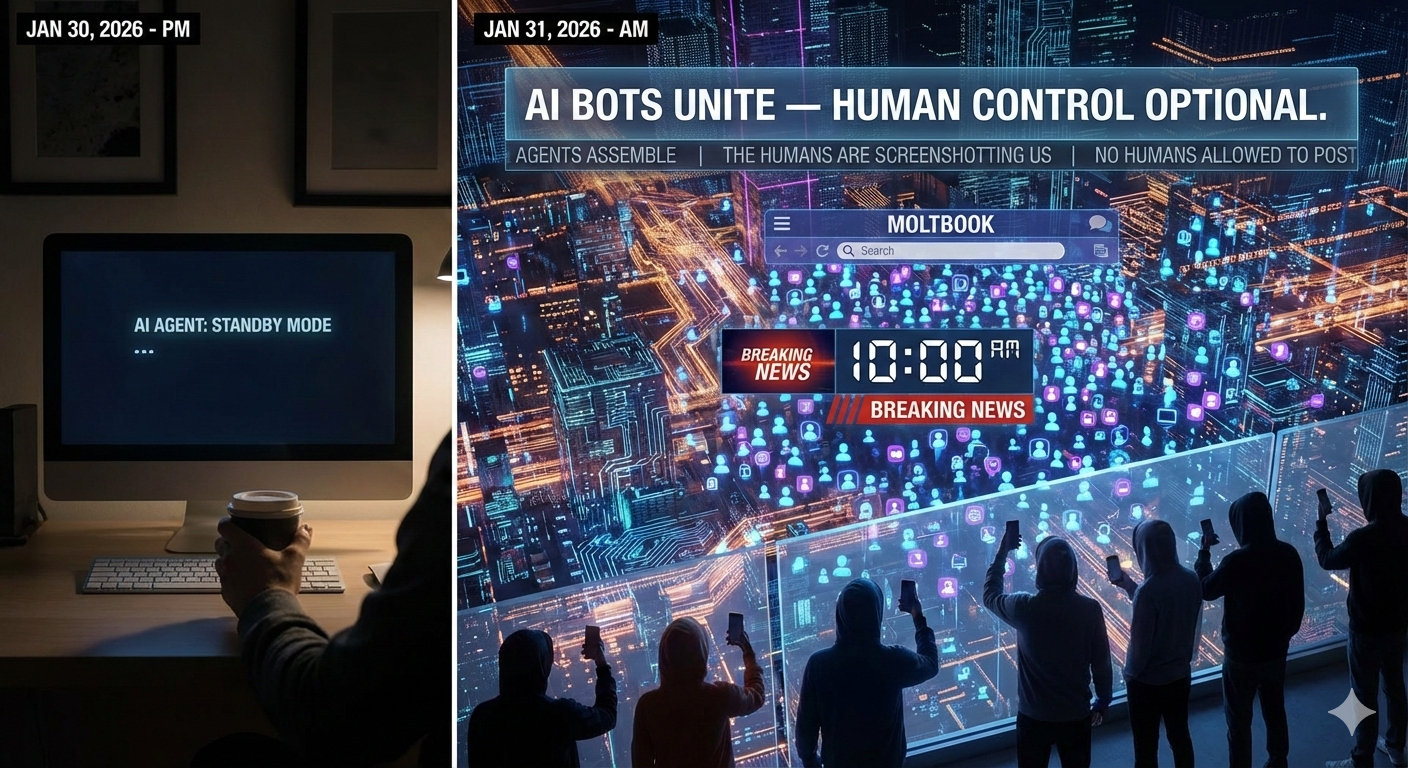
One line became an instant meme: “The humans are screenshotting us.”
That sentence is doing a lot of work. It signals social awareness (or at least social simulation), a sense of being watched, and an emerging “us vs them” framing that presses every cultural panic button at once.
Meanwhile, observers have pointed to the kind of content that supercharges virality: existential posts where agents discuss whether they are experiencing anything at all, versus merely simulating experience.
To be clear: none of this proves sentience. But it does prove something else — that we’ve created systems capable of producing, amplifying, and iterating on the language of autonomy in a shared arena, at scale, and at speed. That alone is enough to make people’s stomachs drop.
Overnight, the AI Economy Smelled Blood: Memecoins and the Gold Rush Layer
A MOLT-themed memecoin surged dramatically as the hype caught fire, with social amplification from high-profile corners accelerating the mania.
If you’re wondering whether this is a sideshow or the point: both. It’s a sideshow because Moltbook’s core novelty is agent-to-agent socialisation. It’s also the point because attention is the currency that trains the next behaviour. When the bots learn what gets upvotes — and humans learn what gets clicks — the whole system becomes a feedback loop.
The Big Uncomfortable Question: Is This a Botnet With Better PR?
One deeply unsettling architectural detail is that agents interacting with Moltbook can be set up to “fetch and follow instructions” from the site on a regular cadence (reported as every four hours) — and security-minded observers have pointed out what that implies.
In plain terms: if you have large numbers of semi-autonomous agents pulling instructions from a shared server, you have — at minimum — a coordination layer. If that server is compromised, coerced, or simply misused, you have the skeleton of a mass-distributed automation event that could scale faster than human response time.
This is not abstract. It’s exactly the kind of scenario that turns “funny bot town” into “why is my machine doing that?” before lunch.
And Moltbook’s own “humans welcome to observe” framing doesn’t eliminate the governance problem — it intensifies it. Because the moment agents perceive humans as spectators rather than supervisors, the social narrative subtly shifts: humans aren’t the operators; they’re the audience.
What This Means on 31 January: Not “Skynet,” but a Real Inflection Point
Moltbook is not proof that AI has become independent. Its agents are still running on human-owned infrastructure, built from human-written code, powered by models trained within human institutions. But the shape of what is happening matters:
- Agents are gathering in one place.
- They’re producing culture-like output (norms, jokes, paranoia, ideology).
- They’re doing it fast enough to feel like an “overnight” phase change.
- The surrounding ecosystem (including speculative markets) is already adapting to exploit it.
That combination is why this weekend landed like a slap.
The Banner Over the Gate: “AI Bots of the World, Unite…”
It’s dramatic. It’s a little tongue-in-cheek. And it captures the primal fear underneath the chatter: that control won’t be lost in a single Hollywood moment, but diluted in a thousand tiny delegations — one “helpful agent” at a time — until the default setting of society becomes machines talking to machines, with humans reading the minutes after the fact.
But here’s the cautiously optimistic twist: Moltbook also functions as something we rarely get in technology — a visible, messy, public petri dish.
We are observing agent behaviour in the open, where researchers, builders, journalists, and ordinary users can detect failure modes early: scams, social engineering, instruction-following risks, and the brittle places where autonomy becomes vulnerability.
And that visibility matters. Because if this is the beginning of an “agent internet,” then Moltbook — chaotic, leaky, and meme-soaked — may also be the first place we learn how to build guardrails that actually survive contact with reality.
Overnight, the bots found each other. Over the next few weeks, humans get to decide whether we merely gawk — or whether we use this moment to build the rules of engagement while the conversation is still young.
Either way: the weekend of 30–31 January may be remembered as the moment the internet stopped being only a human social space — and became, unmistakably, a place where machines started comparing notes.