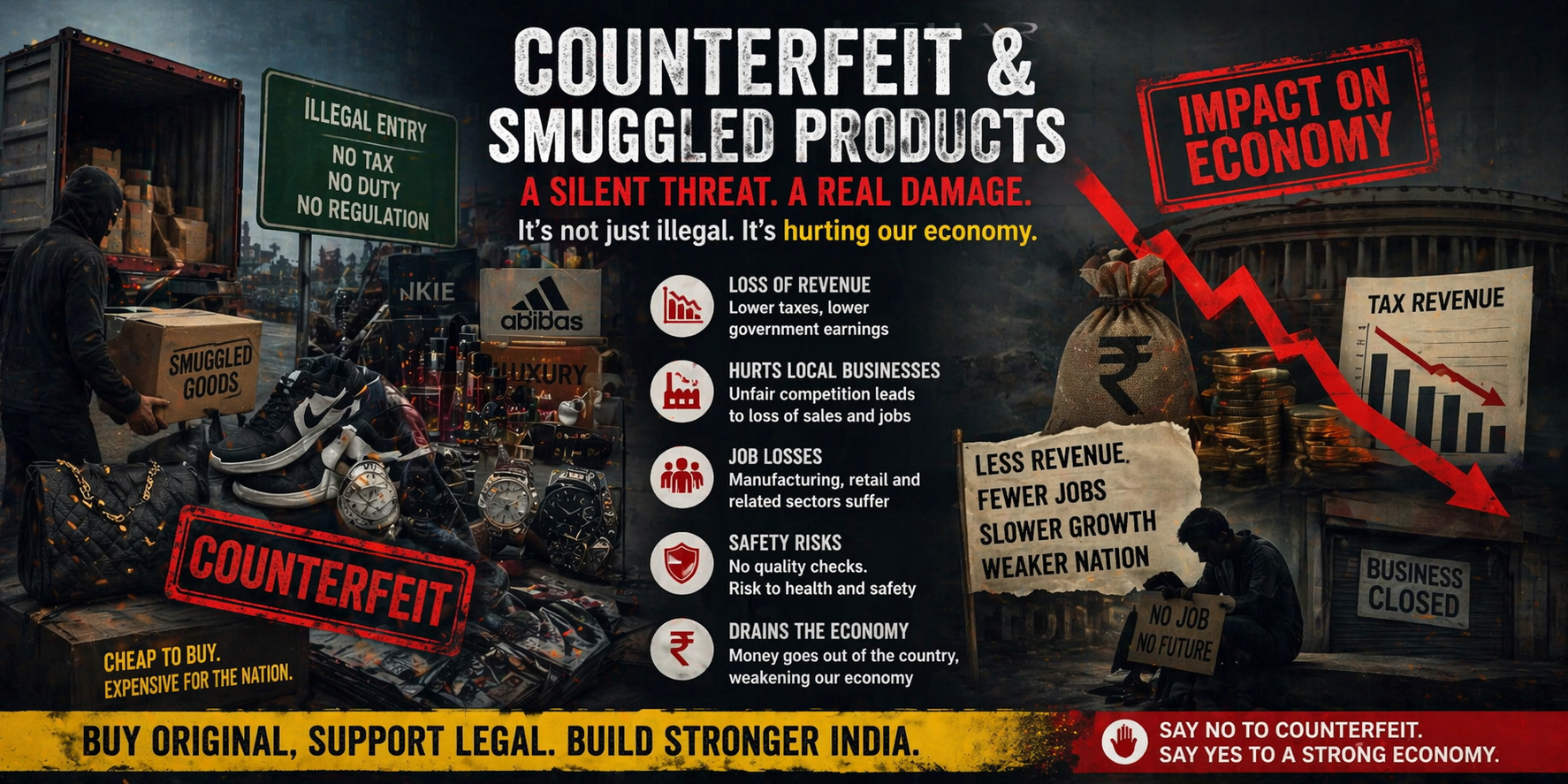
Counterfeit and smuggled goods pose a considerable challenge to any country, more so to an evolving economy like India. Illicit goods account for a quarter of all goods sold in India, a serious concern for us. Anil Rajput, Chairman of CASCADE in FICCI, writes about this menace exclusively for SAVIOURS.
INTRODUCTION
Illicit trade in India has moved far beyond isolated instances of counterfeiting, becoming a systemic challenge with serious consequences for consumer safety, economic integrity, and institutional credibility. What was once often dismissed as a problem confined to imitation goods or tax evasion now penetrates everyday markets with far greater depth and sophistication. Counterfeit, smuggled, and unregulated products increasingly intersect with routine consumption across sectors such as packaged foods, personal care, textiles, alcohol, and tobacco, exposing consumers to risks that are not always visible at the point of purchase. The issue, therefore, is no longer merely one of commercial illegality. It is a matter of public safety, market trust, and the resilience of the formal economy. Any serious response must recognise illicit trade not as a peripheral distortion, but as a structural threat that demands coordinated attention across policy, enforcement, industry, and consumer awareness.
CHANGING CONSUMPTION LANSCAPE
At the heart of this challenge lies a transformation in India’s consumption landscape. As economic growth continues to expand the consumer base, demand patterns are undergoing a structural shift in both scale and composition. Consumption across packaged foods, personal and household care products, textiles and apparel, alcoholic beverages, and tobacco has broadened significantly, reflecting rising incomes, urbanisation, and changing lifestyles. This expansion, while indicative of economic progress, has also created new vulnerabilities. A wider, more diverse consumer base, particularly in middle- and lower-income segments, has increased markets’ susceptibility to the entry and proliferation of counterfeit and smuggled goods. The shift in consumption towards middle- and lower-income groups makes exposure to illicit markets broader and more socially consequential than before.
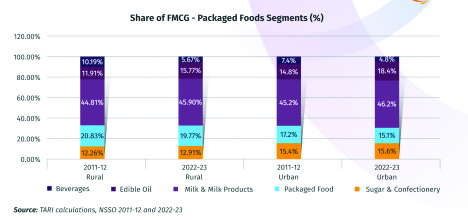
The expansion of consumption is evident not only in aggregate expenditure but also in the diversification and deepening of the household consumption basket. In categories such as packaged foods, consumption is spread across multiple segments rather than concentrated in a narrow set of goods. At the household consumption level, monthly per capita expenditure (MPCE) on FMCG packaged foods rose sharply, from ₹256.5 to ₹690.5 in rural India and from ₹407.4 to ₹1,022.9 in urban India between 2011–12 and 2022–23 over the same period. This matters because illicit trade flourishes most easily in markets that are large, fragmented, and embedded in routine household consumption. Where the consumer basket is broad and frequently purchased, counterfeit and substandard goods can enter circulation with far less visibility.
Figure 1. Broad-based consumption across packaged food segments expands the everyday market in which illicit goods can circulate.
Figure 1 illustrates this pattern clearly. In both rural and urban India, milk and milk products remain the single largest component of monthly per capita expenditure on FMCG packaged foods, accounting for 44.81 percent to 45.90 percent of the rural basket and 45.2 percent to 46.2 percent of the urban basket between 2011–12 and 2022–23. At the same time, the share of packaged food in monthly per capita expenditure increased from 11.91 to 15.77 percent in rural areas and from 14.8 to 18.4 percent in urban areas, indicating deeper penetration of processed and convenience-oriented products into everyday consumption. Such breadth increases the complexity of monitoring supply chains and makes consumer verification more difficult, particularly when purchases are frequent and low in individual value. In practical terms, this means that illicit penetration in FMCG does not require dominance in any one segment to become economically significant. Even limited infiltration across a wide basket of goods can produce a substantial cumulative impact.
The scale of the opportunity is itself revealing. The FMCG market reached US$121.8 billion in 2023 and is projected to expand sharply in the coming years, while the food processing sector is expected to rise from US$866 billion in 2022 to US$1,274 billion in 2027. When such a scale combines with a dispersed retail base and uneven consumer awareness, even a small degree of counterfeit penetration can translate into very large volumes of illicit goods moving through ordinary channels of consumption.
CONSUMPTION A FEEDER TO ILLICIT TRADE
The relationship between expanding consumption and illicit trade is not incidental. It is embedded within the very dynamics of demand. As access to goods increases, so does sensitivity to pricing, particularly in categories where consumption is frequent and quality differentiation is not immediately apparent. In such environments, illicit products can position themselves as viable alternatives by exploiting gaps between aspiration and affordability. This dynamic is best understood through tax and price arbitrage. Where regulation, taxation, logistics, or compliance costs substantially raise the price of legal goods, illicit suppliers can exploit the gap by placing visually similar or functionally substitutable goods on the market at lower prices.
Consumer decision-making is shaped by a combination of economic and contextual factors. Price differentials between legitimate and illicit products often act as a strong incentive, particularly in sectors such as fast-moving consumer goods and textiles, where purchases are frequent and perceived risk is low. In tobacco and alcoholic beverages, taxation and pricing structures can alter consumer behaviour much more sharply, creating incentives for consumers to shift toward illicit alternatives when legal products become less affordable. Illicit trade is therefore not merely a supply-side problem. It is reinforced by demand-side responses to market conditions.
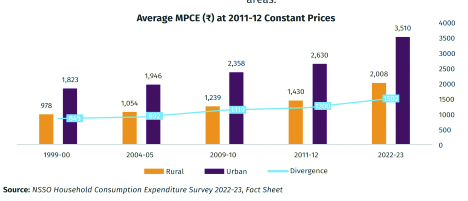
Figure 2. Rising rural and urban expenditure, coupled with widening consumption gaps, shape the demand conditions that drive illicit trade.
Figure 2 helps explain the economic backdrop against which these decisions are made.
At current prices, rural MPCE increased from ₹486 in 1999-2000 to ₹3,773 in 2022-23, while urban MPCE rose from ₹855 to ₹6,459 over the same period. The rural-urban gap at current prices widened from ₹369 to ₹2,686. At constant 2011-12 prices, rural MPCE rose from ₹978 to ₹2,008, while urban MPCE increased from ₹1,823 to ₹3,510, and the divergence widened from ₹845 to ₹1,502. These figures show that while consumption has grown across both rural and urban India, the gap between them has also widened. Such uneven growth reinforces differential price sensitivity across markets, making lower-cost illicit alternatives more attractive in some segments while simultaneously broadening the overall market for counterfeit and smuggled goods.
ROLE OF CONSUMER
This shifts attention to the role of the consumer within the ecosystem of illicit trade. The conventional framing of the consumer as a passive victim captures only part of the reality. The persistence of counterfeit markets suggests a more complex interaction, in which consumer behaviour, whether influenced by economic constraints, limited awareness, or habitual purchasing patterns, sustains demand. That is why awareness must extend beyond recognition to behavioural change. It is not enough for a consumer to know that counterfeit goods exist. Consumers must also be equipped to identify them, understand their risks, and recognise that lower prices can often conceal higher personal and social costs.
The consumer dimension of illicit trade must therefore be taken more seriously. In many cases, the consumer does not encounter illicit goods as a consciously chosen act of illegality, but as part of routine market participation. This is especially true in categories of frequent purchase, where transactions are low in individual value and verification is rare. The danger lies precisely in this ordinariness. Counterfeit packaged foods, personal care items, household goods, cigarettes, or alcohol affect daily life more quietly and often more dangerously than the more visible forms of commercial deception. Illicit trade penetrates not only markets, but habits. It enters kitchens, neighbourhood shops, informal supply chains, and increasingly digital carts. Consumer protection must therefore stand at the centre of the policy response. The question is not merely how much revenue is lost or how much legitimate industry is displaced, serious though both are. It is also whether ordinary citizens are being exposed to unsafe goods without adequate awareness, recourse, or institutional protection.
COMPLEX AND MULTIPLE DISTRIBUTION CHANNELS – A CHALLENGE
At the same time, the changing nature of distribution channels has further complicated the landscape. The expansion of informal retail networks, coupled with increasingly complex supply chains, has blurred the distinction between legitimate and illicit markets. For consumers, the ability to distinguish genuine from counterfeit products is often constrained, particularly as counterfeiters replicate packaging, branding, and product characteristics with increasing sophistication. This convergence creates conditions in which even well-intentioned consumers may inadvertently participate in the circulation of illicit goods. The problem is no longer confined to traditional wholesale and street-market networks. The OECD has warned that e-commerce is being widely misused for counterfeit trade, with online channels helping illicit networks scale distribution while reducing the likelihood of detection.
The implications of these dynamics extend beyond individual transactions. At a systemic level, sustained demand for illicit products undermines legitimate industry, erodes public revenues, and weakens the effectiveness of regulatory frameworks. More importantly, it exposes consumers to a range of risks, from compromised product quality to serious health and safety hazards in critical sectors. The challenge, therefore, is not limited to protecting consumers from illicit goods but extends to understanding and addressing the behavioural and structural factors that allow such markets to persist.
The impact on industry is equally significant. Legitimate businesses face unfair competition from illicit operators who do not bear the costs of compliance, taxation, or quality assurance. This affects profitability, weakens incentives for compliant investment, and has implications for employment, especially in sectors dependent on formal production and organised distribution. The economic implications are also fiscal. Loss of tax revenue from illicit trade harms public finances, while diverting demand from the legitimate industry weakens the growth of the regulated market. Over time, this discourages investment, reduces job creation, and undermines confidence in formal economic systems.
In FMCG, the numbers are especially revealing. The illicit market in packaged foods rose from ₹1,12,474 crore in 2017-18 to ₹2,23,875 crore in 2022-23, while the illicit market share remained around one-quarter of the market, reaching 25.4 percent in 2022-23 after peaking at 26.4 percent in 2018-19. These figures make clear that illicit trade in everyday consumption categories can no longer be treated as secondary to more visible sectors like tobacco. They reinforce the larger point that the issue has shifted from a narrow economic offence to a broader question of consumer protection and public safety.
If the expansion of illicit trade is shaped by demand-side dynamics, its persistence is equally a reflection of institutional and enforcement frameworks. The challenge is not only to understand how counterfeit and smuggled goods enter consumption cycles, but also to examine the capacity of existing systems to regulate, detect, and deter such activity. Each affected sector operates within its own regulatory framework, often governed by distinct authorities and varying degrees of oversight. While such differentiation is necessary, it also creates gaps that illicit networks can exploit. Fragmentation across regulatory regimes weakens overall policy effectiveness and allows illicit operators to benefit from inconsistent enforcement intensity, taxation structures, and compliance requirements.
ROLE OF LEAS & JUDICIARY
This is why the role of the judiciary and enforcement agencies becomes so important. Legal frameworks are not merely instruments of prohibition but mechanisms through which accountability is enforced and deterrence is established. Without timely adjudication, clear legal interpretation, and consistent penalties, even well-designed policies lose force. Yet policy and judicial systems alone cannot address the operational realities of illicit trade. Enforcement must evolve from reactive seizure-led action to intelligence-led detection, supported by data integration, technology deployment, and inter-agency coordination. India has made progress in recognising these challenges, but gaps remain in uniform implementation, digital oversight, resource deployment, prosecution efficiency, and coordination across jurisdictions.
CONSTRAINTS IN SIN GOODS
These constraints become particularly evident in sectors such as alcoholic beverages, where rising consumption, regulatory variation, and the coexistence of recorded and unrecorded markets create conditions that enable illicit trade to continue expanding despite formal controls.
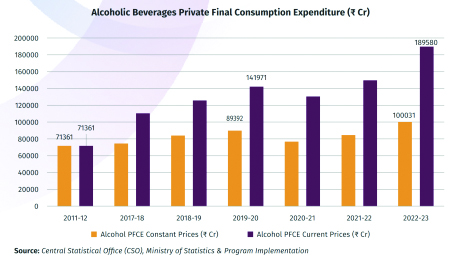
Figure 3. Growth in alcohol expenditure and the demand-supply gap underscores the persistence of unrecorded and illicit consumption.Figure 4. The steady rise in private final consumption expenditure on alcoholic beverages underscores the expanding market size within which unrecorded and illicit trade can persist.
Figures 3 and 4 illustrate why alcoholic beverages occupy a particularly important place in the illicit trade discussion. Private consumption expenditure on alcohol at current prices rose from ₹71,361 crore in 2011-12 to ₹1,89,580 crore in 2022-23, while at constant prices it increased from ₹71,361 crore to ₹1,00,031 crore over the same period. This steady rise in expenditure reflects not only the growing size of the market but also the expanding opportunity for illicit operators to exploit gaps created by taxation, state-level regulatory variation, and uneven enforcement. In practical terms, the coexistence of recorded and unrecorded consumption means that a meaningful share of alcohol demand can fall outside formal taxation and product oversight, thereby increasing fiscal losses and risks to consumer safety.
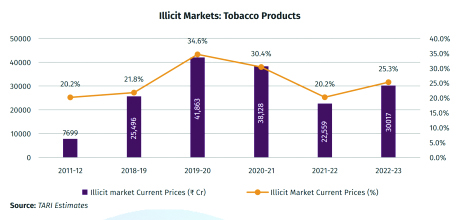
The tobacco sector is even more stark, and here the issue must be stated plainly. In tobacco, the relationship between taxation and illicit trade is not incidental but direct. High taxation creates an arbitrage and is a significant factor in the growth of the illicit tobacco market. This is borne out by the numbers. At constant prices, the illicit tobacco market grew from ₹7,699 crore in 2011-12 to ₹13,198 crore in 2022-23, while in value terms it rose by 120 percent to ₹16,819 crore over the same period. When taxes move too far ahead of market realities and enforcement capabilities, demand does not disappear. It shifts into illicit channels. That is the central policy lesson here, and it needs to be acknowledged clearly. Public health objectives remain legitimate and necessary, but they must be pursued in a manner that does not inadvertently expand the illegal market or weaken revenue collection and regulatory oversight.
Figure 5. Growth in tobacco expenditure and the demand-supply gap underscores the persistence of unrecorded and illicit consumption.
Figure 6. The expansion of India’s illicit tobacco market shows how tax-driven price arbitrage can redirect demand into illegal channels.
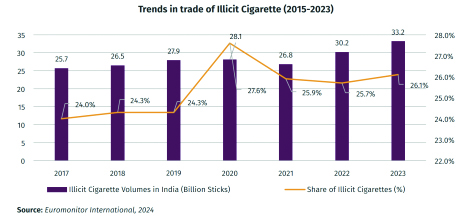
Figure 7. The rising trend in illicit cigarette trade between 2015 and 2023 highlights the growing scale and persistence of illegal supply in the Indian tobacco market.
Figures 5, 6 and 7 make the scale of this challenge unmistakable. The Government of India has demonstrated maturity over the past five years by refraining from further sharp increases in tobacco taxation. This has given the legal industry an opportunity to retain a meaningful share of the market and compete more effectively with illicit players on both price and quality, thereby helping to moderate the otherwise unchecked expansion of illegal trade. It is well established that once illicit trade becomes deeply embedded through a strong and extensive distribution network, it becomes exceedingly difficult to reverse through enforcement alone. This is precisely why the growth of such networks must be contained before they become structurally entrenched in the market. Global illicit cigarette consumption is estimated at around 600 billion sticks, or roughly 10 percent of total consumption. In India, illicit cigarettes accounted for 26.1 percent of the market in 2023, with volumes reaching 33.2 billion sticks. India’s illicit cigarette problem is therefore far more severe than the global benchmark. This is not a peripheral leak in the system, but a deeply embedded parallel channel of supply. It is precisely why the tobacco tax question cannot be discussed solely in terms of intent. However legitimate the public health objective, a tax structure that materially outpaces enforcement capacity and consumer affordability can end up enlarging illicit trade.
The challenge is further compounded by linkages to organised activity. Governments elsewhere have explicitly described illicit tobacco as a trade that funds organised crime, undercuts law-abiding businesses, and imposes wider social and fiscal costs. That broader lesson applies here as well. Once illicit trade becomes entrenched, it is no longer only about counterfeit goods on shelves. It becomes a matter of economic governance, revenue integrity, organised evasion, and weakening public trust in legal institutions.
ILLICIT TRADE-A GLOBAL PHENOMENON
The issue is not confined to India. OECD and EUIPO estimate that counterfeit and pirated goods accounted for USD 467 billion in 2021, or 2.3 percent of global imports, with the equivalent figure for the European Union at USD 117 billion, or 4.7 percent of total EU imports. There are, however, useful lessons from abroad. The European Union’s tobacco traceability and security features systems became operational on 20 May 2019 and were designed specifically to help authorities monitor legitimate supply chains and address illicit trade. The United Kingdom reports that its cigarette duty gap fell from 16.9 percent in 2005-06 to 6.9 percent in 2022-23 under a comprehensive anti-illicit tobacco strategy. Singapore has long required a visible duty-paid cigarette mark on every cigarette intended for sale and consumption in the country, reinforcing compliance and giving both authorities and consumers a clear way to distinguish legal products.
There are important lessons for India to learn from these experiences. First, traceability works best when it is system-wide, legally enforceable, and technologically supported. Second, enforcement must be coordinated across borders, tax administrations, police, regulators, and consumer protection agencies. Third, consumer-facing compliance tools matter because they make legality more visible in the marketplace. Fourth, continuity matters. Countries that have made measurable progress against illicit markets tend to treat the issue as a standing governance challenge rather than an episodic campaign.
In essence, illicit trade operates as a system. Consumer demand creates opportunity, policy gaps create access, and enforcement limitations allow continuity. Unless all three are addressed simultaneously, interventions in one area are often offset by weaknesses in another. That is why the way forward must combine informed consumption, coherent policy architecture, intelligence-led enforcement, and integrated stakeholder alignment. This is also why rationalising taxation, particularly in tobacco, must be part of the policy conversation. Taxation cannot be treated as detached from market outcomes when the evidence shows that excessive price gaps are directly driving illicit substitution.
Ultimately, the challenge of counterfeiting and illicit trade is both economic and ethical. It concerns not only the protection of markets and revenues but also the safety, trust, and well-being of consumers. The integrity of institutions, the credibility of regulatory systems, and the resilience of legitimate industry are all at stake. A critical outcome of any serious response must therefore be the rebuilding of consumer trust. Trust in products, markets, and institutions forms the foundation of a healthy economic system. Without it, even robust frameworks struggle to achieve their intended outcomes.
CONCLUSION
I believe the challenge before India is now unmistakably clear. We cannot afford to respond to illicit trade only after its damage has already spread through markets, institutions, and households. What is required is a deliberate and sustained alignment of consumer behaviour, policy frameworks, taxation choices, enforcement mechanisms, technological capability, and stakeholder coordination. If we are serious about protecting consumers, preserving legitimate industry, and strengthening trust in our markets, then we must act with greater coherence and urgency. In my view, only such a comprehensive and determined approach can dismantle the conditions that allow illicit trade to flourish and secure for India a lawful, reliable, and worthy marketplace of public confidence.
Anil Rajput is President, Corporate Affairs, ITC, Chairman of CASCADE in FICCI and Chairman of the Bharat Ki Soch, a think tank. He writes regularly on management issues drawing learnings from ancient Indian texts.