Introduction
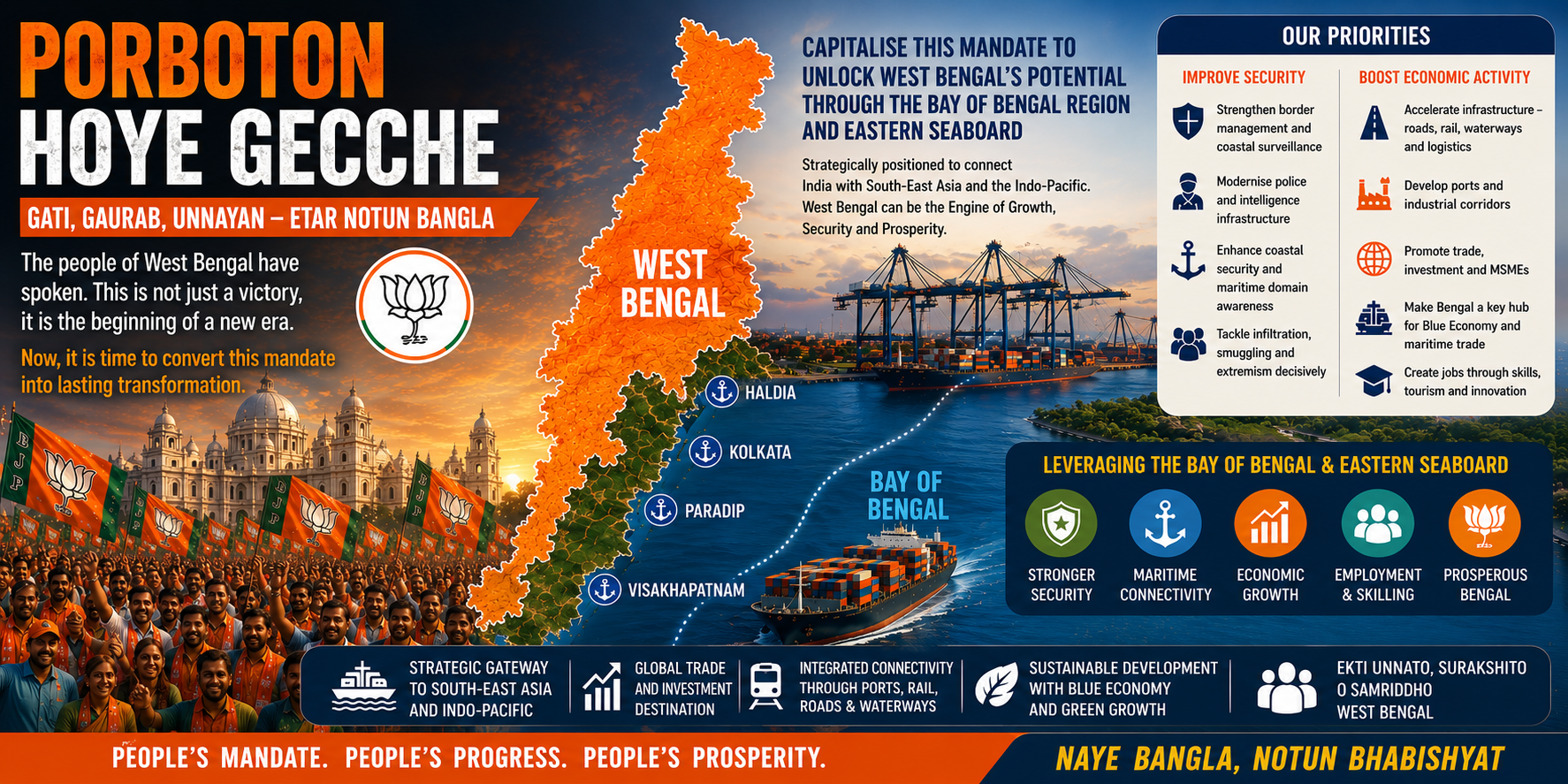
“Poriborton Hoye Gechhe” is not merely a political slogan. It reflects a decisive public shift towards governance that delivers outcomes, strengthens connectivity, and integrates regions into a larger national framework. The alignment between Delhi, Kolkata, and the Northeast creates a rare opportunity for coordinated execution. This alignment is critical for giving real momentum to the Act East Act Fast policy, which is now moving from articulation to implementation.
The implications go beyond domestic politics. This moment directly reshapes India’s engagement with Bangladesh and the wider Bay of Bengal region. A politically aligned eastern corridor enables India to pursue a structured, predictable partnership with Bangladesh, anchored not in sentiment but in economic outcomes and shared growth.
India Bangladesh Partnership: A closer proximity
India and Bangladesh are natural partners, but the relationship must now move beyond cooperation to calibrated interdependence. For the eastern corridor to succeed, Bangladesh must not remain a mere transit geography. It must become a stakeholder whose economic growth is directly linked to India’s development.
This requires a conscious policy shift.
Border infrastructure between India and Bangladesh must be transformed into high-efficiency economic zones. Integrated check posts, seamless customs systems, warehousing, cold chains, and digital clearance platforms must operate with speed and predictability. Border haats should expand into structured local trade ecosystems that support livelihoods on both sides.
More importantly, India must ensure that Bangladesh derives tangible benefits in terms of:
· Trade opportunities and sectoral complementarities
· Joint manufacturing and industrial clusters
· Assured and predictable market access
· Infrastructure investments that generate local employment
If Bangladesh does not benefit economically, it risks becoming vulnerable to external influence. That would turn geography into leverage against India rather than a bridge of cooperation. The objective must therefore be clear: Bangladesh should see its long-term economic stability as closely aligned with India. Only then can the eastern corridor become durable and secure.
Connectivity as the Foundation of Shared Growth
Connectivity is the backbone of the India-Bangladesh partnership. Rail and road links through Bangladesh provide the shortest and most cost-effective access to India’s Northeast. Inland waterways add another efficient dimension. Ports such as Chattogram and Mongla serve as critical maritime gateways.
These are not isolated initiatives. They must operate as an integrated system focused on reducing transit time, lowering logistics costs, and ensuring reliability. Efficient connectivity builds trust, increases trade volumes, and anchors long-term cooperation.
Eastern Corridor as a Parallel to Western Trade Routes
India’s traditional dependence on Western maritime routes through the Strait of Hormuz and the Arabian Sea has exposed structural vulnerabilities. Disruptions in West Asia directly affect trade and energy flows.
The eastern corridor cannot entirely replace these routes, particularly for crude oil imports. However, it can evolve into a parallel system that reduces overdependence and enhances resilience.
Through Bangladesh, India gains direct access to the Bay of Bengal and onward connectivity to Southeast Asia. This includes Myanmar, Thailand, Vietnam, Japan, and the wider Pacific region. Coastal shipping, multimodal logistics, and regional maritime networks can create a distributed trade system that complements existing routes.
Energy diversification can be partially addressed through eastern pathways. Supply linkages through the Strait of Malacca, supported by infrastructure in the Andaman and Nicobar Islands, can provide supplementary channels. This is not substitution but strategic balancing.
Andaman and Nicobar Islands: Strategic Presence in the Eastern Maritime Space
The Andaman and Nicobar Islands are central to India’s eastern maritime strategy. Their proximity to the Strait of Malacca provides a natural vantage point over one of the world’s most critical shipping lanes.
India must strengthen its presence through:
· Development of port and logistics infrastructure
· Expansion of storage and transhipment facilities
· Enhanced maritime surveillance and domain awareness
A long-term maritime grid connecting Southeast Asia to the islands and onward to India’s eastern and western coasts can create internal resilience. This also ensures that India remains an active stakeholder in maintaining regional stability.
Security Imperatives: Eastern Corridor Must Be Secured Through Regional Partners
The eastern maritime space presents a different set of challenges compared to the western seaboard. The Bay of Bengal is increasingly influenced by strategic competition, particularly as China’s presence grows through ports, infrastructure, and maritime outreach.
If India does not actively strengthen and secure the eastern corridor, several risks emerge:
· Strategic encirclement through external maritime presence
· Vulnerability of sea lanes and trade routes
· Increased influence of extra-regional powers in neighbouring economies
· Potential pressure points in Bangladesh and the Northeast
Western partners have not consistently addressed India’s core security concerns in the region. Their priorities are often shaped by broader geopolitical calculations that do not fully align with India’s immediate interests. This has been clearly evident in the conflict in the Arabian Sea, where India’s role has not translated into commensurate strategic influence. Their dependence on Pakistan is a long-time concern.
Developing and securing the eastern corridor, therefore, serves a long-term national interest. A strong presence in the Bay of Bengal, supported by regional cooperation, enhances maritime security, protects trade flows, and reinforces India’s strategic autonomy.
Securing this space must become an integral part of the Act East Act Fast. Maritime cooperation with regional partners, coordinated surveillance, and capacity-building are essential to ensuring the Bay of Bengal remains stable and open.
BBIN and Subregional Logistics Integration
The Bangladesh, Bhutan, India, Nepal framework remains a critical component of the eastern strategy. The Motor Vehicles Agreement must be operationalised to enable seamless cross-border movement of goods.
This will:
· Reduce logistics costs
· Connect hinterland regions to maritime routes
· Strengthen Bangladesh’s position as a transit and trade hub
Subregional integration delivers practical outcomes and builds trust at multiple levels.
Strategic Autonomy and the Limits of External Frameworks
The development of the eastern corridor must be guided by strategic clarity. Frameworks such as the Quadrilateral Security Dialogue are relevant to broader discussions, but they are not a complete answer to India’s requirements in this region.
India must carefully evaluate the extent of external involvement in its eastern trade architecture. Overreliance on powers whose policies may shift can create uncertainty. Western approaches to global trade and security are often shaped by their own priorities, which may not always align with India’s long-term interests.
India’s experience in West Asia also offers lessons. Despite being a major economic partner in the region, India has not always had a decisive role in shaping outcomes. This highlights the importance of building influence through sustained engagement and strategic presence.
For the eastern corridor, India should prioritise:
· Partnerships based on mutual economic benefit
· Reliable and consistent stakeholders such as Japan and key Southeast Asian economies
· Independent decision-making in strategic matters
The objective is not to exclude cooperation but to ensure that it remains aligned with India’s interests.
From Act East to a Balanced Maritime and Strategic Economy
The eastern corridor represents an evolution of Act East into a more comprehensive economic and strategic framework. India must develop a balanced system where western and eastern routes complement each other.
The focus should be on:
· Diversifying trade and energy pathways
· Strengthening regional partnerships
· Building resilient infrastructure networks
· Ensuring security of maritime routes
QUAD and the Limits of External Security Frameworks
The Quadrilateral Security Dialogue adds value to the wider Indo-Pacific through maritime awareness, capacity building, and rules-based cooperation, and its presence can support a stable environment for trade through the Bay of Bengal. Yet the security and stability of the eastern corridor between India and Bangladesh and beyond remain fundamentally regional in character. From border management, water sharing, and transit arrangements to community-level confidence, and from trade routes leading to Southeast Asia or the Strait of Malacca to securing none, all depend on external frameworks or, in particular, on Western participation. These require direct bilateral engagement, sensitivity to regional realities, and mechanisms that are owned and operated by the countries concerned. This requires a shift in approach and direction. A calibrated approach that welcomes QUAD as a supportive platform while preserving strategic autonomy in core security matters will ensure that the eastern corridor develops on the foundation of trust, proximity, and shared responsibility.
Conclusion: From Political Mandate to Strategic and Economic Architecture
The mandate in Bengal provides the political foundation. The challenge now is to build a durable and secure economic architecture.
The success of this vision depends on:
· Deep economic integration with Bangladesh
· Efficient and seamless connectivity
· Strategic strengthening of the Bay of Bengal
· Security preparedness in the eastern maritime domain
· Careful selection of reliable partners
If India does not invest in and secure this corridor, it risks repeating past patterns in which economic engagement fails to translate into strategic influence.
“Parivartan hoye gechhe” must now move beyond intent. It must deliver a system that strengthens both economic growth and national security. The Bay of Bengal, if developed with clarity and foresight, can become not only a gateway to the Indo-Pacific but also a foundation for India’s long-term strategic stability.