
India hosted the Foreign Ministers of the BRICS countries in New Delhi in the backdrop of the US and Israeli war on Iran and its fallout to the Gulf countries. A consensus eluded as Iran and the UAE hold opposing views for obvious reasons. BRICS faces greater challenges if the war does not halt soon.
India Hosts BRICS FMs at a Time of Global Flux
India hosted the BRICS Foreign Ministers’ Meeting on 14–15 May 2026 under the chairmanship of Dr S. Jaishankar, External Affairs Minister of India. BRICS Foreign Ministers and Heads of Delegation from member and partner countries participated in the meeting in the expanded format and also called on Prime Minister Shri Narendra Modi. Of the original five BRICS members, Chinese Foreign Minister Wang Yi was unable to attend due to President Donald Trump’s State Visit to China and was represented by China’s Ambassador to India.
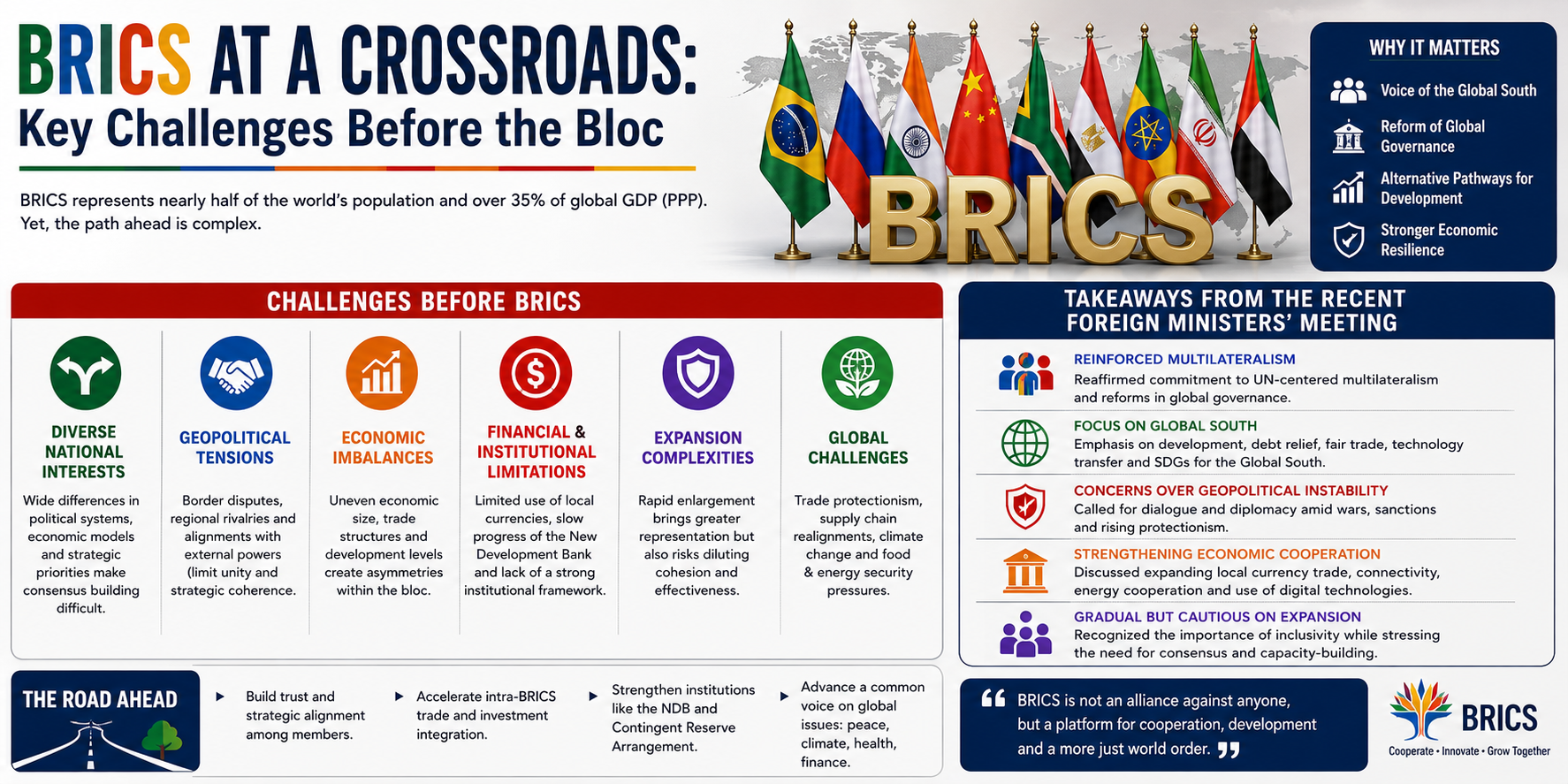
The meeting comprised two sessions under the overarching theme, “BRICS@20: Building for Resilience, Innovation, Cooperation and Sustainability”, followed by a session on “Reforms of Global Governance and the Multilateral System.” The meeting assumed significance as it sought to define the agenda, bridge differences, and lay the groundwork for the forthcoming BRICS Summit and the issuance of a consensus-based Joint Statement.
India’s Diplomatic Balancing Act: From G20 to BRICS
In recent years, Indian diplomacy has had to navigate increasingly complex geopolitical challenges, particularly while leading major multilateral groupings such as the G20 in 2023 and BRICS+ in 2026. The G20 Summit in New Delhi was marked by deep divisions between Russia and Western countries over references to the Russia–Ukraine conflict. Achieving consensus required extraordinary diplomatic agility, political capital, goodwill, and sustained personal engagement by Prime Minister Narendra Modi with world leaders before the final “Delhi Declaration” could be issued. Until the very last moment, uncertainty prevailed.
At such summits, the Joint Declaration often serves as the principal yardstick for measuring success or failure. India’s civilisational message of “Vasudhaiva Kutumbakam” — One Earth, One Family, One Future — had already resonated globally because of its universality and uniqueness. However, the earlier BRICS Sherpas’ meeting had failed to produce a Joint Statement owing to disagreements between the two newer members, Iran and the UAE.
Jaishankar’s Vision: BRICS as a Pillar of Multipolarity
Chairing the session, Dr Jaishankar referred to the global churn and regional turbulence arising from ongoing conflicts. He underlined that BRICS had grown substantially in scale and relevance over the years, reflecting the aspirations of emerging markets and developing economies for a more balanced and inclusive international order.
BRICS, he noted, had expanded both its agenda and membership in response to changing global realities while remaining focused on people-centric development and practical cooperation. “In this spirit, our four priorities — Resilience, Innovation, Cooperation and Sustainability — provide a practical framework for engagement, including with partner countries,” he observed.
He added that the independence and diversity of BRICS constitute its real strengths. “We are perceived globally as a force seeking change and reform. We are the embodiment of multipolarity in a world increasingly focused on de-risking and diversification,” he stated.
The Shadow of the Iran–US–Israel Conflict
India will chair the BRICS Summit in September. This year, however, the ongoing US–Iran–Israel conflict has cast a shadow of uncertainty over the prospects of achieving a consensus-driven outcome document. Iran and the UAE exchanged sharp verbal accusations during discussions, reflecting the deep scars and heightened tensions generated by the conflict.
Ironically, during the Foreign Ministers’ Meeting itself, reports emerged from the Israeli Prime Minister’s Office regarding a purported visit by Israeli Prime Minister Benjamin Netanyahu to the UAE and a meeting with President Sheikh Mohamed bin Zayed Al Nahyan. Iran reacted strongly, alleging that its intelligence agencies were aware of UAE–Israeli complicity against Iran. Tehran also accused the UAE of facilitating actions against Iranian interests and claimed that the UAE had become one of the most targeted GCC countries in Iranian retaliatory strikes.
The UAE denied that any such visit or meeting had taken place during the war. Against this backdrop, it was unsurprising that no consensus Joint Statement could be finalised. Instead, a comprehensive Chair’s Statement and Outcome Document were issued at the conclusion of the BRICS Foreign Ministers’ Meeting in New Delhi.
Reforming Global Governance and Building New Institutions
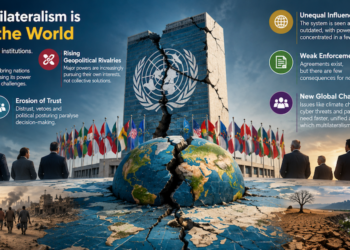
Reshaping global governance and pursuing comprehensive reforms of the United Nations and the UN Security Council, including enhanced representation for developing countries, also figured prominently in the discussions. Reforms of the Bretton Woods institutions were similarly emphasised.
Discussions additionally focused on the BRICS cross-border payments initiative and the implications of the West Asian conflicts. The leaders strongly condemned the April 22, 2025, Pahalgam terror attack. Recognising emerging threats to digital infrastructure and communication systems, the grouping also established a BRICS Submarine Cable Task Force, among several other initiatives.
The Iran War and Regional Strategic Fallout
On 28 February, the United States and Israel launched coordinated attacks against Iran, targeting key political and military leadership structures and establishing significant superiority in Iranian airspace and maritime zones. However, they appear to have underestimated Iranian resilience and Tehran’s evolving military doctrine, which combined elements of a “Mosaic Decentralised Defence Strategy” with a “Scorched Earth Strategy.”
Iran responded forcefully and sustained the escalation ladder for over six weeks before a ceasefire was announced by President Trump. Though fragile, the ceasefire has held so far, offering limited hope for a negotiated settlement.
Gulf Security, Hormuz and the Deepening Trust Deficit
During the conflict, Tehran not only targeted American and Israeli assets but also violated the sovereignty and territorial integrity of Gulf and Arab states through repeated attacks on US military bases, energy facilities, and other critical infrastructure. Iran also disrupted maritime traffic through the Strait of Hormuz, resulting in severe economic and security consequences for the region and the wider world.
The UAE reportedly faced the highest number of drone and missile attacks among GCC countries. The resulting trust deficit has deepened considerably and may take years to repair.
Why Consensus Became Difficult within BRICS
Among the Arab and regional countries, Iran, the UAE, Egypt, and, to a lesser extent, Saudi Arabia are now associated with the expanded BRICS framework. Consequently, when Tehran urged New Delhi to issue a BRICS statement condemning the US and Israeli attacks, the proposal found little resonance among the UAE and several Arab countries, which themselves had come under attack despite claiming strategic restraint and asserting that they had not permitted the United States to use their airspace for operations against Iran.
In the fog of war, truth is often the first casualty as disinformation campaigns and competing narratives obscure reality. Abu Dhabi strongly opposed any formulation perceived as one-sided despite India’s efforts to broker a compromise.
India’s Delicate Strategic Balancing in West Asia
India itself had issued a carefully calibrated statement on 28 February, urging respect for the sovereignty and territorial integrity of all states in accordance with the UN Charter. Implicitly, this position criticised both the US–Israeli strikes on Iran and Iranian attacks on Gulf countries.
Ironically, nearly all major actors involved in the conflict — from the region and beyond — are India’s strategic partners. West Asia’s security and stability, therefore, hold existential significance for New Delhi. Consequently, dialogue, diplomacy, and de-escalation remain India’s preferred pathways for reducing tensions.
Prime Minister Modi and External Affairs Minister Jaishankar engaged extensively with their counterparts across the region and beyond to help reduce tensions while safeguarding the interests of India’s nearly 10-million-strong diaspora in West Asia. Multiple high-level visits and diplomatic engagements were undertaken. Yet in international politics, expectations often serve as the ultimate litmus test of friendship and strategic alignment.
BRICS and the Search for a New Global Order
Prime Minister Modi had expanded the BRICS acronym through the theme of India’s presidency — “Building for Resilience, Innovation, Cooperation and Sustainability.” This theme symbolises the direction in which BRICS, as a non-Western platform in an increasingly fractured global order, is likely to evolve.
While BRICS remains primarily focused on geo-economic cooperation, geopolitical divisions and great-power competition inevitably impinge upon its non-adversarial orientation. India has consistently emphasised that “non-Western” should not be equated with “anti-Western.”
However, as the United States and several major powers increasingly depart from established norms of international law and post-Second World War conventions, the search for alternative frameworks and models of global engagement has intensified.
The BRICS Currency Debate and De-Dollarisation
One of Washington’s principal concerns remains the prospect of a BRICS currency or alternative financial architecture that could accelerate de-dollarisation. President Trump even threatened BRICS countries with 100 per cent tariffs.
Nevertheless, the search for less cumbersome, less unilateral financial mechanisms is likely to continue as more countries seek to conduct trade in local currencies, reducing uncertainty and transaction costs. There is growing support within parts of the Global South for BRICS-led banking and financial arrangements as alternatives to existing institutions. This trend has also been reinforced by US sanctions on Russia and the exclusion of Russia and Iran from the SWIFT financial system.
India’s Cautious Approach to Financial Alternatives
This presents both opportunities and challenges for India. While New Delhi supports bilateral payment mechanisms, digital public goods, and systems such as UPI, it remains cautious about adopting overtly confrontational postures toward the existing global financial order.
Responding to a Parliamentary Question on 13 March 2026, India’s Ministry of External Affairs clarified that “there is no agreement within the BRICS framework on trade among all member nations in their respective local currencies. However, the issue of local currency financing has been discussed in the context of the BRICS Interbank Cooperation Mechanism.”
Economic cooperation among BRICS member states, it added, would continue through the BRICS Finance Track, including meetings of Finance Ministers and Central Bank Governors.
West Asia’s Crisis and Its Impact on BRICS Deliberations
That the ongoing Middle East conflict influenced deliberations in New Delhi during both the BRICS Foreign Ministers’ Meeting and the forthcoming Summit is beyond doubt. Earlier indications had already emerged during the meeting of BRICS Deputy Foreign Ministers and Special Envoys on the Middle East and North Africa, held on 24 April 2026 in New Delhi, where members exchanged views on the deteriorating regional situation but could only issue a carefully worded Chair’s Statement that reflected the absence of consensus.
India’s Position: Dialogue, Diplomacy and De-escalation
Dr Jaishankar was unequivocal in highlighting the dangers posed by the conflict in West Asia. Reaffirming India’s commitment to the principles of the UN Charter, he stressed that respect for sovereignty and territorial integrity must remain the foundation of international relations.
“Dialogue and diplomacy are the only sustainable means of resolving conflicts,” he emphasised. He further observed that continuing tensions, threats to maritime traffic, and disruptions to energy infrastructure underscored the fragility of the regional security environment.
Safe and unimpeded maritime flows through international waterways, including the Strait of Hormuz and the Red Sea, remain essential for global economic stability. He underlined that stability cannot be selective and peace cannot be piecemeal. Upholding international law, protecting civilians, and avoiding attacks on public infrastructure are imperative. India, he clarified, stands ready to contribute constructively toward de-escalation and regional stability.
Gaza, Humanitarian Concerns and the Two-State Solution
The wider regional situation also continues to generate concern. The Gaza conflict carries grave humanitarian implications. A sustained ceasefire, unhindered humanitarian access, and a credible pathway toward a durable political settlement remain essential.
India continues to support a two-state solution to the Palestine issue.
BRICS Beyond Conflict: The Promise of the Global South
Yet BRICS extends far beyond the immediate conflict. The grouping possesses an expansive agenda covering economic cooperation, counter-terrorism, climate action, trade, technology, connectivity, people-to-people exchanges, and sustainable development.
Under India’s presidency, several practical, forward-looking initiatives are likely to emerge that could significantly contribute to security, prosperity, and equitable development across the Global South.
Equity, equality, and equanimity — driven by consensus, inclusiveness, and sustainable growth — increasingly define both the foundational principles of BRICS and India’s broader diplomatic priorities. These principles have acquired growing relevance and appeal among countries of the Global South or the “Global Majority,” despite the many internal and external challenges confronting the grouping.
Dr Jaishankar reaffirmed India’s commitment to BRICS in unequivocal terms: “India remains committed to strengthening BRICS in line with the principles of mutual understanding, solidarity, openness, inclusiveness, full consultation, and consensus.”