

Amal Chandra, a political analyst and columnist, walks us through the challenges of peaceful coexistence in a neighbourhood in turmoil and, at times, even hostile. He looks in depth at Bangladesh in this piece and is of the view that engagement with the BNP government has to be calibrated afresh and with honesty on both sides.
Introduction
For New Delhi, few bilateral relationships in South Asia appeared as stable or instructive as those with Bangladesh. For over a decade, India’s eastern neighbour seemed to validate the logic of sustained engagement, leadership-level trust, and incremental cooperation. Under the Awami League, Dhaka aligned closely with India on counter-insurgency, connectivity, trade facilitation, and regional diplomacy. The stabilisation of India’s Northeast, improved border management, and the expansion of economic ties reinforced the perception that India’s “Neighbourhood First” policy could succeed when political continuity was assured.
That phase, however, did not end smoothly. Instead, it gave way to a period of acute uncertainty. The collapse of the Awami League was followed by an interim phase marked by institutional fragility, rhetorical hostility toward India, and the visible activation of external actors seeking to exploit the vacuum. During this period, India–Bangladesh relations experienced a sharp downturn. Public discourse in Dhaka grew palpably anti-India, shaped in part by the strident posturing of the caretaker leadership and the influence of hardline elements within its advisory structures.
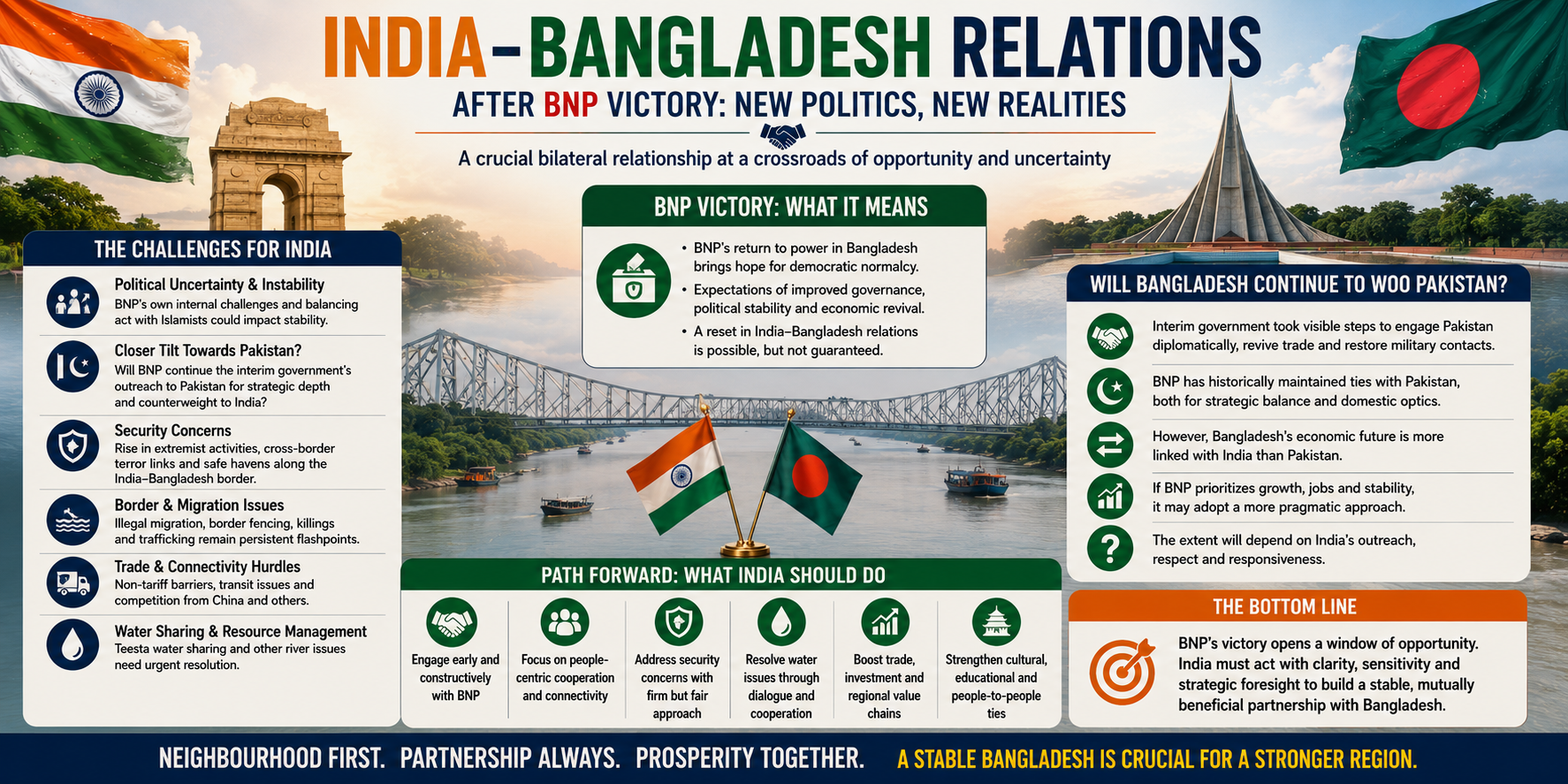
This phase also witnessed a notable resurgence of Pakistan’s engagement with Bangladesh. Moves to normalise ties, ranging from discussions on trade and the docking of Pakistani vessels at Bangladeshi ports to high-level military and intelligence exchanges, signalled an attempt to re-establish strategic relevance in Dhaka. Such developments, coupled with inflammatory rhetoric from Pakistani leadership about renewed eastern pressure on India, underscored the extent to which the absence of a stable, popular government had opened space for competitive geopolitical manoeuvring.
Yet this period proved to be an interregnum rather than a structural realignment. The subsequent consolidation of power by the Bangladesh Nationalist Party (BNP) under Tarique Rahman has once again altered the trajectory. While the tone of India–Bangladesh relations has changed from the familiarity of the Awami League era, it has also moved away from the volatility of the interim phase. What has emerged is neither hostility nor alignment, but distance—measured, managed, and politically conditioned.
The relationship has thus entered a phase of recalibration: less predictable, more transactional, and ultimately more honest. The apparent stability of the past has given way to a more complex but arguably more sustainable equilibrium.
Tarique Rahman and the Politics of Strategic Autonomy
Rahman’s leadership comes at a moment when Bangladesh’s domestic legitimacy and foreign policy positioning are deeply intertwined. Internally, the BNP must distance itself from its earlier reputation for political volatility and governance deficits. Externally, it must reassure regional and global actors that Bangladesh remains a stable and reliable partner after a period of visible disruption.
This dual imperative explains the calibrated tone of Dhaka’s outreach to India. The emphasis on “sovereign equality,” “mutual respect,” and “balanced engagement” reflects not rhetorical preference but political necessity. Unlike the interim dispensation, whose posture often translated into overt signalling, the current government has adopted a more measured and pragmatic approach. At the same time, unlike its predecessor, the BNP operates within a domestic political environment where overt proximity to India carries electoral and ideological costs.
This does not translate into antagonism. On the contrary, the Rahman government has taken deliberate steps to stabilise ties with New Delhi, recognising that economic recovery, trade access, and regional connectivity depend on functional relations with India. However, the terms of engagement have shifted. Cooperation must now be publicly defensible within Bangladesh’s political discourse, not merely effective at the executive decision-making level.
For India, this shift is consequential. It requires moving beyond the assumption that goodwill at the leadership level can insulate bilateral ties from domestic political pressures. The interim phase demonstrated how quickly public narratives can reshape diplomatic space. In contemporary Bangladesh, opposition voices, media scrutiny, and civil society debates play a more assertive role in shaping foreign policy choices. Strategic patience, rather than political familiarity, becomes the central instrument of engagement.
From Personal Rapport to Political Resilience
India’s response to Bangladesh’s transition suggests an evolving diplomatic approach. Rather than signalling preference for any political formation, an especially sensitive issue given the recent past, New Delhi has focused on restoring institutional normalcy. Prime Minister Modi’s outreach to the new leadership conveyed recognition of political change without appearing invested in regime continuity.
The gradual restoration of visa services is a particularly significant step. This is not a routine administrative decision but a strategic recalibration. People-to-people connectivity, encompassing education, healthcare, tourism, and family ties, forms the social foundation of India–Bangladesh relations. The disruptions during the interim period underscored how quickly mistrust can accumulate when mobility is restricted. Their resumption signals India’s recognition that societal linkages are its most durable source of influence.
Equally notable is India’s expanding engagement beyond the executive branch in Dhaka. Contacts with opposition leaders, policy institutions, and civil society actors indicate a shift toward a more resilient diplomatic model, one that seeks continuity across political cycles rather than reliance on incumbency. This approach reflects lessons drawn directly from the volatility of the recent transition.
However, India’s influence now operates in a more competitive environment. The interim phase illustrated how quickly external actors could step in during moments of uncertainty. China’s rapid diplomatic and economic outreach, alongside Pakistan’s renewed strategic signalling, demonstrated that Bangladesh is no longer insulated from broader geopolitical contestation.
Yet the notion of an inevitable shift away from India remains overstated. Geography continues to confer enduring advantages. India offers proximity, integrated markets, energy connectivity, and deep cultural linkages that external powers cannot replicate. Bangladesh’s emerging strategy appears to favour diversification rather than substitution—balancing multiple partnerships while avoiding overdependence on any single actor. For India, this means that influence must increasingly be earned through consistent delivery rather than assumed through historical ties.
Economic Interdependence as Strategic Anchor
In this more complex phase, economic engagement has become the central stabilising force in India–Bangladesh relations. Bilateral trade has expanded significantly, with Bangladesh emerging as one of India’s largest trading partners in South Asia. Yet structural imbalances persist. Non-tariff barriers, logistical inefficiencies, and regulatory asymmetries continue to constrain the full potential of economic integration.
Addressing these constraints is no longer optional. For Bangladesh, export diversification and industrial growth depend on improved market access. For India, particularly its northeastern states, deeper economic integration with Bangladesh offers a pathway to regional development and connectivity.
Connectivity projects are central to this dynamic. Initiatives linking India’s Northeast to Bangladeshi ports and transit corridors are not merely infrastructural but strategic. They reduce logistical costs, enhance regional integration, and embed interdependence into the relationship. For Bangladesh, these projects generate transit revenues and reinforce its role as a regional hub. In India, peripheral regions are integrated into broader economic networks.
Energy cooperation further strengthens this interdependence. Cross-border electricity trade, joint power projects, and grid connectivity create mutual dependencies that are less vulnerable to political fluctuations. Such arrangements transform the relationship from one of discretionary cooperation to one of structural necessity.
Recalibrated Security Ties in a Competitive Regional Order
Security cooperation, once the most robust pillar of India–Bangladesh relations, has evolved alongside a wider regional realignment. The earlier era of intensive counter-insurgency collaboration has largely receded. In its place, a broader and more nuanced security agenda has emerged, centred on coordinated border management, efforts to combat trafficking and transnational crime, disaster response cooperation, and maritime security in the Bay of Bengal.
At the same time, unresolved issues continue to test the relationship. Border incidents, though reduced, still retain the potential to inflame public opinion. The interim phase demonstrated how quickly such incidents can be politicised in the absence of stable governance. Managing these challenges requires mechanisms that privilege predictability and restraint over episodic political intervention.
This evolving security landscape is inseparable from Bangladesh’s growing regional diversification. The recent past highlighted how external actors could leverage transitional instability. Yet under the current government, this diversification appears more calibrated—aimed at maximising economic opportunity without compromising strategic autonomy.
For India, this marks a structural change. Bangladesh is no longer a space of uncontested influence, but one of managed competition. Yet such competition is not inherently zero-sum. The challenge for New Delhi lies less in countering individual actors than in sustaining its credibility as a reliable and responsive partner.
Water, Borders, and the Politics of Everyday Friction
One of the most consequential developments shaping the future trajectory of India–Bangladesh relations is the re-emergence of unresolved structural issues—most prominently, water sharing. The impending expiry of the Ganga Water Treaty in December 2026 has reintroduced a politically sensitive and strategically significant question into bilateral discourse.
One of the most sensitive unresolved issues in India–Bangladesh relations remains the long-delayed Teesta water-sharing agreement. Negotiations produced an in-principle framework in 2011, but the arrangement stalled amid opposition from West Bengal over dry-season water availability and state-level agricultural concerns. As a result, Teesta has become more than a hydrological dispute; it now functions as a test of India’s ability to reconcile domestic federal politics with neighbourhood diplomacy. Recent reports that Dhaka has formally sought Chinese involvement in the Teesta River Comprehensive Management and Restoration Project add a new geopolitical layer to an already difficult issue. For Bangladesh, Chinese financing and engineering support offer developmental leverage after years of delay. For India, however, the presence of third parties around a strategically sensitive transboundary river system near the Siliguri Corridor is likely to raise concerns. If unresolved, Teesta risks evolving from a bilateral water-sharing question into a broader contest over influence, credibility, and regional infrastructure politics.
Unlike earlier phases, when leadership-level understanding could facilitate compromise, the current environment is more complex. In Bangladesh, water-sharing is tied to agriculture, climate vulnerability, and national perceptions of fairness. In India, particularly within its federal framework, any agreement must balance domestic political pressures.
Dhaka has increasingly framed a revised water-sharing arrangement as a test of trust and long-term partnership. This reflects a broader shift: water is no longer a peripheral irritant but a foundational issue that will shape the legitimacy of the bilateral relationship in the years ahead.
Border management presents a parallel layer of everyday friction. While the era of insurgent sanctuaries has largely ended, new challenges have emerged in subtler forms—localised tensions, irregular migration concerns, and politicisation of identity issues. Stability is no longer self-sustaining; it must be continuously maintained.
Reset in Motion: Diplomacy Beyond Optics
Recent diplomatic engagements suggest that both sides are working to stabilise relations without reverting to past patterns. The contrast with the interim phase is instructive: where that period was marked by rhetorical escalation and strategic ambiguity, the current moment reflects cautious, issue-based engagement.
High-level visits, renewed dialogue, and the restoration of key channels of interaction indicate a deliberate attempt to rebuild ties through institutional mechanisms. The agenda of these interactions—focused on trade, energy, connectivity, and water-sharing—signals a shift toward sectoral cooperation rather than broad political alignment.
Such compartmentalisation is a sign of maturity, not decline. It indicates that both countries recognise the value of sustaining cooperation despite differences. At the same time, it also reflects a more demanding relationship—one that requires constant negotiation rather than relying on implicit understanding.
Another potentially disruptive variable lies in the treatment of Bangladesh’s Hindu minority and the political use of communal narratives on both sides of the border. Periodic attacks on minority communities, temple vandalism, land disputes, and migration anxieties have historically reverberated inside India, particularly in West Bengal, Assam, and at the national level. For the BJP, such incidents can quickly become domestic political issues tied to border security, citizenship, and the protection of Hindus in neighbouring states. Conversely, overt politicisation from India can deepen nationalist backlash within Bangladesh and strengthen anti-India constituencies. This creates a dangerous feedback loop in which minority insecurity inside Bangladesh and electoral mobilisation inside India reinforce one another. Unless managed with restraint, religious identity politics could become one of the most emotionally charged and least controllable irritants in an otherwise pragmatic bilateral relationship.
Bangladesh as a Test Case for India’s Future Neighbourhood Policy
Bangladesh’s political transition has become a critical test for India’s regional diplomacy. The movement from a relationship anchored in personal rapport to one defined by institutional resilience reflects wider changes across South Asia.
The lessons of the recent past are clear. Overreliance on political continuity can create vulnerabilities, while transitional instability can invite external intervention. The challenge for India is to build relationships that endure beyond electoral cycles and political alignments.
If India adapts effectively, it can demonstrate that regional leadership is compatible with political plurality. This would require engaging multiple stakeholders, respecting domestic sensitivities, and delivering tangible benefits that remain visible across governments. If it fails, the implications are equally clear: geography may ensure relevance, but it cannot guarantee trust.
Conclusion
The future of India–Bangladesh relations, therefore, will not be shaped by nostalgia for past alignments, nor by the turbulence of the interim phase, but by the ability to sustain a more balanced and candid partnership. What is emerging is not a breakdown, but a maturation—one that replaces implicit assumptions with explicit negotiation.
Bangladesh’s recalibration mirrors a broader regional trend. Across South Asia, states are asserting greater autonomy, diversifying partnerships, and responding to more politically conscious societies. In such an environment, influence cannot rest on proximity or historical goodwill alone; it must be reinforced through credibility, consistency, and respect.
For India, this moment offers an opportunity to refine its neighbourhood policy—from seeking alignment to managing divergence without rupture. Success will not be measured by how closely Dhaka aligns with New Delhi, but by how effectively the relationship accommodates differences while sustaining cooperation.