

Introduction
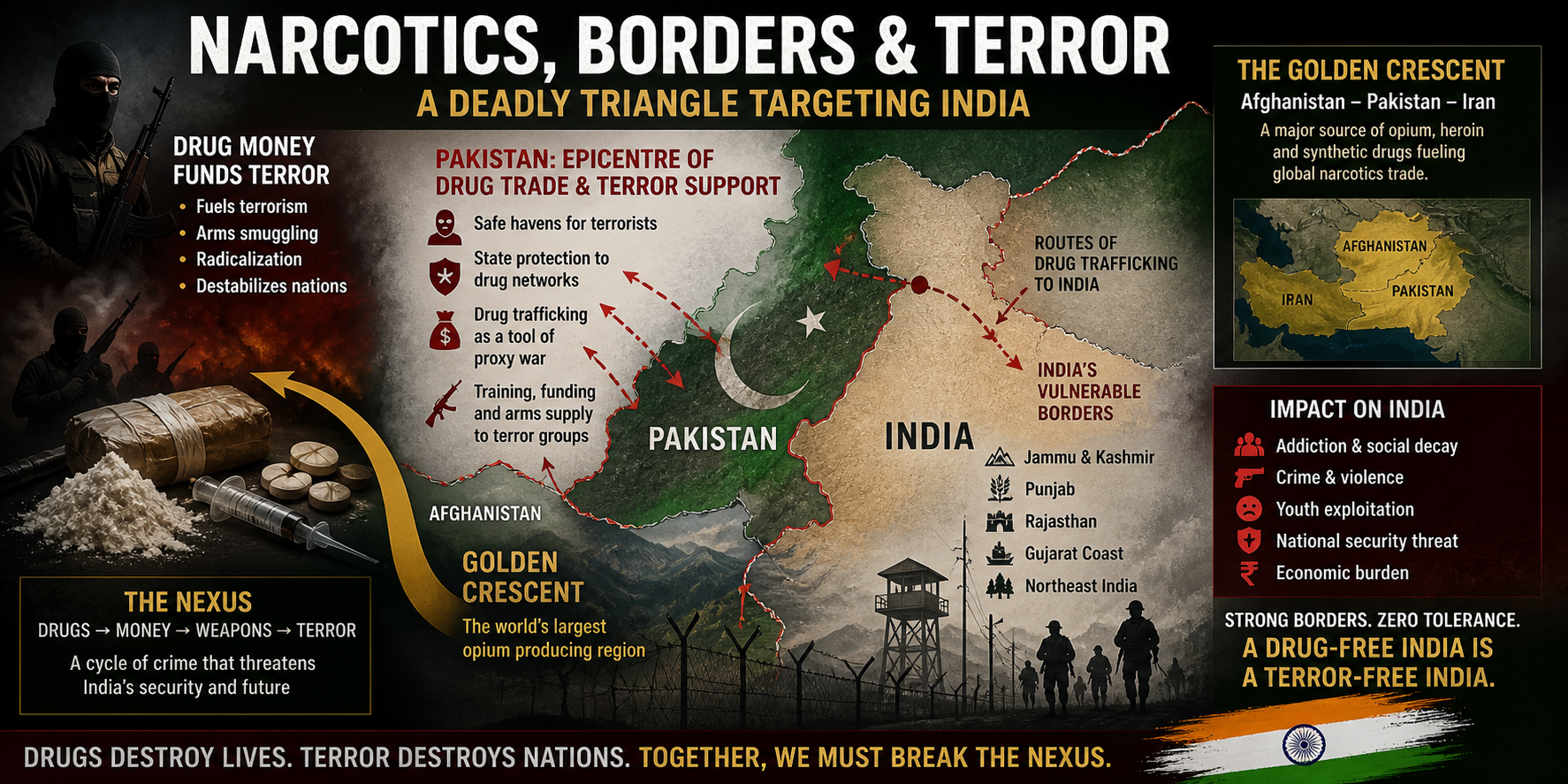
Drug trafficking is a borderless, transnational organised crime, in which the networks are anonymous to each other, and each network is so strong and intertwined with the others that penetrating and destroying it is a Herculean task for drug law enforcement agencies worldwide. Drug trafficking is the most lucrative transnational organised crime, having a nexus with terror and insurgent groups. It is a significant and growing threat to national and international security, with serious implications for the nation’s socio-economic fabric. Drug trafficking generates trillions of dollars worldwide, and channels of transfer of illegal proceeds are mostly through hawala and cryptocurrencies, and rough estimates indicate that it hovers between 2% to 5% of world GDP. India is no exception. As per the UNODC Drug Report 2024, Transnational Organised Crime (TOC) Groups control the tri-border areas of the Golden Crescent and the Golden Triangle, now termed as Death Crescent and Death Triangle by the hon’ble Prime Minister of India is also indulging in similar activities, and the players therein are actively supported by the ISI in Golden Crescent, for funding terror activities in India, and by the rebel groups in Myanmar, in Golden Triangle, with suspected indirect support of China, funding, and supplying arms to the insurgent groups in the North-East, and left-wing extremists in other parts of India.
Golden sandwich
Traditionally, India has been seen as a country sandwiched between the Death (Golden) Crescent and the Death (Golden) Triangle, which is being flooded with drugs, especially Heroin and Methamphetamine, from these two regions, by the drug lords. Nearly 90% of the world’s demand for the aforesaid drugs is met by these two regions alone. Ironically, India has been both a destination for consumption, as it’s a big market, and a transit route for other countries. The money thus generated by this illicit trade is phenomenal. As a matter of design by the ISI, the younger generation of Punjab, J&K, and Haryana has been badly afflicted by the infusion of drugs on a large scale from across the border. After successfully battling terrorism in the state of Punjab and defeating designs of the ISI-backed terrorism, the menace of drugs in this bordering state is causing concern for the law enforcement and security agencies. This is a different type of terror, a different type of war, in which the lives of millions are put at risk without firing a bullet. This is a type of war which is silently crippling human resources and is adversely affecting economic growth. The most dangerous aspect is that this trend of cross-border push is not limited to Punjab and J&K alone. North-Eastern India is also badly afflicted with the menace of drug abuse, wherein the indirect role of China through Myanmar is quite evident. With the passage of time, every town /city in almost all the states in India is afflicted by the cancerous growth of drug abuse, which is slowly eating away the youth and destroying a large number of families.
One can safely imagine that the amount of illegal money generated by this trade is generally used in other organised criminal activities, especially gun running and terror activities. Consumption is not limited to Punjab or the Northeast; it is pan-India, and besides being a social problem, it is a serious concern for the drug law enforcement agencies and the security agencies, as it leads to narco-terror and other organised criminal activities.
AF-Pak & Myanmar Axis
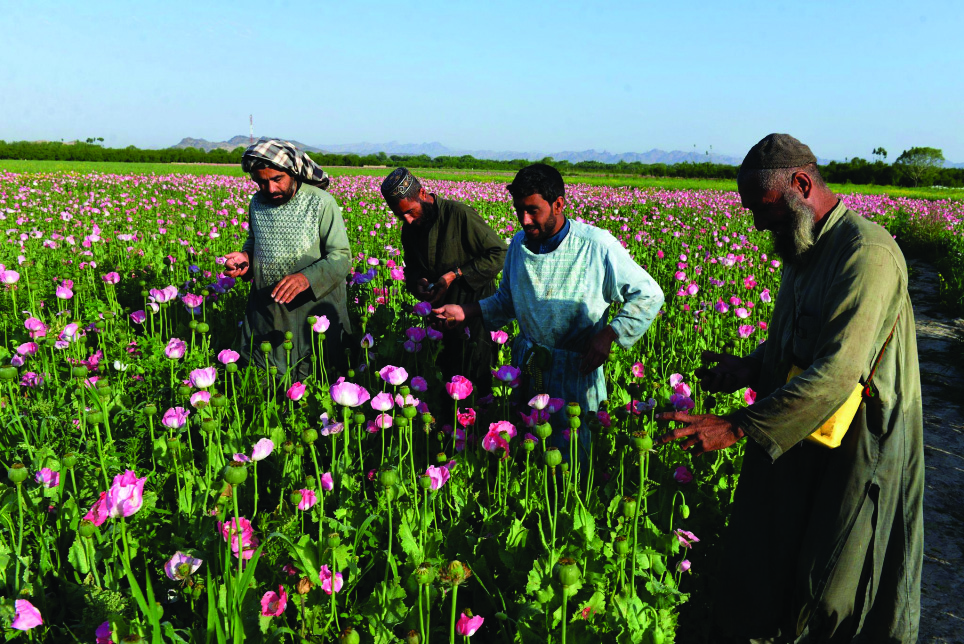
Afghanistan/ Pakistan axis, and Myanmar, source the supply of Opioids and synthetic drugs to India. Afghan opium provides more than 90 per cent of the world’s heroin. As per data on record, there has been bumper production of opium in Afghanistan in the years 2017 and 2018. Presently, there are around 3 lac hectares of the Afghanistan land under opium cultivation (UNODC Crop Monitoring Survey). There are indications that parts of Pakistan adjoining Afghanistan are also used by the Pakistani drug traffickers to convert Afghan Opium into Heroine. However, as per the UNODC Drug Report,2024, there has been a drastic decrease in opium production in Afghanistan in 2023 (95% less than 2022) due to the drug ban by the Taliban Government, which has led to a precarious socio-economic situation in rural Afghanistan. According to the World Drug Report 2025, published by the UNODC, the drug ban of 2022 resulted in the lowest level of opium and heroin production, but illegal cultivation increased between 2023 and 2024.
However, stockpiles of Opium in Afghanistan prior to 2023 were 13,200 tons, which is sufficient to meet the demand for Afghan opiates until the end of 2026. The value of these stockpiles at 2023 prices is worth between 4.6 billion and 5.9 billion dollars. Global Heroin seizures have fallen to almost 50% of the 2021 level, and Heroin prices in Afghanistan and neighbouring countries have tripled, suggesting limited availability of the drug. This has impacted the production of alternative synthetic opioids, like Methamphetamine, Fentanyl, Nitazenes, etc., which are showing upward trends.
Myanmar, to the East, throws another challenge to India, with its Heroin and Methamphetamine production, and porous borders. It is the second largest opium producer with 33,000 hectares of land under opium cultivation in Shan and Kachin provinces, which share a border with China. Reportedly, these provinces are under the total control of rebel groups, which are getting tacit support from the Chinese. In addition to drugs, illicit arms are also manufactured here and supplied to underground groups in India. Shan province is also a major production hub of Methamphetamine.
According to the World Drug Report, 2024, seizure of Meth in Southeast Asia increased eightfold over 2007-17 and rose by a further 42% in 2018. 99% of all tablets seized in East and Southeast Asia were seized in the Greater Mekong region (which includes Myanmar). There are strong indications that a part of raw materials and precursors, necessary for the manufacture of Heroin, Methamphetamine, etc., is mainly being smuggled from China, and some from India. As per the World Drug Report,2025, poppy cultivation in Myanmar fell by 4% from 2023 to 2024, and opium production by 8%. This has also resulted in an upward surge in the production of synthetic drugs, especially Methamphetamine and Amphetamine, in Myanmar. The total value of Myanmar’s national opiate economy in 2024 ranged from 589 million to 1.57 billion dollars, or 0.9%-2.4% of GDP. The synthetic drug market continues to expand globally. In 2023, Methamphetamine and Amphetamine dominated the use of and trafficking in the synthetic drug market. Production of Meth requires precursors like ephedrine and pseudoephedrine. India is one of the largest exporters of both, and there is always a possibility of diversion of the same. A similar situation exists with another precursor, Acetic Anhydride, for the production of Heroin. India is a leading exporter of the same. However, a major part of it comes from China. Of late, Thailand has reported significant seizures of trafficked precursors as mentioned above, diverted through the precursor industry in India.
In a nutshell, on both frontiers, i.e., Eastern and Western, the hostile neighbourhood, along with the drug cartels, is actively involved in pushing narcotics in India. This serves their strategic interests in both the short and long term. Besides impacting the social fabric adversely by way of destroying the youth, it generates lots of money, which is used by the terror groups/underground insurgents/extremist groups in unleashing a reign of terror and challenging the might of the Indian state. While it is mostly the land route, which is traditionally used for drug trafficking on the NE and Western borders, the maritime route has also become very active for the NW borders after the recent developments in J&K, and infusion of a large number of security forces in the region. Use of drones to supply drugs and weapons across the border in Punjab is a recent phenomenon, and the agencies are working out strategies to neutralise this, but the volume of drugs which can be supplied through the maritime route in the Arabian Sea is very high, because this route is comparatively safer. This has shifted the focus to Gujarat and Maharashtra coasts, as drugs so transported are dumped there for further distribution in other parts of the country. The cartel’s network from Punjab has established a base in the coastal area of Gujarat and is managing distribution from there. The Indian Coast Guard (ICG), in conjunction with the intelligence agencies, has been making big seizures frequently. It had made the largest seizure of heroin amounting to 1445 kgs on high seas near the Gujarat coast, in addition to various other seizures. ICG has, over time, developed strong synergy not only with the intelligence agencies and the Indian Navy but also with the Coast Guards of Sri Lanka, the Maldives, and Bangladesh, which is yielding good results. It has helped Sri Lanka and the Maldives effect major seizures totalling nearly 1,500 kg of Heroin in their respective jurisdictions in 2019-20 alone. ICG is equally active in the Bay of Bengal. It had seized 1,160 kgs and nearly 1,000 kgs of Methamphetamine in two different seizures near Andaman & Nicobar Islands, destined for Thailand from Myanmar. A good synergy cutting across the agencies and coordinated operations is the only effective way to tackle this menace of drug trafficking across the borders, which is badly affecting our society.
Geopolitical Overtones
Recent geopolitical developments, in view of the war in Iran, and the rising importance of Pakistan in the region of late, due to US backing, should ring alarm bells for our security agencies. This development, coupled with an apparent shift in the stance of Bangladesh towards India, is a bad omen for us, so far as the war against Narcotics and Narco-terror is concerned. Pak army chief’s bonhomie with President Trump and the American set-up, and his proximity with Bangladesh, Turkey and other Islamist countries is disturbing, and should be viewed seriously. In January this year, a top Bangladeshi army officer, Lt. Gen Karm-ul-Hassan, met the Pak Army chief and discussed regional security dynamics. Both emphasised the importance
and relevance of a strong defence partnership in the current external scenario. In the same month, Pak’s ISI team, led by its chief, Lt Gen Asim Malik, visited Dhaka to establish an information-sharing network between the two countries’ intelligence agencies. It was the first time in decades that the chief of ISI had visited Bangladesh. He, along with his team and Bangladeshi officers, had visited Rangpur district, which is close to India’s chicken neck, and the sensitive Chittagong hill tracts.
These visits and the developing collaboration with the Bangladeshi security set-up will adversely affect peace in the northeast, especially in Assam, Meghalaya, Mizoram, and Manipur. Drug trafficking and drug abuse have been a bane of the North-East for a long. There has been a constant inflow of drugs, especially Heroine and Methamphetamine, from Myanmar, through the porous border, and the entire region is very badly affected.
Drug lords sitting across and within the North-East use the narco money for promoting their self-interests. Keeping the North- East on boil is one of their prime motives, and to achieve this, they indulge in the business of providing logistics, arms and ammunition to the insurgent and separatist groups in the North-East. Since ISI has been using Narco money for aiding, abetting, and promoting terror in J&K and Punjab, during all these years, it will definitely use the drug lords sitting in Myanmar, with links on our side in North-East, to promote insurgents and the separatists in the region. It has taken long years to effectively tackle these anti-national forces, and only recently, with the active support of the central government, especially the MHA, have peace accords been signed in Assam, with different separatist groups. Pakistan will target to upset this peace momentum in the North-East to create a second front. The borders in the northeast are porous and mostly unfenced, especially the borders with Myanmar. Part of the Bangladesh border is also unfenced in Bengal and Assam. This is in contrast with the borders with Pakistan, which are mostly fenced, and making inroads from there is very difficult. In view of such a scenario, border policing in the northeastern region must be impeccable. However, to deal with the problem of narcotics and the concomitant problem of narco terror requires a comprehensive approach.